

ENTJ | Analyst @TheSpartanGroup | ex-Risk @HSBC 💬 Everything expressed here is solely my own opinion.
Joined June 2021
- Tweets2.1K
- Following107
- Followers29
- Likes1.3K
One thing i might say, i was correct when Hype was $21, and right now spot another undervalued token - METUSDT.
Everyday, i track revenue generating tokens, and i think Meteora is the next token that need to put an eye on. I think questions related to technology, or what the project is doing, you guys can chatgpt them easily.
In this post, just want to highlight 2 key fundamental/valuation metrics:
1. Currently, FDV/Rev of Meteora is lower than the median of the most current 50 days, specifically, -16.32% lower. This is the highest mispricing among the tokens i track. But this alone cannot say anything.
2. Peers multiple analysis (See image 2):
Comparing it with peers in the market, the minimum implied valuation for Meteora is around $0.29 (which is even higher than the curent $0.25 price). I will take median of FDV/Rev as a benchmark (it has always been my favorite metric), the upside is 3x from here.


94


Damn, i did not think i am so good at predicting


My short trade on Lighter was actually supported by the fact that tvl and revenue generated by them declined significantly.
For me, that's a show of lack of strong fundamentals.
With the current Annualized Revenue, I believe the fair valuation could fall down to 1.7B - 2.3B

70

Rain definitely raise at a good premium.
17x increase in 10 months. 30x card growth. 38x payment volume growth.
Visa-based issuers and cards from @raincards ,@RedotPay are also showing significant growth in deposit volumes. At the beginning of the year, the total volume was around $61M, and by December 2025, it had surged to $364M - a remarkable 496% increase. This trend highlights not only the growing adoption of crypto-linked @Visa cards but also the expanding role of these platforms in everyday digital finance.
Valuation approach:
with 1.95B and assume $30M annual revenue (3B TPV with assumed take rate of 1%). -> 65x multiple
while for Redotpay (a similar competitor): 1B valuation with 100M (10B Volume with 1% assume take rate) -> 10x multiple.
Clearly, Rain considered as the fastest growth in the sector create a good premium for the company.


68
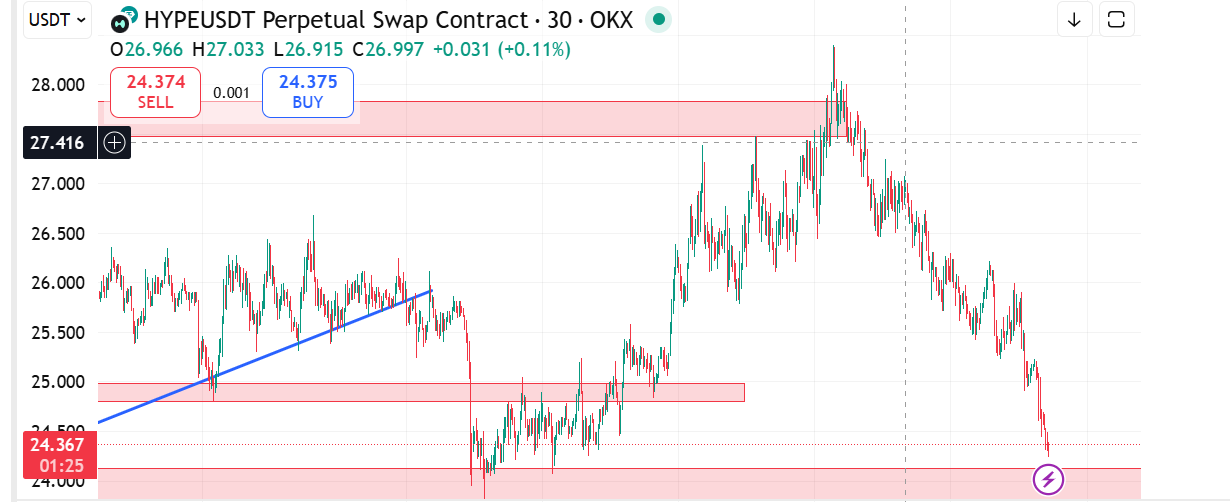
Predict the correct top of $Hype, the current price movement reflect how it's not a sustainable price growth (due to high OI - as i discussed in the post before).
Next important price target would be $24, current multiple is 11x. A safe trade would be around $21 since:
- In the last 30d, most perp projects have difficulties in revenue and fees. Hyperliquid 30d annualized rev goes down to around $500-600M, while before is $800-900M. Historically, a safe MC/annualized Revenue is 9x-10x. With 10x, $HYPE would fall to $21
Im a pro-hyperliquid guy, but to be honest, will be cautious with buying $Hype, at least it around $21-22, that would be a safe bet for me
My short trade on Lighter was actually supported by the fact that tvl and revenue generated by them declined significantly.
For me, that's a show of lack of strong fundamentals.
With the current Annualized Revenue, I believe the fair valuation could fall down to 1.7B - 2.3B
Lighter TGE: What FDV should we expect? (Independent Personal Research)
The DEX and Perp DEX sectors have seen a massive surge in attention lately. With the launch of Hyperliquid and then Aster (backed by CZ), market participants are looking closer at the major players. Lighter is the next big TGE, and finding its fair value is key for anyone looking at launchpads, Polymarket bets, or potential positions post-listing.
I’ve seen many analysts on X focusing on FDV/TVL, but I personally lean toward FDV/Revenue. But to be fair, I conducted a valuation analysis comparing Lighter against peers like Hyperliquid (HYPE), Aster, and Avantis, etc. using three core approaches:
- FDV / TVL
- FDV / 30d Volume
- FDV / Revenue (My preferred benchmark)
Why I prefer FDV / Revenue? In a mature or risk-off environment, this is the cleanest business-like metric. If you have a look at the image attached, this approach provides the tightest implied valuation range compared to TVL or Volume, making it more reliable. While:
- FDV/TVL is often a "noisy" metric for DEXs because TVL isn't the product, execution is.
- 30d Volume is highly regime-dependent (bull vs. bear) and can be easily distorted by short-term incentives.
Therefore, based on the median FDV/Rev of its peers, a reasonable range for Lighter would be around $2B – $3B FDV (in my opinion, this is my safe zone).
At the current pre-market price of ~$3.46, it carries a slight premium. However, looking at the MEXC Launchpad prices ($1.6 for new users / $2.0 for existing), it looks like a safe bet relative to the fundamentals. Personally, it would be interesting to look for speculation positions based on the analysis and how scenarios play out.
At the bottom line, as the market is getting more mature, you will see investors or traders will go with bets that are backed by logics and fundamentals.
Disclaimer: Again, this is for insight and research purposes only, not investment advice. And this post is also not related to any parties, it's a personal opinion.


As expected

Lighter TGE: What FDV should we expect? (Independent Personal Research)
The DEX and Perp DEX sectors have seen a massive surge in attention lately. With the launch of Hyperliquid and then Aster (backed by CZ), market participants are looking closer at the major players. Lighter is the next big TGE, and finding its fair value is key for anyone looking at launchpads, Polymarket bets, or potential positions post-listing.
I’ve seen many analysts on X focusing on FDV/TVL, but I personally lean toward FDV/Revenue. But to be fair, I conducted a valuation analysis comparing Lighter against peers like Hyperliquid (HYPE), Aster, and Avantis, etc. using three core approaches:
- FDV / TVL
- FDV / 30d Volume
- FDV / Revenue (My preferred benchmark)
Why I prefer FDV / Revenue? In a mature or risk-off environment, this is the cleanest business-like metric. If you have a look at the image attached, this approach provides the tightest implied valuation range compared to TVL or Volume, making it more reliable. While:
- FDV/TVL is often a "noisy" metric for DEXs because TVL isn't the product, execution is.
- 30d Volume is highly regime-dependent (bull vs. bear) and can be easily distorted by short-term incentives.
Therefore, based on the median FDV/Rev of its peers, a reasonable range for Lighter would be around $2B – $3B FDV (in my opinion, this is my safe zone).
At the current pre-market price of ~$3.46, it carries a slight premium. However, looking at the MEXC Launchpad prices ($1.6 for new users / $2.0 for existing), it looks like a safe bet relative to the fundamentals. Personally, it would be interesting to look for speculation positions based on the analysis and how scenarios play out.
At the bottom line, as the market is getting more mature, you will see investors or traders will go with bets that are backed by logics and fundamentals.
Disclaimer: Again, this is for insight and research purposes only, not investment advice. And this post is also not related to any parties, it's a personal opinion.
1
64
Lighter TGE: What FDV should we expect? (Independent Personal Research)
The DEX and Perp DEX sectors have seen a massive surge in attention lately. With the launch of Hyperliquid and then Aster (backed by CZ), market participants are looking closer at the major players. Lighter is the next big TGE, and finding its fair value is key for anyone looking at launchpads, Polymarket bets, or potential positions post-listing.
I’ve seen many analysts on X focusing on FDV/TVL, but I personally lean toward FDV/Revenue. But to be fair, I conducted a valuation analysis comparing Lighter against peers like Hyperliquid (HYPE), Aster, and Avantis, etc. using three core approaches:
- FDV / TVL
- FDV / 30d Volume
- FDV / Revenue (My preferred benchmark)
Why I prefer FDV / Revenue? In a mature or risk-off environment, this is the cleanest business-like metric. If you have a look at the image attached, this approach provides the tightest implied valuation range compared to TVL or Volume, making it more reliable. While:
- FDV/TVL is often a "noisy" metric for DEXs because TVL isn't the product, execution is.
- 30d Volume is highly regime-dependent (bull vs. bear) and can be easily distorted by short-term incentives.
Therefore, based on the median FDV/Rev of its peers, a reasonable range for Lighter would be around $2B – $3B FDV (in my opinion, this is my safe zone).
At the current pre-market price of ~$3.46, it carries a slight premium. However, looking at the MEXC Launchpad prices ($1.6 for new users / $2.0 for existing), it looks like a safe bet relative to the fundamentals. Personally, it would be interesting to look for speculation positions based on the analysis and how scenarios play out.
At the bottom line, as the market is getting more mature, you will see investors or traders will go with bets that are backed by logics and fundamentals.
Disclaimer: Again, this is for insight and research purposes only, not investment advice. And this post is also not related to any parties, it's a personal opinion.
The Great Capital Rotation: Why 2025 Was About Plumbing, Not Prices
Before wrapping the year of 2025, I would love to share my opinions on narratives in 2025 and 2026E.
If you look closely at the 2025 fundraising data, the signal is quite clear. While the retail market obsessed over daily price action, smart capital quietly executed a massive structural rotation. We didn’t just see funding; we saw a flight to fundamental utility.
The chart below highlights a reality: Prediction Markets and Global Payments eclipsed nearly every other sector in late-stage deal flow. This wasn't accidental.
The 2025 Trend: Infrastructure over Speculation
- The dominance of Prediction Markets (led by Polymarket and Kalshi) signals that "Event Contracts" are graduating from niche betting to a recognized asset class. With ICE (parent of the NYSE) backing Polymarket, we are seeing the institutionalization of the "Degen" economy. Investors realized that in a world of eroding trust, a market-clearing price on truth is a scalable product. It channels speculative energy into high-fidelity information signals.
- The massive inflows into Global Payments (Tempo, Ripple, Circle) represent a bet on stablecoins as the "internet’s dollar." This isn’t about crypto as an investment; it’s about crypto as a rail. The funding here is building the boring, high-volume plumbing to settle the world's commerce instantly.
- The capital committed to Institutional Finance (Fnality) confirms that the "Real World Asset" (RWA) thesis has moved from pilots to production. Wall Street is no longer experimenting; they are integrating.
So, what to watch in 2026: The "Application" Phase
If 2025 was about funding the rails, 2026 and maybe in the next few years will be about who rides them. Expect five dominant narratives to emerge from this foundation - in my opinion:
- Prediction Markets as Global Intelligence Terminals: The "truth markets" of 2025 will evolve into sophisticated information aggregators. These platforms will serve as the new "Bloomberg for the internet," distilling fragmented speculative energy into high-fidelity, real-time data signals for both retail and institutional decision-making.
- The Rise of Autonomous Economic Agents: Moving beyond simple bots, 2026 will be defined by agents with verifiable cryptographic identities and the ability to execute micro-transactions. We are transitioning to a machine-to-machine economy where autonomous agents procure compute, data, and services via agent-native payment protocols without human intervention.
- The "Perpification" of Every Asset: Following the RWA infrastructure built in 2025, the focus shifts from settlement to liquidity. Expect the rise of synthetic perpetuals for private equity, macro data, and global commodities, providing 24/7 exposure and capital efficiency that traditional stock markets cannot match.
Blockspace as a Corporate Commodity: In 2026 or beyond, large companies will stop viewing crypto as just an "investment" and start treating it like "digital bandwidth." Just as a tech giant buys dedicated fiber-optic cables or cloud server capacity (like AWS) to run their apps, corporations will now buy dedicated "lanes" on the blockchain. This ensures their financial operations—like global payments or supply chain tracking—run instantly without being slowed down by public network congestion or unpredictable fee spikes.
The casino is closed; the factory is open. 2026 is when we turn the machines on.

42