

The drop-in Postgres cache. Check your workload: https://nitter.gq/t.co/WkdtkZP5G8 Quick start: https://nitter.gq/t.co/zEEzsoPPoR Discord: https://nitter.gq/t.co/2KP69gQ4ys
Los Angeles, CA
Joined April 2026
- Tweets83
- Following62
- Followers17
- Likes27





Pinned Tweet
PgCache 0.8.0 is out!
@leonardobenedet, one of our design partners, benchmarked it the day after release. On a complex multi-tenant dashboard it served 24x the requests per second of Postgres alone at 100 tenants, and was still 1.5x ahead at 1,000 😎

Nobody who got close to trying PgCache this year held off over speed. Mostly it was stale data, which is interesting, since lots of teams already read from a replica that lags the primary.
If that's you, here's a first step: test PgCache on the reads you send to a replica.

ALT A psql terminal window. The query SELECT replay_lag FROM pg_stat_replication returns one row: 00:00:00.284153. Below it, SQL comments read: "a replica 0.3 s behind: totally normal." "a cache fed by replication: wait, what about stale data?" "fair question. more in the post." Footer: PgCache, smart read replica for Postgres.
PgCache retweeted

Why does PostgreSQL’s extended query protocol complicate caching?
James Nelson from @PgCache explains his Postgres pet peeve: youtu.be/Rfepa73_W74

Oracle has a built-in read cache .. why doesn't PostgreSQL?
Teams migrating from Oracle end up rebuilding it in the app.
At PgCache we think there's a better way to serve reads for Postgres: a drop-in proxy that automatically caches hot reads.
pgcache.com/try

Reliability is indeed one of the big reasons that James is building @PgCache on PostgreSQL!

What keeps you coming back to PostgreSQL?
For James Nelson of @PgCache, it’s reliability, even with the trade-offs.
Watch: youtu.be/iBtHtSzsZBw


PgCache retweeted
Postgres logical replication and schema changes: James Nelson, Founder and CTO of @PgCache, shares his Postgres Wish on T3D.
youtu.be/YC5B1zjFaZ0
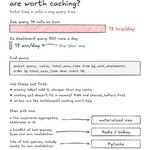
Which Postgres queries are worth caching?
We shared a free online Postgres tool on Reddit yesterday. 26k views and 180 shares so far!
The idea behind it is pretty simple: rank your queries by total time vs what "feels slow."

Here's the free WASM tool we built to speed up some of the analysis for you:
pgcache.com/fit

PgCache retweeted

CYBERTEC CEO Hans-Jürgen Schönig (@postgresql_007) breaks down why the massive, unstoppable PostgreSQL ecosystem is what actually makes the difference for enterprise stability and long-term dominance.
Watch the full #ConvoWithCEO interview here 👇
youtu.be/g6PL2uUL4lY?si=hOTa…

Want to know if your workload fits before you build anything? Paste your pg_stat_statements into the Fit Analyzer. It shows which queries PgCache would cache, which pass through, and why. Runs in your browser: no signup, nothing uploaded.
pgcache.com/fit
We built PgCache but we've never met (yet!)
That'll change when we head to NYC in a couple weeks for Postgres Summit US/ @pgconfnyc
And, if you're in SoHo 9/30 to 10/2, and want to grab a coffee, send us DM --we'd love to connect!

You probably don't need another read replica.
What you probably need is the answer to this question:
"how much of our read traffic can be cached?"
Check yours for free in 2 minutes, locally in your browser, at pgcache [dot] com/fit.

We see a third path for scaling reads on PostgreSQL
Path 1 - Read replicas & server upgrades.
Path 2 - External caches.
Path 3 - CDC-driven smart read replicas.
We saw what's possible with PostgreSQL Logical Replication, and thought "it doesn't have to be this complicated."
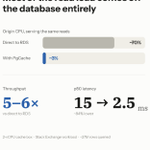
Independent benchmark of PgCache.
16M rows, published in full.
No difference for point lookups, because that's not what we're solving for (0.3ms → 0.3ms).
But the 10M-row join?
2.9s → 0.6ms
Unpaid, unaffiliated, MIT repo:
dev.to/huluwz/how-i-put-pgca…
