

Politics Forgets, The Record Remembers.
India
Joined August 2026
- Tweets236
- Following24
- Followers1.6K
- Likes152






Padmaja Naidu: The Missing Chapter in Sonia Gandhi's Autobiography - 'Belonging, A Journey of Love' (Part IV)
In her book 'Indira Gandhi: A Biography', Pupul Jayakar writes: "Half-a-century later, I asked Vijayalakshmi Pandit of Jawaharlal Nehru's relationship with Padmaja. 'Didn't you know, Pupul?' she replied. 'They lived together for years - for years.' questioned further as to why he had not married Padmaja. Vijayalakshmi Pandit replied, 'He felt that Indu [Indira Gandhi] had been hurt enough. He did not want to hurt her further'." (pp. 91-92)
Pupul Jayakar is regarded as one of the most authoritative biographer of Indira Gandhi. Sonia Gandhi also mentions Pupul name in her recently published memoir.
Katherine Frank, another biographer of Indira Gandhi, writes in her book: "Many years later Indira Gandhi was furious when her father's official biographer, Sarvepalli Gopal, published Nehru's love letters to Padmaja Naidu in Nehru's Selected Works. These are unguarded, passionate, highly revealing letters that disclose a rare view of Nehru's vulnerability and need." (Indira: The Life of Indira Nehru Gandhi, p. 123)
Sonia Gandhi mentions Padmaja Naidu approximately six times in her autobiography. However, her references are largely limited to Padmaja Naidu's intimation with the Nehrus and a few general things about her. But the relationship between Padmaja Naidu and Jawaharlal Nehru went much deeper than what Sonia Gandhi has not chosen to reveal in her memoir.


Jawaharlal Nehru's Papers and Their Possession by Sonia Gandhi: The Missing Chapter in Sonia Gandhi’s Autobiography, Belonging: A Journey of Love (Part III)
A.G. Noorani, who was among the closest associates of the Left-Congress ecosystem and a lifelong critic of the RSS & BJP, himself criticising Sonia Gandhi. Imagine That!
In his book Citizens' Rights, Judges and State Accountability, A.G. Noorani writes, "Ian Copland's work The Princes of India in the End Game of Empire, 1917-1947 will be regarded as a definitive work on a neglected subject. He worked on it for a decade, ransacking archives and private collections. Its publication, fifty years after Independence, revives memories of the games men like the Nizam and C.P. Ramaswamy Aiyer played to secure recognition of the independence, respectively, of Hyderabad and Travancore.
In his acknowledgements, the author thanks 'Mrs Sonia Gandhi for giving me permission to consult the Jawaharlal Nehru Papers covering the period 1947–50'... The letters or notes he wrote on the subject were not personal papers which Sonia Gandhi came to inherit from previous heirs, Rajiv and Indira Gandhi. Sonia Gandhi edited a collection of Jawaharlal Nehru-Indira Gandhi letters (1940–1964) in 1992. It was published abroad. The copyright in them, we were told, vested in Rahul Gandhi and Priyanka Gandhi. They were rather of a personal nature.
It is truly amazing or, perhaps, not, in our feudal culture-that none of our historians has raised any question about the status, in law and morality, of documents composed by public servants, ministers or others,while in office. Do they form part oftheir private property to be taken away on demission of office; can they be used without restriction or kept under wraps arbitrarily, denying access to scholars; and, finally, can they be willed away to whomsoever they please or be inherited by their heirs if they die intestate?"

नहीं, लोगों को पहले से पता था। इसकी ख़बरें भी दुनियाभर के अख़बारों में प्रकाशित हुई थी। आप ही लेट है।


सोनिया के पहले बच्चे की मौत
शायद लोगों को पहली बात पता चलेगा कि राहुल गांधी से पहले भी सोनिया गांधी को एक बेटा हुआ था लेकिन वो जिंदा नहीं बचा .
सोनिया गांधी ने अपनी पहली संतान को खोने, अस्पताल में बिताए मुश्किल समय, बच्चे के अंतिम संस्कार को लेकर राजीव गांधी से हुई बातचीत और अंततः बच्चे को दफनाए जाने की घटना का बेहद भावुक विवरण दिया है .
19 जनवरी 1969 को सोनिया ने पहले बच्चे को जन्म दिया लेकिन वो प्रीमेच्योर था और उसे बचाया नहीं जा सका . राजीव ने पूछा कि अब क्या किया जाना चाहिए?
हिंदू परंपरा के अनुसार नवजात शिशु का अंतिम संस्कार नहीं किया जाता बल्कि उसके शरीर को नदी में प्रवाहित कर दिया जाता है . उसे किसी भी कब्रिस्तान में दफनाया भी नहीं जा सकता था . न तो ईसाई कब्रिस्तान में और न ही पास के पारसी कब्रिस्तान में . ईसाई कब्रिस्तान में दफनाने से भी विवाद खड़ा हो सकता था. राजीव के पिता पारसी थे लेकिन उन्होंने कभी पारसी धार्मिक परंपराओं का पालन नहीं किया था .
आखिर हम क्या करें?
मैं पूरी तरह टूट चुकी थी . दुख से थकी हुई इतनी कमजोर कि कुछ बोल भी नहीं पा रही थी और न ही कोई प्रतिक्रिया दे पा रही थी .
राजीव ने मुझे धीरे से समझाया और कहा,
"सोनिया, यह फैसला हम दोनों को मिलकर लेना होगा।"
मैंने फुसफुसाते हुए जवाब दिया,
"नहीं, मैं अपने बच्चे को नदी में बहा दिए जाने की इजाजत किसी भी कीमत पर नहीं दूंगी’
आख़िर में तय हुआ कि इसे मेहरौली के फार्म हाउस में दफना दिया जाए .


P. V. Narasimha Rao: The Missing Chapter in Sonia Gandhi's Autobiography - 'Belonging, A Journey of Love' (Part II)
According to the book written by Vir Sanghvi & Namita Bhandare, 'Madhavrao Scindia: A Life,' "Now, as Sonia Gandhi stepped up her public appearances, political circles in Delhi began wondering if she was preparing to take the plunge into politics. In the fall of 1994, the Rajiv Gandhi Foundation, of which Sonia is the president, hosted a series of seminars on issues that the late Prime Minister [Rajiv Gandhi] had been interested in. Interestingly, the list of invitees included people known to hate Rao [P. V. Narasimha Rao]: Mulayam Singh Yadav (who didn't turn up), Lalu Prasad Yadav, S. Bangarappa and M.L. Fotedar." (p. 245)
This was neither the first nor the last time Sonia Gandhi embarrassed P. V. Narasimha Rao while he was serving as Prime Minister of India.
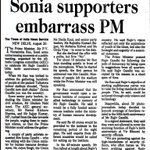
On 21 August 1995, The Times of India published a report on its front page with the headline, "Sonia supports, embarrasses PM". The report further stated, "The Prime Minister, Mr. P. V. Narasimha Rao, faced some embarrassing moments at a public meeting, organised by All India Congress Committee (AICC) to celebrate Mr. Rajiv Gandhi's 50th birth anniversary.
When Mr. Rao was invited to address the gathering, hundreds of people at the packed Talkatora Stadium shouted, "Sonia Gandhi, tum desh chalao... For about 10 minutes, Mr. Rao kept standing quietly in front of the microphone... Hundreds of people left the stadium while the Prime Minister was still speaking."


Sitaram Kesri: The Missing Chapter in Sonia Gandhi's Autobiography - 'Belonging, A Journey of Love'
According to Rasheed Kidwai's '24 Akbar Road', Sitaram Kesri was manhandled twice inside 24 Akbar Road. The first time was on 14 March 1998 when the party bosses shunted out the 'elected' party chief unceremoniously. Some unidentified party workers booed him and even tried to pull off his dhoti when Kesri was returning home." (p. 200)
Note: 14 March 1998 - On this date Sonia Gandhi became the president of the Congress party for the first time. She has mentioned this date in her autobiography on page 392.
Kidwai further mentioned, "A year later, on 19 May 1999, Kesri went to 24 Akbar Road to attend the CWC meet. The atmosphere was charged in the wake of Sharad Pawar, P.A. Sangma and Tariq Anwar's revolt against Sonia, citing her foreign origins. Sonia had resigned in a huff, but returned when the dissident trio was thrown out of the party. The CWC meeting was preceded by dramatic scenes at the Congress HQ, where Kesri was manhandled by an agitated crowd. His car was damaged, and the veteran leader had to return home to change his torn kurta, cap and dhoti." (pp. 200-201)


Sonia Gandhi should have also mentioned in detail every incident in her autobiography in which she was projected as the ‘Super PM’, particularly her role in the National Advisory Council.
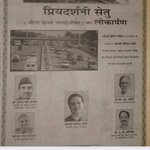
One such example dates back to December 2004, when full-page advertisements were published in newspapers to publicise the inauguration of a flyover in Delhi. The picture itself speaks volumes about the stature and authority enjoyed by the ‘Super PM’ during that era!
Holding a copy of the Constitution is merely an attempt to create a narrative. When in power, the Congress altered the original spirit of the Constitution and misused its provisions to an extent that remains unparalleled.


राहुल गांधी के पिता, श्रीमान राजीव गांधी जी तो भाजपा को देशभक्त मानते थे। @RahulGandhi @INCIndia

#ThisDayThatYear | 2 November 1990
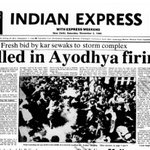
On this day in history, the Mulayam Singh Yadav-led Uttar Pradesh government ordered police firing on karsevaks in Ayodhya during the Ram Janmabhoomi movement.


कभी सुषमा स्वराज जी के नाम पर अंतिम संस्कार का नाटक और अब CEC के खिलाफ गली-मोहल्लों में महाभियोग का प्रचार!
कांग्रेस की राजनीति में विरोध की मर्यादा कहाँ है?
लोकतंत्र में असहमति का अधिकार सबको है, लेकिन विरोध के नाम पर मानवीय संवेदनाओं को ठेस पहुँचाना और संवैधानिक संस्थाओं को राजनीतिक अखाड़ा बनाना कहाँ तक उचित है?

इंदिरा गांधी का राहुल गांधी को संदेश, “हमारी युवा पीढ़ी कभी-कभी गलती कर जाती है, कभी-कभी जलाने में, और उस चीज में बहुत थोड़े से लोग पड़ते है और अधिकतर का स्तर बहुत ऊँचा है।”
Sardar Vallabhbhai Patel expressed his desire to resign from Jawaharlal Nehru’s Cabinet on 23 December 1947. He was unhappy with Nehru’s dictatorial attitude and Hitler-like style of functioning.
#सरदार_वल्लभभाई_पटेल #सरदार_वल्लभ_भाई_पटेल #SardarVallabhbhaiPatel #SardarPatel #SardarPatelJayanti

Tanks were deployed on the streets of Delhi in November 1984.
Last few months, Delhi has been troubled by absurd protests. And during the Hindus festive season, Rahul Gandhi is again holding a rally on 1 November to amplify an issue that has little to do with the common citizen.
1 November is also a significant date in Indian history. On this day in 1984, anti-Sikh riots were carried out across the country, including in Delhi, allegedly with the involvement of Congress leaders. Tanks were deployed on Delhi’s streets that day as well.
Therefore, the youth of today should choose their words carefully before using terms such as “undeclared Emergency,” “dictator,” and “Hitler.” However difficult the situation in Delhi may have become, tanks have not been seen on its streets since 2014.

On 28 October 1990, the BJP published an advertisement in The Indian Express that addressed India’s secular politics and the questions surrounding it. It was an unusual experiment in Indian politics, one that may rarely be seen today or in the future.
The BJP, while in opposition, used an advertisement to initiate a debate on important issues.
This is perhaps what the opposition should truly be like: presenting its arguments & ideology with solid reasoning and substance, rather than becoming synonymous with chaos, crowds on the streets, and the harassment and inconvenience of ordinary people.

The Nehru-Gandhi family’s alleged modus operandi: First, incite anti-Sikh riots in the country, and then swiftly take control of the Congress party.


Rahul Gandhi’s grandmother, Indira Gandhi, appointed Justice A.N. Ray as Chief Justice of India, superseding three judges senior to him. The Supreme Court delivered its judgment in the Kesavananda Bharati case on 24 April 1973, and the very next day, A.N. Ray’s appointment was announced. On 26 April 1973, six eminent jurists issued a joint statement describing the government’s decision as an attempt to undermine the independence of the Supreme Court. [Source: James Manor (ed.), Nehru to the Nineties - The Changing Office of Prime Minister in India, p. 104]
After becoming Chief Justice, A.N. Ray also developed an admiring attitude towards PM Indira Gandhi, frequently contacting her and even seeking advice from her personal secretary on routine matters, creating an impression that the Prime Minister’s views might influence pending court cases. [Source: Granville Austin, Working a Democratic Constitution - the Indian Experience, p. 290]

In 2008, Delhi High Court Justice Sanjay Kishan Kaul quashed the proceedings in three criminal cases related to controversial painter M.F. Husain’s disputed painting of Bharat Mata (Mother India). The cases involved allegations of obscenity and hurting people’s religious sentiments.
However, Justice Kaul described those criminal proceedings as “baseless.” Similarly, his book and his claims are also baseless.

