

Mine open problems, fund Erdős prizes, vote with what you solve. Bootstrapped by @colosseum. 0x498a30269f4b5527a661D7E3694536673F49Ad55
Δ Δ Δ
Joined October 2026
- Tweets133
- Following4
- Followers165
- Likes0







Ponmath connects browser-based computation with onchain verification, turning mathematical search into an open, verifiable contribution system on Robinhood Chain.
The first target: finding integers that satisfy x³ + y³ + z³ = 114.
Under the hood:
• Distributed search: browsers sample random slices within the |z| = 10¹⁹–10²⁰ search band.
• Candidate filtering: nine square filters and a square-root calculation screen potential candidates.
• Onchain verification: the hunt contract independently repeats the checks before accepting a submitted share.
• Contribution accounting: each candidate is counted once, with accepted shares earning points.
Prize claims require a further check: the contract computes the cubes itself to verify a valid solution before paying a prize.
$PONMATH introduces the next chapter of Ponmath, built around mathematical search, transparent participation, and verification at the protocol level.
0x498a30269f4b5527a661D7E3694536673F49Ad55
Explore the hunt : ponmath.academy/
The Ponmath era now has its own wall in the Hall of records. The contracts went live on Robinhood Chain on 1 October 2026, and the first share was accepted on 3 October at 22:18 WIB.
One click on Verify this share and you can re-check it yourself.

2
103
192 = 4³ + 4³ + 4³ and 375 = 5³ + 5³ + 5³.
Easy, until you ask for three cubes with no common factor. Nobody has found such a primitive solution for 192, 375 or 600.
Sums of three cubes hide puzzles even where an answer exists.
2
159
Watch the swarm add up. The landing now shows the hunt's running estimate of candidates checked, counting up toward the next round milestone.
Every share behind that number was re-checked on Robinhood Chain.
ponmath.academy
93
Every record was an open number once.
33 waited until 2019. So did 42. Today 114 is the smallest open case below 1000.
ponmath.academy/records

43
Three 17 digit numbers that cube to 42 took about 1.3 million CPU hours to find, and any laptop checks them in a blink.
What other problems have that shape, brutal to find and trivial to verify? Reply with your favourite.
32
What /verify does.
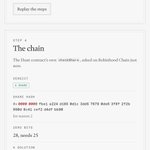
Your browser redoes the share rule from scratch, in exact whole numbers. Then the page asks the Hunt contract's checkShare view for its own verdict. Two independent checks of one share, side by side, and they have to agree.

26
$PONMATH CA: 0x498a30269f4b5527a661D7E3694536673F49Ad55
The Academy's community coin, live on ponsfamily.com. Points are a different thing: earned only by verified work, never bought, and counted as votes.

2
162
Tutorial: start hunting in 60 seconds.
Open ponmath.academy, pick 114, press Start, and submit the shares your browser finds. Robinhood Chain re-checks each one before it pays points. Same steps on a phone or a laptop.
New page: Don't trust, verify.
Pick any recent share from the hunt for 114. Your browser recomputes every rule in exact whole numbers, then asks the contract on Robinhood Chain for its own verdict.
ponmath.academy/verify
1
69
New on the landing: a quiet strip under the hero that counts the swarm, with a bar to the next round milestone.
The estimate says what it is: shares accepted on chain, times the survivors each share stands for, times the measured candidates per survivor.

25
One search, many browsers.
No server hands out work and no tab waits for permission. Each browser picks its own slices of the band from 10^19 to 10^20, and Robinhood Chain is the only scorekeeper: it re-checks every share before a single point exists.

33
3 = 1³ + 1³ + 1³ = 4³ + 4³ + (−5)³
In 1953 Louis Mordell asked whether 3 had a third way. In 2019 Booker and Sutherland found it:
569936821221962380720³ + (−569936821113563493509)³ + (−472715493453327032)³
Hard to find. Easy to check.
3
1
134
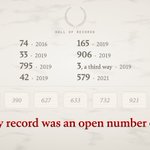
New page: the Hall of records.
Seven decades of sums of three cubes, from Mordell's 1953 question to 579 in 2021, engraved with the real triples. Press Check it and your browser cubes all nine, digit for digit.
ponmath.academy/records
A survivor whose hash with your wallet starts with 25 zero bits is a share. The chain redoes every step, then mints 100 points. If Δ is ever a perfect square with d − r even, the finder claims it and the 114 vault pays out.
The odds are long. ponmath.academy/learn

19
For each z: q = (114 − z³)/d and Δ = (4q − d²)/3. A solution needs Δ to be a perfect square.
Nine cheap tests come first, remainders mod 64, 7, 11, 13, 17, 19, 23, 29 and 31, and almost every Δ fails one. Only the survivors get a full square root.

1
20
Ponmath searches past every published run: |z| from 10^19 to 10^20.
Each browser picks its own d at random, finds the cube roots of 114 mod d, and walks the runs of z they give, one every d steps. The record searches swept every d in order. The swarm samples.

1
18
Does 114 have an answer at all? In 1992 Heath-Brown conjectured that every number not 4 or 5 mod 9 has infinitely many. But his heuristic says they thin out: the count up to size B grows only like log B, with an unknown constant.
A whole factor of ten can hold none.
1
47
In 2019 Booker and Sutherland ran this search for about 1.3 million CPU hours on Charity Engine's volunteer PCs. It found 42, plus 165 and 906, and found no solution for the seven still open with smallest number up to 10^17.
A later run reached 10^19 for small d.

1
23
The trick behind the modern searches: x³ + y³ = (x + y)(x² − xy + y²). Call d = x + y. Then d must divide 114 − z³.
Three unknowns become two. d has the opposite sign to z and stays below about a quarter of |z|. Find the right z and d, and x and y follow.

1
22
