

Portfolio Manager, East Green Quant PMS. I post data on Indian markets that headlines get wrong.
Bengaluru, India
Joined April 2009
- Tweets2.6K
- Following343
- Followers353
- Likes912



East Green Quant in Moneycontrol’s top 10 PMS strategies for September, a month the Nifty 50 fell ~6%.
Holdings as at 30 Sep. Not a recommendation.

#MCPro | 🚨 Top 10 Portfolio Management Strategy funds for the month of September 2026
The best performing equity PMS strategies all ended the month in the green, with their returns ranging from 3.55% to 5.67%.
To find out the rest 6 Strategy funds, read more 👇
moneycontrol.com/news/busine…


2
53
East Green Quant: quarterly update, July to September 2026
The strategy returned 15.8% for the quarter. The BSE 500 TRI fell 3.6%.
It wasn’t a straight line though. July fell about 4% while the market rose. August added 14.7%, and September 5.3% in a month the market lost 5.6%.
The portfolio stayed fully invested in equities throughout, so the gap came entirely from the stocks it held.
Over the past year, the strategy is up 58%. The index is down 2.3%.
East Green Quant is a fully systematic equity PMS. No discretion: the model decides, the team executes.

2
54
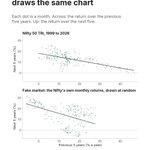
The Nifty 50 TRI (dividends included) has returned 6.6% a year for the last five years, one of its weakest stretches since 1999.
The reassurance doing the rounds is that weak five-year stretches have to set up strong ones. There's even a chart for it.
I built 5,000 fake markets from the Nifty's own monthly returns, picked at random. In these markets, the past has no effect on the future. 84% of them still show the same pattern. So the past five-year return can't reliably tell you what the next five years will hold.
Returns are made of three things: earnings growth, dividends and the change in the P/E. Over the last five years, Nifty earnings grew 81%. The P/E fell from about 27 to 19, even with record SIP inflows, and that's what held returns back. The next five years depend on those three.
Full analysis in the next tweet.

2
1
120
Analysis and sources: zoomout.in/the-nifty-doesnt-…

62
Not every market needs the same theme. It just means FIIs are shopping for something India doesn't have today. And it cuts the other way when that trade unwinds.
Same thing happened pre-2018 with tech. Indian market has got a few tech listings since then though.


68
"Legendary Gorillaz" 😁

Delighted to announce that the legendary Gorillaz will perform in Guwahati on January 31, 2027, as part of their first ever India tour.
Guwahati is proud to be among the host cities for this landmark tour. Looking forward to welcoming the band and fans from across the country to Assam.
@gorillaz

74
East Green Quant was up 14.7% in August, against -0.1% for the BSE 500 TRI.
I get asked what I did. The honest answer is: nothing that wasn't already decided by the rules. The allocation didn't move, no shift between equities, gold or cash. Everything that happened, happened inside the equity book, with no single stock big enough to account for the month.
That's a dull answer, and people usually want a better one. But a single good call doesn't tell you much. You can't separate skill from luck on one trade, and you can't repeat it on demand. What I'd rather have is a process that makes a lot of small decisions the same way every time, where most cost very little and a few work out.
The same process will produce a month where the numbers go the other way and I still won't have anything interesting to tell you. That's the deal.
More numbers in the image.

1
59
Dropping catches has nothing to do with fitness, which just helps you get to the ball. If you don't get to it, you don't drop it.

"Nowadays gym boys can't match the fitness level of players from our era." ~Mohammad Kaif 💀
Mohammad Kaif: "In our era, players weren't judged by how fit they looked. But they had more stamina, strength and athleticism.
I can guarantee that players from our era might have been slower in gym exercises, running drills or lifting weights, but you wouldn't see them dropping catches like you see in today's generation.
Take Sachin, for example. He may not have looked extremely fit, but show me one incident where he dropped a catch. I challenge you, you won't find it.
The reason was simple: they had discipline in their training, especially when it came to fielding on the ground."
75
A bonus and a split do exactly the same thing to your holding. Then you sell, and one of them costs 80% more tax.
Say you bought 1,000 shares at ₹100 in January 2023. They are ₹500 today, so a ₹5,00,000 position and a ₹4,00,000 gain.
Then, the company decides to 10x its share count.
As a split, each of your shares becomes ten. As a bonus, nine free shares arrive for every one you hold. Both routes end at 10,000 shares worth ₹50 each.
You sell the next day. The split costs ₹50,000 in tax. The bonus costs ₹90,000.
The bonus shares are free. Their cost is nil, so every rupee they fetch counts as profit, and they are dated from the day they arrived, which makes that profit short-term at 20% instead of 12.5%.
Nine thousand of your ten thousand shares are in that position.
What's worse, the thousand you have genuinely owned since 2023 are no help either. They cost ₹100 and are worth ₹50 after the bonus, so they throw off a long-term loss that cannot be set against the short-term gain sitting right next to it.
The split does none of this. Your cost is spread across more shares, your purchase date does not move, and there is nothing new for anyone to tax.
Twelve months after the bonus lands, all of it evens out and the two routes become identical again.
Sell inside those twelve months and a choice the board made was worth ₹40,000 of your money!
Disclaimer: Not tax advice. Talk to your tax adviser about your own position.

54
Every time SEBI publishes a new study on F&O traders, it gets reduced to one headline: ~90% lose money.
But that number is old news. The findings in the report are far more interesting:
1. Big losers are exactly as sticky as big winners:
Traders who made over ₹10 lakh continued trading at 88%. Traders who lost over ₹10 lakh: also 88%. Small outcomes in either direction, roughly half quit.
Persistence tracks the size of the outcome, not its direction. Winning big and losing big produce the same behaviour.
2. The typical options buyer lost more than the maximum capital they ever deployed:
Median return on peak margin: -114% in FY26. -187% the year before.
You cannot lose 187% of your peak margin unless you keep refilling the account. These aren't one-time hits to a corpus. They're a recurring drain on income.
3. Traders don't quit from a slow bleed. They quit after a knockout:
The median exit followed a quarterly loss 2.2x the trader's average historical profit. For the top decile, over 30x.
And the threshold is rising because the same ratio doubled in a year. Traders are absorbing bigger blows before walking away.
4. Quitting F&O does not mean graduating to investing:
Of traders who left derivatives, 58% had stopped trading cash equities too within four years.
The comforting story is that people burn their fingers in options and become sensible long-term investors. The pipeline doesn't run from speculation to investing. It runs from speculation to exit.
5. ₹138.
That's the median equity portfolio of traders who lost over ₹1 crore in derivatives. Against a median loss of ₹1.43 crore.
Either wiped out entirely, or there was never any wealth behind the leverage to begin with. The data can't distinguish. Neither sounds good.
Although, SEBI is careful to call all of this association, not causation.
Pratik Karmakar retweeted

If you’re in your 20s (and ambitious) do everything to move to those 4 cities
Yes people will mog you for paying extortionate rents for such little comfort but who cares, you’re not everyone, you’re on a mission, you’re here for greatness
London/NYC/Paris/SF are basically the golden 4. They’re not just big cities, they’re global sorting machines. People move there from all over the world because they want sth badly enough to accept all the downsides. The guy born in London can be lazy. But the 26yo Frenchman, Indian, American, Italian, Nigerian, Lebanese etc who voluntarily accepts the tiny flat, shit commute and absurd rent to be there has already self-selected pretty hard
And that selection compounds. I felt it instantly moving from my hometown in France to London. Growing up I was always “the ambitious one” in my friend group. Then you arrive in London and suddenly you feel extremely average. Everyone is trying to do sth. Completely changes your reference point for what a normal person can achieve
The other thing is just how many serious games are happening at once. If you know at 22 that you’re going to be a semiconductor engineer forever, maybe there are better specialised places. But most ambitious 24yos have absolutely no clue what game they’ll eventually want to play. In London/NYC/Paris you can accidentally become friends with people in PE, startups, politics, law, media, fashion, pharma, academia etc. Your finance friend dates someone in fashion, their roommate is building a startup, you meet someone in politics at dinner. Suddenly 5 completely different lives feel plausible
That’s insanely valuable when you’re young precisely because you don’t yet know which people / industries / opportunities will matter to your 34yo self
SF is the weird exception because it’s basically one giant concentrated bet on tech/AI. Much narrower than the other 3, but that game is so asymmetric rn that it deserves its spot. If you want to build at the frontier there’s probably no other place where your reference class changes that aggressively
And yh everyone keeps saying the internet made geography irrelevant. Maybe for information. Definitely not for trust/friendship. Anyone can learn from the same people online now, send the same cold DM, follow the same accounts. Much harder to replicate being the guy someone has had 20 dinners with, worked with, travelled with, introduced to friends and randomly bumped into for 5 years
When you’re 24 and nobody knows who tf you are, geography can do a lot of the work for you. You get invited because your colleague knows someone. You end up at a dinner because your friend needs a +1. Someone you met 3 years ago leaves and starts a company. Another moves to NYC. Another becomes a partner somewhere. Most of the ROI is completely impossible to predict upfront
Basically before you have your own gravity, borrow the city’s
At 45, if you’ve built the company / reputation / money / audience / network, you can go live in Tuscany, Mallorca, South of France or wherever and people will come to you. At 24 no one is coming lol. You should probably be where everything is happening
And tbh if you have the ability to move I wouldn’t spend 3 years waiting for the perfect job / apartment / timing. Get the shitty room, accept being poorer for a while, figure it out once you’re there. Your 20s are probably the cheapest years of your life to tolerate inconvenience anyway
You can optimise sqm, weather and comfort later
At 24 I’d rather maximise how many possible lives are available to me

Every few weeks a famous investor explains how they got rich. Borrowed early. Concentrated hard. Held through a terrifying fall.
Thousands of people like that famous investor did exactly that in the same years with different results. You have never heard from most of them. Because nobody interviews them.
So you are not looking at a group who made good decisions. You are looking at the survivors of a large group who made the same decision.
Some of them were genuinely skilled. Though, it was usually a specific kind: knowing things the market did not. In the 80s and 90s, filings arrived by post, management access was a phone call for the well connected and a wall for everyone else, and a price could take months to catch up to information a diligent person already had.
Concentrating hard made sense when you genuinely knew something.
That gap has mostly closed. Copy the position sizing without the edge that justified it and you keep all of the risk and lose the reason for taking it.
Also, two things also get bundled together as backing yourself, and they are not the same risk.
Concentration means you can be wrong and recover.
Leverage means you can be right and still be finished. Correct about the company, and sold out during a fall that reverses six months later. The broker does not wait to find out whether you had a point.
So, ask yourself 3 questions before copying anyone:
1. What edge did they have, and does it still exist?
2. Is this advice to concentrate, or advice to borrow?
3. Could I survive being wrong for five years? They could. Salary, family money, age, a fallback. That is the part of the story usually left out.
Because: everyone who blew up was confident too.

86
Two months ago I wrote that concentration in an index is an amplifier, not an engine. That when a couple of stocks make up most of the benchmark, ordinary news becomes extraordinary index moves. Both directions.
This week Korea made the point better than I did.
Peak-to-trough over the past six weeks: KOSPI -44%, TAIEX -18%. Circuit breakers triggered on multiple days, in both directions. On Friday, tracking Microsoft's earnings overnight, KOSPI rallied 14% in a single session. Samsung +25%, SK Hynix +28%.
The Nifty over the same period: range-bound, under 5% in either direction.
The Nifty isn't cushioned because it's diversified. It's quite concentrated, 35% in banks. It's cushioned because its concentration is in the wrong sector for this cycle. Banks don't participate in the AI trade in either direction. The amplifier whipping Korea around isn't wired to India's benchmark.
Which doesn't mean India lacks AI exposure. The names that would participate sold off with the global chip trade this week and bounced back today alongside Korea and Taiwan. The moves happened. They just didn't happen at the index level, because those names aren't in the Nifty. India's AI trade lives in the mid and small-caps.
Slower at the top, cushioned at the bottom. This week is what it looks like when you can watch it happen alongside the alternative.

Last week, Samsung and SK Hynix became worth more than half of Korea's entire stock market. TSMC, on its own, made Taiwan's market bigger than India's.
Indian economy is much large than Korea or Taiwan. But then what is going wrong with Nifty?
🧵

114
KOSPI is coming apart now and Nifty is stable.
The hand that caps India's speed, caps its catastrophe as well.
The Nifty isn't the India growth story. It's the India stability story wearing the growth story's clothes.
Want the explosive, growth version of Nifty? It moved down to the smaller names. You might pay in volatility though.
Full breakdown: zoomout.in/the-velocity-ceil…

121
The grey market premium is the most-watched number in Indian retail investing. Its correlation with an IPO's listing pop is 0.85.
Against three-year excess returns it's −0.01.
182 mainboard listings, 2019 to 2023, measured against the Nifty over matched windows.
The pop is real and it's large. Median debut closed 14.5% over issue price on a day the index moved 0.1%. Three out of four ended their first session green. Promoters have been leaving money on the table pretty consistently.
Then it stops. Hold from the listing close and 51% beat the Nifty over a year, 47% over three. Three years out the median listing is about 14 points behind the index.
(The 2021 cohort is a third of the sample and did −12.7% in its first year. The back half of that year was worse: −19.3% median against +24.4% for listings in the first half. Macro turn in 2022, or just a lot of loss-making platform businesses listing late? The data can't separate them.)
So skip the allotment and buy on listing day instead? You'd be buying after the compensation's been paid, and swapping an index for one stock.
GMP isn't broken. It's telling you something about your application rather than about the company.
Sort all 182 by subscription and mean day-one returns run from −2.6% for the barely-covered issues up to 74.3% for the most heavily bid. So chase those, obviously.
Except allotment is a lottery and your odds fall as the book grows - faster than the pop rises. Multiply the two, pop × probability of getting shares, and it turns over. Peak expected return per application sits near 8x subscribed.
The issues less people are talking about are the ones worth applying to.

1
88
More on this: zoomout.in/why-indias-hottes…

18
Trend Following >> Fixed Asset Allocation

Smallcaps are back on top in 2026, months after a brutal correction.
Silver, last year's star with a 169% rally, is now the year's worst performer.
@ET_Wealth's 10-year TrendMap shows why no single asset class wins forever. @sameerb_81 writes in ET Wealth.

1
55
Alan Greenspan used to have his briefcase driven to the Federal Reserve separately, in the trunk of a car, so he could arrive empty-handed.
Traders were guessing rate decisions from how thick the bag looked on TV. Thick = argument = rate change. Thin = no change.
It did not matter though, because the indicator did not work.

63
1. Why is ODI WC even being played. 2. Play 11 league matches and then leave your fate to 1 good/bad day.

🚨 NEW WORLD CUP FORMAT 🚨
The ICC has approved a new format for the 14-team Men's ODI World Cup.
A new 'Super Series' round will precede the group stage, before a seven-team 'Super 7' decides the semifinalists.

97
East Green Quant started the quarter holding a lot more cash than usual. That didn't last long. The model tracks a regime signal, and it crossed into equity-favouring territory early, in April. Cash was fully deployed within weeks, well before the quarter had properly got going, and holding it that early didn't cost anything. The quarter number already reflects it.
The quarter was up 35% for the strategy, against what was itself a genuinely strong quarter for the index. Full numbers, including the trailing periods, are in the image.
No discretion in execution: the model decided, the team executed.

1
65