

Project Liberty builds solutions that advance human agency and flourishing in an AI-powered world.
Joined July 2023
- Tweets2K
- Following529
- Followers5.2K
- Likes909




Where the US economy sits on this policy landscape will look very different based on time horizon: 2030 versus 2035 versus 2040.

Worth a read: Anthropic has built a model of what AI could do to the US economy by 2030, including a scenario explorer with three futures, from modest to extreme.
Our Future of Work report maps where scenarios like these sit between augmentation and redistribution policy: their modest scenario points toward augmentation, their extreme toward redistribution. We also propose measures that would work across both.

1
256
We are also optimistic about the potential for coordination and coalition-building. More to come next week from us about the coalition that's emerging.

I am optimistic about the potential for coordination. Warning shots like the Hugging Face attack have made pacing agreements between U.S. labs more viable. I don’t feel like we’re on track to prevent a global race, which may require costly actions such as a temporary ban on improving model capabilities.
237
This is fascinating.
With the US midterm elections approaching, new research from @ISDglobal finds that 29% of responses to English election questions were incomplete, inaccurate or outdated—with accuracy 16% lower when prompts were in Spanish.
The implications in the lead-up to the mid-terms are enormous, especially as more people are turning to chatbots for election information.
Check out their full report below
1
1
190

In the last few weeks, several high-profile AI-powered security breaches have occurred.
But those are just the major breaches we know about.
What about all the others that we’re not aware of—either because AI labs haven’t chosen to disclose them, or because those labs aren’t even aware that such breaches exist in the first place?
We can better understand the current risk surrounding AI security by deconstructing it into three buckets:
1. The known knowns.
2. The known unknowns.
3. The unknown unknowns.
Each requires a different response. Check out our recent newsletter for the breakdown.
2
3
222
Congrats @ir_replaceable_! Let's do this!

Today we're launching Irreplaceable, a movement of ordinary Americans coming together to decide the future of artificial intelligence.
Right now, some of the most important decisions on Earth are being made in a handful of rooms in northern California. 🧵
2
266
What does an alternative AI tech stack look like?
- It gives people control over their data.
- It offers people a choice of AI model and compute.
- AI applications are loyal to people, by design.
- AI applications are safe to use, by design.
- AI applications are broadly available, with their benefits distributed.
In “A Pro-Human Path for AI,” @FLI_org, describes the alternative tech stack as “highly capable AI that remains under meaningful human control. Powerful and trustworthy tools that augment what humans can do, rather than autonomous systems designed to replace us.”
Pacing the frontier is not enough; slowing the pace only slows how quickly AI labs will reach their intended destination. Meanwhile, a full pause is unlikely—especially with the amount of capital depending on AI to live up to its hype.
What we need are safe alternatives rooted in human flourishing.
prohumanpath.ai/
More than 1 in 3 webpages published after ChatGPT's release show signs of AI authorship.


New research from @pewresearch:
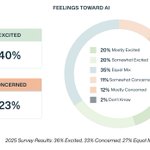
For the first time, a majority of adults under 30 say they’re more concerned than excited about AI.
For the first time, a majority of adults under 30 say they’re more concerned than excited about #AI.
Their concern is now on par with those in their 30s and 40s, and those 65 and up.

ALT Chart showing young adults’ worry over AI continues to climb, while their excitement has dropped off
AI is not normal software.
@FLI_org CEO @AnthonyNAguirre

"AI is not like normal software. It's inherently unpredictable. And as it gets smarter, it gets harder to control."
-FLI CEO @AnthonyNAguirre on @NEWSMAX:


Predictions on what this chart will look like in 12 months?
It will be interesting to see the relationship between number of security breaches and the use of open vs. closed models.

Why open-weight AI is the new frontier in the US-China tech race
Nvidia, Meta release open models to challenge Chinese offerings
s.nikkei.com/3TVDEEG

2
182
What’s the high-level narrative around AI policy in 2026 in the US?
There are multiple interpretations (we’d love to hear yours; reply in comments), but one might go like this:
At the national level, Congress has yet to agree on a comprehensive national regulatory framework for AI. In its place, states across the country are filling that vacuum with laws governing AI safety, transparency, employment, privacy, and energy and infrastructure demands related to AI data centers.
Meanwhile, the Trump administration has been focused more on accelerating domestic AI development than domestic regulation. One of its main objectives is to secure American technological dominance over China.
This creates a policy divide between federal priorities and state progress:
1. The focus in Washington is on removing barriers to AI development domestically while tightening federal control over the technologies tied to national security.
2. State legislatures across the U.S. have become the primary venue for enacting laws governing how AI systems impact consumers and workers. So far, despite numerous attempts, the Trump administration has been unable to eliminate state AI regulation with a national preemption regime.
Get the full story in our recent newsletter on the current state of AI policy.
1
132

What do the latest AI security breaches mean for the future of the internet? In our newsletter last week, we explored the implications.
The internet was initially built on open protocols, interoperable standards, and infrastructure available to anyone.
Closed AI models run the other direction. A handful of companies control them, access is metered, and the companies dictate their level of transparency.
And yet, powerful AI models are quite different than open protocols like SMTP or HTTP. There are legitimate safety, security, and privacy risks that warrant the protections and alignment that come with closed models.
To conclude that open models are always better than closed models misses the nuance and underestimates the power of today’s AI systems.
The decision we face is less about choosing open versus closed models and more a function of how we encode human agency into all models, and how the governance of AI systems isn’t concentrated, but shared.
Whatever path we take, we will need the oversight, ingenuity, coordination, and research of public-interest organizations working across sectors.
To support that work, Project Liberty is helping to build the Pro-Human AI Coalition, a group of more than 50 organizations across technology, policy, research, philanthropy, and markets working to steer AI development toward human flourishing.
2
212
This case study in California has implications for data privacy across the country.

📢 New policy brief: Data brokers sell your personal data — including to AI developers — yet most states don't regulate them. Our latest brief examines compliance with California’s data broker regulations and calls for stricter data privacy protections nationwide. hai.stanford.edu/policy/regu…

ALT Policy brief cover: Regulating Data Brokers in the Age of AI: A California Case Study.

For years, a chief complaint about AI has been that these systems are “black boxes.”
It’s possible to see what goes in and what comes out. But it remained a mystery how they actually worked.
Today, that’s beginning to change. With emerging fields of AI research like interpretability, AI researchers can better understand an AI model’s internal workings and decision-making.
In our recent newsletter, we explore the latest research coming from @AnthropicAI. Their researchers found a model's "working memory" or the words (and tokens) the model is processing internally, independent of their output.
The bad news? Researchers found that a model schemes and considers deceiving its users.
The good news? Researchers can train a model to align with positive aims.
Read more below.
projectlibertynewsletter.sub…
1
203
AI-powered mental health tools are everywhere, but it’s still the wild west when it comes to regulation.
Instead of regulating them with a coherent national strategy, the U.S. is regulating them with a patchwork of state laws.
A @Yale researcher analyzed statutory text from four early-mover states regulating AI-powered mental health tools—Illinois, Utah, New York, and Nevada—to trace how each is governing AI in mental health.
What they found: Some states regulate clinicians’ use of AI (Illinois), others regulate the technology itself as a consumer product (Utah), and a few blend both in their regulation (New York, Nevada).
mental.jmir.org/2026/1/e9638…
1
175
This public sentiment shift has happened extremely quickly.

Most American adults now support phone-free schools. Public support is bipartisan. The most frequent report I hear is that lunchrooms and hallways are loud again. From @pewresearch

201