

Crypto Educator 🧘♂️ | DeFi Security & Exploit Analysis 🔎 | Breaking Down What Goes Wrong Onchain | Market Insights 💡 | Always DYOR | DM for collabs
The Cosmos
Joined July 2012
- Tweets82.3K
- Following1.5K
- Followers3.8K
- Likes122K







Pinned Tweet
My prediction for Q1 2027
The biggest single crypto loss of the quarter will come from access, not code
A key, a credential, a vendor or a signer
Not a smart contract flaw
If CertiK’s Q1 2027 numbers put a pure code bug behind the biggest individual loss, I was wrong
Here’s the case:
Frequency isn’t severity
CertiK’s H1 2026 numbers
Code vulnerabilities, 204 incidents, $152M
Wallet compromises, 33 incidents, $445M
That’s about $0.75M per code bug
And about $13.5M per wallet compromise
Roughly 18 times more per incident
The Tranche Vault drain this week, about $1M so far, is the typical code bug
Frequent and small
The biggest losses come from the other side
Q2’s two biggest were Kelp at $291M and Drift at $285M
A cross chain verification failure and an admin takeover through tricked signers
Q3’s biggest was Bitget at $387.5M
Bitget says attackers used a flaw in a third party security product to reach internal credentials and forge withdrawal commands
The forged commands were treated as legitimate
Two small test transfers stayed under the risk threshold
The big ones followed about 30 minutes later
Now look at the disclosures since September
Trezor, a third party email provider
Bitget, a third party security product
NGRAVE, a third party push service
Foundation, pointing to Cloudflare API keys
Solflare, a staking provider holding validator keys
Different brands
Same pattern
And this week, Bithumb disclosed an intrusion into groupware
An office tool
Not a chain, not a contract
Code bugs aren’t dead
Liquid lost $319M to one in September, and about 85% came back
I’m not saying they’ll disappear
I’m saying they’ll stop being the biggest
The part that protects you
Bitget says its cold wallets weren’t touched
Solflare says delegated SOL stayed in users’ own stake accounts
You can’t promise you’ll never be breached
You can decide how much a breach can reach
So the question isn’t “is it audited”
It’s “who else holds a key, and what can it move” 🧘♂️

🚨 Was Ansem hacked, or did a wallet linked to him just sell?
A wallet linked to Ansem has been selling $ANSEM and other memecoins this morning
$ANSEM is down about 51% over the last 24 hours, with its market cap now around $19.5M
Lookonchain called it a hack and says 2.15M USDC from the sales has already moved to an Arbitrum wallet
But another onchain analyst, mlmabc, says an older Ansem labeled wallet funded that receiving wallet about an hour before the sales began
According to mlmabc, that makes the activity look less like a hack
Someone has already challenged that explanation, arguing that the older wallet may have been drained too
Ansem hasn’t commented, and no security firm has confirmed a compromise
What’s still unclear is who controlled the wallets and whether any private key was actually compromised
My take:
Until Ansem speaks or the onchain evidence establishes how the wallets were used, treat “hacked” as a claim, not a fact


It looks like Ansem(@blknoiz06) was indeed hacked!
The hacker has moved all the funds from selling memecoins to wallet 0xAC33 on Arbitrum.
So far, the hacker has transferred 2.15M $USDC.
arkm.com/explorer/address/0x…
arkm.com/explorer/address/GV…
nitter.gq/lookonchain/status/212…


Update: Ansem has now spoken
He says his pump wallet was hacked, likely through unauthorized access to his Bullpen profile, where the Solana private key was imported
He later said he still doesn’t know the exact attack vector and is running a security audit
His EVM wallets look untouched, with those positions still open
This is now the owner calling it a hack
Access, not code: one imported private key may have been all it took
4
Gm legends 🧘♂️
The Ethereum Foundation just said the quiet part out loud
Quantum computers are no longer the most urgent threat to Ethereum
AI is
In a blog post yesterday, the Ethereum Foundation said AI models are already finding bugs in production software faster than humans can review them, including thousands of bugs in the Linux kernel
In response, it has doubled its protocol security team
The plan is to move validators and wallets to hash based signatures, while blobs move to hash based commitments
Justin Drake put forward December 2028 as the target, with 2029 as the Foundation’s internal deadline
The EF itself says this transition is harder than the Merge, with less time to prepare
What this means for you today
👉Nothing to move
👉Nothing to sign
When wallets eventually need to migrate, the update should come through your wallet app itself, not through a random link
Expect scams claiming to offer a quantum safe ETH migration or asking you to connect your wallet
Ignore every one of them
My take:
Ethereum is changing its locks before AI learns to pick them, and scammers will try to sell you fake keys first

How do you lose $600K from a hardware wallet you say you never touched?
A user says about $613K left a Trezor Safe 7 and an Exodus wallet that were both used on the same iPhone
Most of it, about $580K, was USDT on TRON
They say the seed only ever lived on paper and they approved nothing
But on chain, the transfers were signed with the wallet's own keys, with no approval tricks involved
Trezor says there are no reports of devices being drained remotely, and cases like this usually trace back to a leaked backup
The cause isn't confirmed yet, so don't jump to "Trezor is hacked"
What you can do today:
Never type or photograph your seed, not even once
Keep big holdings off any wallet whose seed has touched your phone
Use a passphrase so the seed alone can't open your main funds
My take: The device was probably never the weak point, the backup usually is
Calm in chaos 🧘♂️


🚨 INVESTIGATION
OVER $600K DRAINED FROM TREZOR AND EXODUS WALLETS ON THE SAME IPHONE
Attacker funded from @binance. Part of hacked funds sent to @Bybit_Official.
A user reports losing over $600K across TRON and Solana while using an iPhone 17 Pro Max running iOS 27.2.1.
Both their Trezor Safe 7 and Exodus wallets were reportedly affected.
We examined the transactions, signing authorities, and attacker movements.
Here's what we found:
1/n 🧵

What I’m watching this week 🧘♂️
A trading key exposed through its own signatures, a court deal involving 40,000 BTC and the countdown to US stablecoin rules
Here’s what has my attention this week :
👉 Trading API keys after Lighter
On November 16, an attacker drained a trader’s accounts on Lighter without compromising Lighter’s own systems
The trader’s signing code reused nonces, allowing anyone to work out the API key from public signatures
Lighter says it is adding IP allowlists and limits for each API key
I’m watching whether other perp DEXs follow the same approach, because a trading key can now drain an account almost as quickly as a seed phrase
👉 Movie2k’s 40,000 BTC deal
A Leipzig judge offered to drop the case against the alleged Movie2k operator if he hands over 40,000 BTC, worth about $2.6B
Prosecutors believe he still holds around 56,000 BTC
Neither side has accepted the offer yet, and the trial resumes on December 3
If the deal goes through, the next question is what Saxony does with the coins
In 2024, the state sold almost 50,000 BTC from this same case
👉 The GENIUS Act start date
The US Treasury expects the stablecoin law to take effect on January 18, 2027
On November 17, six senators led by Lummis and Gillibrand warned that Treasury’s draft rule protects issuers waiting for federal approval but does not offer the same protection to state licensed issuers
I’m watching the final rule because it will help determine who can legally issue the dollar stablecoins most of us hold
I’ll come back to these as they develop
What are you watching? 👀

Crypto_Rexy🧘♂️ retweeted
🚨 Would you paste your private key into a website just because the website asked?
Pump.fun is asking some users to do exactly that
From November 30, pump.fun will remove Phantom, Solflare and Ledger sign in from its web platform and move to email, Google, Apple or GitHub
If you want to keep an account linked to an existing wallet, you’ll need to paste that wallet’s private key into a window inside your signed in account
Pump.fun says the key is encrypted in your browser and held by Privy, its login provider
Ledger and other wallets that cannot export their private keys will have to start with a fresh account
The bigger concern is the copycats
For the next week, “pump.fun migration, paste your key” is an easy phishing script for scammers to imitate
If you have real money in that wallet, starting fresh and moving your funds is safer than pasting your private key
Never paste a private key through a link sent in DMs, email or X
My take:
The day a major crypto platform makes pasting private keys feel normal is the day drainers get their best phishing script
🚨 Nobody hacked WazirX this time
They breached the company WazirX uses to send its emails
WazirX told customers their data was exposed in a breach at MoEngage, the third party it uses for customer messaging
The exposed information includes email addresses, contact identifiers, device data and engagement data
WazirX says passwords, private keys, funds and trading data were not affected
MoEngage says the breach came through a compromised vendor account in late October
ZebPay customers were also affected by the same incident
Two Indian exchanges, one compromised vendor account
If you use WazirX or ZebPay, expect emails claiming to offer refunds, KYC updates or security alerts
These messages may look convincing because the sender already knows you’re a customer
Do not click links in those emails
Open the exchange app yourself and use app based two factor authentication
My take:
Your exchange can secure its own doors and still expose your information through the company it pays to email you
Access, not code, Incident #1 this week

Gm legends 🧘♂️
Can a malicious ad drain your crypto wallet without you clicking download?
On an iPhone that isn’t fully updated, yes
Security firm Confiant tracked a group it calls MoldyRoost running malicious ads across more than 480 ad domains in over 47 countries between May 12 and November 17
Open one of its landing pages on a vulnerable iPhone and the exploit can run while the page loads
No download
No prompt
Nothing to paste
The exploit kits target wallet apps like MetaMask, Phantom and Trust Wallet
They search for seed phrases stored in notes, screenshots and saved QR images, along with keychain data
What I would do today?
👉Update your iPhone to the latest iOS version
👉Never store your seed phrase in notes, photos or screenshots
👉Keep significant balances in a hardware wallet
My take:
If your seed phrase lives in your camera roll, it was never really yours alone

🚨 Developing
How do you drain a token without breaking its code?
You just use the key that's allowed to mint it
Blockaid says Fusionist's privileged bridge minter on BNB Chain is printing unbacked $ACE and dumping it for USDT
Blockaid had it at about $1.04M as of 8:08pm Lagos, and said it was still ongoing
Fusionist confirmed it and is asking everyone to pause ACE transfers, trades and bridging on BSC
If you hold ACE, don't buy the "dip" and ignore any "refund" DMs
My take: A single wallet allowed to mint is a risk no audit can fix
Looks like access, not code
🚨 Bridge drain
A bridge paid out tokens that should never have existed
Cyber (formerly CyberConnect) says it spotted unexpected minting of 5.21M CYBER on Solana yesterday
Two minutes later the same amount left its Ethereum bridge lockbox
Most of it was sold for about $968K in ETH, and 575.29 ETH was moved to a fresh wallet
Upbit and Bithumb have frozen CYBER deposits and withdrawals
A day later the team still hasn't said how that mint got through, and the bridge is still on hold
If you hold CYBER, don't bridge it and don't send it to an exchange until the team gives the all clear
Cyber says you don't need to migrate, connect a wallet or sign anything, so anyone asking you to is a scammer
My take: Two bridge drains in one day, Chainflip and Cyber, a bridge is only as safe as whatever is allowed to say "mint"
Update 🧘♂️
Chainflip has put the protocol in full safe mode
Deposits, withdrawals, swaps and quoting are all paused while they investigate
Lookonchain now says the stolen USDC, ETH and USDT were swapped into 2,910 ETH and sent into Tornado Cash
On chain the drainer wallet swapped the stablecoins on Uniswap within about 3 minutes of getting the funds
The team still hasn't said how the valid signature got out, so treat this as an access problem until they post a report
If you have funds sitting in their vaults, sit tight and ignore any recovery DMs
My take: The contract did its job, the attacker just walked in with a real key, and the cash out was already done before the pause landed
nitter.gq/Promirexy/status/21240…

🚨 Developing
How do you empty a vault without breaking a single line of code?
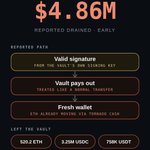
Chainflip's Ethereum vault was just drained for about $4.86M
520.2 ETH, 3.25M USDC and 758K USDT went out to a fresh wallet
The withdrawal carried a valid signature from the vault's own aggregate signing key, so the contract treated it like a normal transfer
Early trackers point to a suspected private key compromise, Chainflip has not confirmed yet
The attacker is already pushing ETH through Tornado Cash
If you have a swap in flight on Chainflip, hold off until the team gives an update
My take: Threshold keys spread the risk, but if the signing process leaks, the vault can't tell the network from the attacker
Three weeks after the $6.4B Binance hack, where is the money now? 🧘♂️
SomaXBT traced 31,763 attacker wallets across 12 chains and the picture is clear
$2.82B is frozen by token issuers, about 44%
$2.67B is still sitting in the attacker's wallets, about 42%
Only $32M has been recovered so far
The first hour was a race against the freeze
One wallet sent 300M USDT onward at 20:56 UTC and Tether froze it at 21:09, 13 minutes too late
Another wallet dumped 245M USDT for ETH at 10% to 25% below market, giving up about $37M just to get out before Tether could act
Now the attacker is splitting ETH into fresh wallets of exactly 12,000 ETH each and pushing funds through THORChain into Bitcoin, with 1,482 BTC already through CoinJoin
How to spot the side effect: scammers are already sending fake "ETH" tokens from lookalike addresses to those wallets, the same address poisoning trick they use on normal users
If you copy an address from your transaction history, check every character, not just the first and last few
My take: freezes saved almost half, but once stolen money leaves stablecoins, recovery gets very slow
It all started with one fake job interview, not a code bug
nitter.gq/Promirexy/status/21176…
Binance just dropped its initial findings on the $6.34B hack and it confirms what I've been saying all along
It started with a fake job interview
An employee downloaded malware during the "interview"
The attackers then used that device, internal AI tools and stolen credentials to reach Binance's internal wallet signing service
From there they moved funds outside the normal withdrawal checks and abused EIP 7702 authorization on a hot wallet
No smart contract bug, and no private key leak according to Binance
About $2.85B is frozen or intercepted so far and Binance says no user bears the loss
Why it matters: the weak point wasn't code, it was one person, one laptop and an internal tool with too much reach
If you work in crypto, never run a "recruiter's" take home test on the machine you use for work or wallets
Access is the attack surface now, not code
Nobody had to break a vault this week 🧘♂️
Most of the money walked out through a side door
A trading key, a wallet module, a signing tool, a support vendor, a shipping partner, a relayer
Here's every hack and scam from Nov 14 to 20, and the one lesson behind them 🧵

10/ And the scams needed no hacking at all
A deepfake Musk livestream pushed people to send crypto, and Coinbase says it stopped $4.7M
Trigram fake job tests tried to get devs to run malware
18,000 GTA VI tokens showed up in 48 hours
Lesson: Urgency is the attack
1
3
40
My tally hit 8 access incidents this week, and the biggest loss again came from a key, not a contract
Code bugs still happen, ask Kava and K3
But the biggest money keeps leaving through access
So before you trust any app, ask who else can move your funds
Calm in chaos 🧘♂️
nitter.gq/Promirexy/status/21157…
My prediction for Q1 2027
The biggest single crypto loss of the quarter will come from access, not code
A key, a credential, a vendor or a signer
Not a smart contract flaw
If CertiK’s Q1 2027 numbers put a pure code bug behind the biggest individual loss, I was wrong
Here’s the case:
Frequency isn’t severity
CertiK’s H1 2026 numbers
Code vulnerabilities, 204 incidents, $152M
Wallet compromises, 33 incidents, $445M
That’s about $0.75M per code bug
And about $13.5M per wallet compromise
Roughly 18 times more per incident
The Tranche Vault drain this week, about $1M so far, is the typical code bug
Frequent and small
The biggest losses come from the other side
Q2’s two biggest were Kelp at $291M and Drift at $285M
A cross chain verification failure and an admin takeover through tricked signers
Q3’s biggest was Bitget at $387.5M
Bitget says attackers used a flaw in a third party security product to reach internal credentials and forge withdrawal commands
The forged commands were treated as legitimate
Two small test transfers stayed under the risk threshold
The big ones followed about 30 minutes later
Now look at the disclosures since September
Trezor, a third party email provider
Bitget, a third party security product
NGRAVE, a third party push service
Foundation, pointing to Cloudflare API keys
Solflare, a staking provider holding validator keys
Different brands
Same pattern
And this week, Bithumb disclosed an intrusion into groupware
An office tool
Not a chain, not a contract
Code bugs aren’t dead
Liquid lost $319M to one in September, and about 85% came back
I’m not saying they’ll disappear
I’m saying they’ll stop being the biggest
The part that protects you
Bitget says its cold wallets weren’t touched
Solflare says delegated SOL stayed in users’ own stake accounts
You can’t promise you’ll never be breached
You can decide how much a breach can reach
So the question isn’t “is it audited”
It’s “who else holds a key, and what can it move” 🧘♂️
3
16