

Decoding real estate beyond noise.
Earth
Joined August 2023
- Tweets9.6K
- Following661
- Followers10.4K
- Likes20.1K





Pinned Tweet
So today, I introduce myself as Property Decoder @ Ground Lens —
A dedicated consumer centric knowledge platform built to decode how real estate really works.
For a long time, I myself have faced a massive gap between what’s projected and what’s real in Indian ‘Real’ Estate.
What began as simple curiosity gradually became a deeper purpose – to decode what lies beneath the surface-level real estate chatter – full of overhyped narratives, speculative sales pitches, cherry-picking bias, inflated claims, tailored data – often supplied as “knowledge” or “insights.”
Here's why I had to start this 👇( 1/n)


🌻Announcement🌻
A Small Change, A Bigger Purpose
After much thought (and a fair share of nervous excitement), I’m making a small but meaningful shift.
I started this account on X with a simple intention: to share my learnings, question dominant narratives, and connect with people trying to make sense out of complexities around real estate in India, beyond just glossy brochures and narrative hype.
Over time, I realised how one-sided and supply-driven most real estate discourse is, often fueled by FOMO, half-truths, greed, and promotional hype – majorly focusing on pushing sales rather than addressing buyers’ voice/needs or empowering them to take informed decisions.
There were moments I genuinely considered stepping away. Because real estate has long been the most uncomfortable zone for me, not due to any problem wrt this need based asset, but because of the ecosystem around it which often feels opaque, fake and disturbingly anti-consumer.
Yet, for many in the industry, that’s just business as usual. Though the presence of bad actors has made trust hard to come by, but those who bought wisely have fulfilled their needs and also seen real value creation over time.
What kept me going, despite all the doubts and dilemmas, was the thoughtful support and encouragement I received from family, friends, and many of you who have been engaging with me since the beginning.
Some even pushed me to take it a step further, to get my hands dirty and build something more meaningful. For that, I’m genuinely grateful.
So today, I’m doing just that.
Soon this account will no longer carry the name “Indian Real Estate Index.”
It marks the beginning of a new phase - still rooted in the same core values:
👉 Clarity over noise
👉 Ground truths over narratives opium
👉 Putting the buyer’s voice first because that’s where I’ve mostly been
If you’ve found value in what I’ve shared so far, I hope you’ll continue to be part of what’s next.
The journey ahead is going to be more focused, more structured, and hopefully, far more impactful.
🙏 Thank you for reading, engaging, and helping shape this.
See you on the other side :)
I usually avoid getting into social media e-lafdas, but this one was hard to ignore.
How can brokers, especially with decent presence on social media followings, openly promote projects, where EWS flats are subject to a 5-year lock-in after delivery under the applicable policy and cannot be resold during that period?
Same project is yet to be delivered and has been stuck since long due to several reasons is another issue here.
But if the registration can't be done and also builder can't do transfers in their records and municipal can't do mutation in the name of new buyer, how exactly will the title be transferred to the buyer?
And if the proposed transaction is based on a GPA+Will as usually offered as a "file" in such transactions, then let me tell you several Supreme Court judgments have already clarified that such instruments do not, by themselves, confer ownership or legally transfer title to immovable property. Plus there are several other issues with GPA too.
So, how exactly are investors supposedly buying 3 or even 5 such units at a time and getting ownership transfer in their names?
Camellias EWS is the headline, 99.75% discount on actual Camellias is promoted and 9% yield is also advertised but forgot to clearly explain whether the new buyer will actually acquire legal title to the property or not before the lock-in period expires?
Whether the ticket size is Rs. 25 lakh or Rs. 2.5 lakhs, whether the promised rental yield is 9% or 18%, the first question should always be.... DO YOU ACTUALLY GET LEGAL TITLE TO THE PROPERTY for which you are paying for?

Meet Camellias (EWS).
If a Camellias apartment is ₹100 Cr, this one is at 99.75% off.
Camellias is for a handful of people. This is what the rest of us can afford, inside the same Golf Course Road compound.
EWS flats are meant for families earning less than ₹1.8 lakh a year, and every developer has to build them in a project like this.
Now see what happens. Some allottees take money upfront from a buyer, a file gets made for that unit, and everybody just waits for the building to come up and the appreciation to come. By then the flat is being quoted at ₹25 lakh.
And who's buying it?
A few buy it for their house helps and drivers, and they actually use it for that.
But almost 90% of these flats are bought by people who can't afford the actual Camellias. They want this address, and they want it so they can rent it out to cabin crew and to young kids who've just got jobs on Golf Course Road. Those kids can't pay ₹50,000 to ₹60,000 a month for a premium 1 BHK here, or even ₹40,000 for a 1 RK.
So EWS flats already standing on this road fetch more than ₹20,000 a month. On ₹25 lakh that's ₹2.4 lakh a year, a 9.6% gross return, which is very good compared to the prices here. That's why investors are picking up 3, 4 or 5 units in one go.
And nobody says this part out loud, but a lot of adjustment happens in this sale and purchase too.
Every premium project in Gurugram has these units, and every time one changes hands at ₹25 lakh, half the people call it a scam and the other half call it the best deal in the city.
Which half are you?
DLF launched shops at Galleria Market, Gurugram, at ~Rs. 4,000/sqft in the early 2000s, and delivered in 2004.
It was conceived as an open-air, more like a neighbourhood retail market because at that time when malls were booming across India, and Gurugram was rapidly gaining popularity for its cluster of malls lined up along MG Road.
That's why perhaps even DLF couldn't have imagined that 2 decades later, prices would appreciate by 100x at around Rs. 4,00,000/sqft commanding rentals of Rs. 1,500-1,800/sqft (prime ground-floor shops), making it one of India's most expensive retail markets.
Maybe that's why this time DLF hasn't sold any in its newer retail destination on similar concept, DLF Summit, located in one of Gurugram's most affluent neighbourhoods.
Time will tell whether Summit can ever match or surpass Galleria's rental values.
But here's something to think about... most people don't have very good view of investing in retail real estate BUT then why one of India's top developer is holding on to it?
Maybe the problem isn't retail real estate itself, but maybe what it's being sold, why it's being sold and how it's being sold and then understanding the underlying fundamentals around it, which makes or breaks it.
After all, maybe DLF knows a thing or two about what to sell, and what to hold on to. Because, in recent years, same developer has sold other retail projects too, but their investors are struggling big time.


Median home prices in this area are around ₹5.5 crore for single-family homes. You can get a ~1,200 sq yd lakefront house with private beach access for around ₹18 crore (shared below).
And here, top developer is talking about selling 4,000-5,000 sqft flat. that too in super area, with a special Chakarpur view for ₹20-25 crore, while AQI stays above 300 for at least 3-4 months a year.
What a life here... spend tens of crores, even hundreds in some cases, to buy and live in so called "luxury" home, and yet the overall livability standards still sucks...


Gurgaon Real Estate
2024: Demand started weakening. The argument was there can't be a slowdown... the cycle still had 2-3 years to run.
2025: Demand weakened further. Anxiety? None visible... Because another narrative... here's no supply. Cycle is yet to peak.
2026: Demand is now down to around 50% of 2024 levels, possibly much lower. Still, no visible panic... coz 360 North sell out is a Arbour moment. Gurgaon real estate has its own cycle.
Perhaps Mumbai's real estate ecosystem needs to learn something from Gurgaon one that how to keep a straight face while the numbers keep getting worse.
That's why I feel we talk so much about Mumbai's spirit but often underestimate the underdog spirit of Gurgaon's RE ecosystem... coz no sales slowdown seems capable of shaking its conviction.
After all, in real estate, sometimes the last thing to collapse is not the market, but the narrative.

Property Decoder retweeted

Anything to do with property be very careful in India. Even with ready to move in properties- do your due diligence and study all marketing and sales tactics that brokers employ. Don’t fall prey to them- middle class families have everything to lose
In India, if you're buying real estate, especially a home to live in, try to avoid under-construction projects as much as possible.
And be even more cautious about buying in under-construction projects on a loan/EMI.
Uncertain delivery timelines can take a toll on both your mental peace and financial health, especially when you're paying rent and EMIs simultaneously for a home whose delivery date keeps moving further away.
Below post might look like a joke, but in India, many builders have long been buying land parcels adjoining/near cemeteries, graveyards and cremation grounds because the land comes much cheaper. Yet, they rarely sell cheap to buyers.
Because they know how to package in the name of a "gated society", as their brokers can sell them while dancing around showing off the "luxury" clubhouse.


Poor air quality is a feature of India's major cities, not a bug anymore.

Air quality across major cities
Proves that
- Our cities are badly polluted
- Pollution dpt are useless
- Wind flow & rains are only saviour 👑
#aqi #delhi #mumbai #Bengaluru #chennai #Hyderabad #pune #kolkata #ahmedabad

In India, if you're buying real estate, especially a home to live in, try to avoid under-construction projects as much as possible.
And be even more cautious about buying in under-construction projects on a loan/EMI.
Uncertain delivery timelines can take a toll on both your mental peace and financial health, especially when you're paying rent and EMIs simultaneously for a home whose delivery date keeps moving further away.

The worst investment I did is buying a property of Godrej- big brand bigger, bigger fraud.
Bought a property in 2023, they told we will get possession in 2026 mid, forget the possession, they are telling they want to add additional floors and that too 8-9 floors, without adding any extra plot to the project.
From past 3 months the CRMs has bullied, disturbed, bribed and what not for us to sign the consent form to modify the RERA, as a person who works a full time job, this kind of harassment takes a toll on mental health, as now I am paying full EMI and possession not sure when they are going to give(maybe 2028(Rera date)), the constructions they have left in mid. For Phase1 owners also they are pushing the handover deadline.
This is so disappointing! and now I am stuck, so whenever you decide to buy a property in Godrej, think 100 times before.
If even high-paying jobs aren't secure anymore, can India's salaried middle class still afford to bet 15-20 years on a home loan?
There was a time when companies avoided layoffs during the festive season.
I know people in my close circle who have been laid off by global giants in recent weeks, just before Diwali. Multiple reports suggest employees over 40 and those earning 50 lakh+ are also facing significant job-security risks.
The window for India's salaried middle class to build their lives seems to be shrinking. Looks like they have just 15-20 years to settle down, raise a family, fund their children's education, pay off home loans and build a build some retirement corpus also.
So, when job security itself is uncertain, why would people rush to buy homes?
And if even those earning 50 lakh+ cannot count on stable employment, how many can confidently commit to even Rs. 2-3 crore homes? After all, this is the very segment that premium and luxury housing increasingly depends on.
Meanwhile, builders have flooded markets with premium and ultra-luxury launches in recent years, seemingly encouraged by investor/trader interest, betting that end-users would eventually absorb this supply.
But that doesn't seem to be happening anymore. Sales of high-value home have significantly slowed and may go down further, no matter what seller ecosystem claims.
Because until the uncertainty around high-paying jobs eases, homeownership dreams seems to be slipping further out of reach for even the high-salaried middle class.
This could matter most in Delhi NCR and Mumbai, where housing prices relative to incomes are already around twice what many consider a comfortable level.

If Delhi NCR represents North India's love affair with real estate, Hyderabad seems to be doing the same for South India.
Both cities are making headlines for record-breaking real estate deals. Real estate remains one of the most visible ways to signal wealth and status in these two cities which are miles apart, yet remarkably similar in their fascination with "trophy" real estate.

The problem with real estate isn't necessarily real estate itself.
Real problem is buying without being well-informed, relying blindly on a commission-driven ecosystem rather than understanding what you are actually buying into.

As housing prices in Gurgaon start catching up with Mumbai, perhaps Gurgaon residents might also start saying the same thing...
"Gurgaon is now too expensive to build a life in..." and then start looking at Hyd, Pune, Blr or other cities instead with similar job opportunities.

India's Grade A office leasing picks up 📈 again.
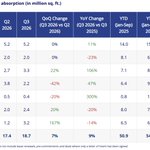
According to Colliers, gross leasing across 7 major cities reached 18.7 million sqft, up 9% YoY and 7% QoQ.
- Bengaluru remained the largest market, with 5.2 million sq. ft. leased, broadly flat QoQ and YoY.
- Delhi NCR recorded the sharpest increase (⏫106%) among the major markets, more than doubling its leasing volume YoY.
- Hyderabad continued to grow (🔼47%) YoY strongly, although leasing fell (🔻42%) QoQ.
- Mumbai and Chennai saw YoY declines of 🔻20% and 🔻23%, respectively.

We continue to see more and more reports about housing prices rising 📈 YoY across our major cities.
But rarely do we get to hear how our basic civic infra is crumbling and weather conditions are worsening 📉DoD (decade on decade), making our cities increasingly unlivable with time.
This decoupling can't continue forever.
Or can it?


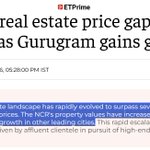
While Mumbai folks are dreaming of seeing Gurgaon real estate finally getting humbled, but Gurugram seems to be winning the battle against the "erstwhile" king of Indian real estate, Mumbai.
Because Gurugram property prices has now already surpassed Mumbai, with staggering 450% 📈 growth since 2020.
So now Mumbai real estate has a new challenge... to now compete with Gurugram!
After all, Gurugram is already on its way to beat New York, Singapore, Monaco and every other expensive real estate market on the planet.
Ab Manhattan door nahi hai... bas NCR ke builders aur unke brokers ko lage rehna hain... continue the bombardments of reels/shorts/posts... with thumbnail "Gurgaon property prices will keep going up".


Decade long price stagnancy has humbled us in MMR.
Gurgaon's turn will come.
@PropertyDecoder
Whether you believe it or not, many/most builders in India seem determined to extract as much as they can from homebuyers, first through hidden/random charges, years of delay, then through secondary-sale/transfer charges, and later even through maintenance charges for years like their fixed rental income, often while delivering only the bare minimum.
So, until the builder is finally out of the picture, homebuyers find themselves facing one layer of extraction after another.
This Post is from an account that no longer exists. Learn more
I don't know if Gurgaon or NCR developers will ever get humbled, but absolutely sure they'd never say something like this publicly, despite knowing the game.

"Project book kara lo sir... ab toh RERA bhi hain..."
RERA hain na?
This Post is from an account that no longer exists. Learn more
Once, I met a very senior sales guy from a developer that was then considered one of the top developers in NCR. His analysis was almost exactly the same...
"Input costs are rising, so we’ll keep passing them on to buyers through higher prices. Buyers will eventually have no choice but to buy at those prices and they will keep buying..."
This was during the (last) 2010-2012 real estate cycle.
We all know what happened afterwards... demand weakened, sales slowed, and the market eventually went through a prolonged price correction.
The problem with this argument is that it assumes buyers will "magically" absorb every increase in the cost structure.
But they don’t.
At some point, affordability becomes the constraint. The number of willing buyers starts shrinking, the market gradually turns into a buyers' market, and builders and sellers begin to lose their pricing power.
Yes, land can become more expensive, construction can become more expensive, financing can become more expensive, developers and lenders can demand higher returns.
But they can only pass those costs on to buyers as long as they retain pricing power, something that usually happens during an upcycle.
Once that pricing power starts weakening, rising costs don't automatically translate into higher selling prices.
None of this guarantees that buyers will have the purchasing power or the willingness to pay whatever price the industry wants to charge.
Costs can rise indefinitely on paper but buyers' ability to pay cannot.
And when the two diverge far enough, the market eventually has to adjust.
The mistake is assuming that because the cost of producing a house keeps rising, the buyer's ability to pay must rise with it.
History has shown that it doesn't.

