the cases America still argues about | real footage, both sides
Joined July 2026
- Tweets797
- Following253
- Followers1.8K
- Likes1.8K


Quantex retweeted
A jury said O.J. Simpson didn't kill his ex-wife. Twelve years later he looked into a camera and said: "I remember I grabbed a knife. I do remember that portion."
Then, he said, everything went blank. The next thing he remembers is standing there, with "all kind of stuff around."
He called it a hypothetical.
On June 12, 1994, Nicole Brown Simpson and her friend Ron Goldman were stabbed to death outside her home in Los Angeles. O.J. never took the stand. This 2006 interview was the closest he ever came.
In the video below, he walks through the night. The wool cap and gloves. The knife he kept under the seat of the Bronco. A friend called "Charlie."
The interviewer reads his own book back to him: "I had never seen so much blood in my life."
"I don't think any two people could be murdered the way they were without everybody being covered in blood."
After the victims' families protested, the interview was shelved. It aired 12 years later.
In 1997 a civil jury found him liable for both deaths and ordered him to pay $33.5 million. He died in 2024 without ever confessing.
Was it a hypothetical, or the confession he never gave in court?
Quantex retweeted
Jeffrey Dahmer had one group of friends in high school. One of them later said: "That could have been me in the trunk of that car."
His name is Derf Backderf. Weeks after they graduated in 1978, Dahmer picked up an 18-year-old hitchhiker named Steven Hicks. He was the first of 17.
In the video below, Derf describes the moment he knew something was really wrong. A ride to the mall. Dahmer in the back seat, drinking. Derf watching him in the rearview mirror.
"My instincts just said get away from this guy."
He says they were the only friends Dahmer really had. "There was nothing about him that was normal."
Derf spent 19 years turning those school days into a graphic novel, My Friend Dahmer. When they made it into a movie with Ross Lynch, they filmed at the real house. Nobody joked on that set.
This month Dahmer is back on TV in American Horror Story.
Could his friends have stopped him, or was that never their job?
Quantex retweeted
Jeffrey Dahmer was asked what would have stopped him. "I can't think of anything."
A year later, another inmate stopped him with a metal bar. Then he walked up to a guard and said: "God told me to do it."
Dahmer killed 17 men and boys between 1978 and 1991. This month he's back on TV in American Horror Story.
In the video below, he sits in prison in 1993 and says who's to blame. Not his parents. Not society. "The person to blame is sitting right across from you."
Then he describes the night it ended, when one man got away and came back with the police.
On November 28, 1994, guards left him alone with Christopher Scarver and a third inmate to clean the prison gym. Scarver was already serving life for murder. Dahmer was 34. He died within an hour of reaching the hospital.
His mother asked reporters one question: "Now is everybody happy?"
Justice, or just one more murder?
Quantex retweeted
In March 1990, a woman walked into the Beverly Hills police station and said she knew who shot Jose and Kitty Menendez.
Their own sons. She said she had heard them confess, from outside their therapist's office.
Seven months earlier, Lyle and Erik had shot their parents with shotguns in the family den. Then they spent about $700,000. Rolex watches, a Porsche, a restaurant. The police were sure it was them. They had no proof.
Her name was Judalon Smyth. She was the therapist's girlfriend.
In the video below, she tells what she heard in that office, and why she finally talked.
The psychologist, Dr. Jerome Oziel, had recorded the sessions. Judalon knew about the tapes. When she and Oziel broke up, she went to the police.
Within days, both brothers were arrested.
They fought to keep the tapes secret. Therapy is confidential, right? Not always. The court let part of them in, because Oziel said the brothers had threatened him.
On those tapes, the brothers never mentioned abuse.
Without her, they might have walked free. Hero, or a woman settling a score with her ex?
Quantex retweeted
In 1989, Lyle and Erik Menendez shot their parents in their Beverly Hills mansion. Then they spent about $700,000 in six months. Rolex watches, a Porsche, a restaurant, a tennis coach. Netflix made a whole season about them. 35 years later, America still can't agree on why they did it.
In the video below, Erik testifies at his first trial in 1993. Watch his face and decide for yourself.
The brothers said their father had abused them for years, and their mother knew. They said they killed out of fear.
Prosecutors said it was about the money: a $14 million estate and parents who were about to cut them out.
Erik confessed to his therapist. The therapist's girlfriend went to the police.
The first trial ended with hung juries. The second found them guilty. Life without parole.
In 2025 a judge cut their sentences and made them eligible for parole. The parole board said no.
Abused kids who snapped, or killers who learned the right story?
Quantex retweeted
The Golden State Killer murdered at least 13 people and attacked around 50 women across California between 1974 and 1986. For part of it he wore a police badge. He called some of his victims years later just to scare them. HBO made a whole series about the hunt. For more than 40 years, nobody knew his name.
Paul Holes spent most of his career hunting him. Days before he retired, he parked across the street from the killer's house.
He thought about knocking. Just a quick chat, maybe ask for a DNA sample.
He drove away instead.
The next day he turned in his badge, his gun and his car.
In the video below, he tells the whole story himself, and why he's glad he never knocked.
The man inside was Joseph DeAngelo, 72, a former cop living a quiet life in a Sacramento suburb.
Holes found him through a free family-tree website. DNA from the crime scenes matched distant relatives, and the tree led to one man.
A few weeks later, police matched DNA he had thrown away. DeAngelo was arrested and got life.
He had a lot of guns registered to him. Holes was alone that day.
Would you have knocked?
Quantex retweeted
In December 2008, Bernie Madoff wanted to pay $173 million in bonuses two months early. His sons asked where the money was coming from. By the next morning, they had turned him in.
In the clip below, Andrew Madoff tells 60 Minutes what his father said in that apartment.
Bernie broke down. The business was "one big lie." For decades he had paid old clients with new clients' money. He asked his sons to wait a week, until the last money went out.
They didn't wait. They went to a lawyer that same day. At dawn, the FBI was at his door.
The math is the part people forget. Client statements showed $65 billion. The real cash that ever went in was about $17.5 billion. The other $47 billion was numbers on paper.
Every client saw about 10% a year, almost never a losing month. That smoothness was the fraud.
This week Turkey is living its own version: an $18.3 billion Ponzi scheme, a market regulator who resigned, and a finance minister explaining how long Madoff's victims waited to get paid.
Bernie got 150 years. Mark never spoke to him again. Two years to the day after the arrest, Mark took his own life. Andrew died of cancer in 2014. Bernie outlived both sons.
Mark and Andrew chose thousands of strangers over their own father. Would you?
Quantex retweeted
Kim Kardashian says Kanye gave away all five of their Lamborghinis to his friends. She just came home and they were gone.
Then they got five more. And he did it again.
In the video below she tells the whole story herself, and her reaction the second time says everything.
It wasn't about the cars. It was one of the reasons she left: "I didn't know what you're going to get when you wake up."
Four kids, almost seven years of marriage, divorce filed in February 2021.
Today he pays her $200,000 a month in child support. Ten Lamborghinis is roughly what that adds up to in a year.
Would you have stayed after the second time?
Quantex retweeted
THIS IS A F*CKING CHEAT CODE FOR QUANTS
Mistral just dropped Timestral. #1 on 3 forecasting benchmarks. open weights, runs on a CPU.
Opus 5.5 + REA wired it to 20 open-source repos:
→ ccxt pulls 2,000 BTC 1h candles
→ Timestral forecasts the next 96 hours
→ statsforecast builds a random walk to beat
→ CRPS grades both on data it never saw
→ the GATE kills it if it loses
#1 on benchmarks. zero proof on your chart.
skill = 1 − CRPS_model / CRPS_random_walk
below 0 = a coin flip with 209M parameters.
paste this into Claude Code ↓
"Install Timestral from timestral github repo. Pull 2,000 BTC 1h candles with ccxt. Forecast 96 steps, score with CRPS against a random walk on 200 unseen windows. Show diffs first."
save it before the next forecast goes viral.


Quantex retweeted
THIS IS THE PART OF KRONOS NOBODY F*CKING USES
Kronos reads candlesticks the way GPT reads English. 12 billion K-lines, 45+ exchanges, open source.
Everyone is posting its forecast line.
But Kronos is GENERATIVE. It can draw 1,000 different futures. That line is just their average.
and the average lies.
400 paths rip +6%. 600 paths bleed -2%. the average says “slightly up”. 60% of the futures say you lose.
So Opus 5.5 + REA wired it to 20 open-source repos and made it give ODDS:
→ ccxt pulls the last 512 candles
→ Kronos samples 1,000 paths for the next 24
→ the paths become a CONE, not a line
→ properscoring grades the whole cone with CRPS
→ vectorbt replays it with fees
→ the GATE kills it unless it beats a random walk on data it never saw
P(up) = paths that close higher / 1,000
and the “93%” you keep seeing? it’s how much RankIC improved over the best rival model. not 93% accuracy. not even close.
a forecast without odds is a guess with a chart.
a cone wider than your stop is a no-trade.
paste this into Claude Code ↓
“Install Kronos from Hugging Face. Pull the last 512 BTC 1h candles with ccxt. Sample 1,000 paths for the next 24, report P(up) and the 5-95% band. Score with CRPS against a random walk on a holdout. Show diffs first.”
save this before the next chart tells you where price is going.
Quantex retweeted
THIS IS A PURE F*CKING GOLDMINE
Opus 5.5 + REA turned 20 open-source repos into one PROBABILITY ENGINE.
→ PyMC + ArviZ put a posterior on the edge
→ hmmlearn finds the regimes
→ XGBoost, PyTorch fit the models
→ Optuna runs 500 trials, finds Sharpe 1.9
→ the OVERFIT GATE deflates it to 0.4
1 model out of 500 survives.
E[max Sharpe] ≈ σ · √(2 ln N)
test enough strategies and the best one looks brilliant by pure luck.
paste this into Claude Code ↓
"Build a research loop: fit with PyMC and hmmlearn, tune with Optuna, deflate the best Sharpe by the number of trials, validate on an unseen holdout. Show diffs first."
save it before your next optimizer run.
Quantex retweeted
Holy sh*t. A coin that ended exactly where it started turned $1,000 into $361,099.
100 flips. Heads doubles it, tails halves it. 50 heads, 50 tails.
→ HOLD the coin: $1,000 → $1,000
→ Let Grok Bot keep 50% coin, 50% cash and rebalance every flip: $1,000 → $361,099
Same coin, same flips. The only difference is resetting to 50/50 after every flip.
The math:
½ ln(1.5) + ½ ln(0.75) = ½ ln(1.125) > 0
Heads grows the pot 1.5x, tails only cuts it to 0.75x. Over 50 pairs that's 1.125⁵⁰ ≈ 361x.
Claude Shannon worked this out in the 1960s. His Bell Labs colleague Kelly turned the same math into a betting formula. In 1996 a physicist named Parrondo found it again: two losing games, alternated, start winning.
Information theory, gambling, physics. Same line of math.
Real markets don't double and halve, so it won't be 361x. But the idea holds: volatility plus discipline can beat holding.
Do you rebalance, or just hold and pray?
Quantex retweeted
I don’t f**king understand why nobody talks about the most expensive exit in quant history.
In 1989 a Berkeley math professor named Elwyn Berlekamp took over the company running Jim Simons’ Medallion fund.
In 1990 the fund made 55.9% after fees.
Then he sold his stake to Simons for 6x what he’d paid, 16 months earlier.
On paper that’s a 283% a year return. By any normal standard he won.
Here’s what he walked away from [Fig. 1].
Medallion went on to average 39.1% a year AFTER fees for three decades. At that rate money makes another 6x every 5.4 years:
6x → 36x → 216x → 1,296x → 10,308x
He took the first 6x. The machine kept going for 28 more years.
And he’s not unusual [Fig. 2]. A study of 10,000 brokerage accounts found people sell their winners 1.5x more readily than their losers.
When a few huge winners drive most of the returns, selling everything at 2x keeps just 14% of the gains [Fig. 3].
A great return on a sale can still be a terrible decision.
The most expensive trade is usually the winner you sold early.
Working Paper Q-008. Save this.

Quantex retweeted
I don't f**king understand why people still think you need a big salary to get rich.
In 1935 a secretary named Grace Groner bought 3 shares of her company's stock for $180.
She never sold. She reinvested every dividend, lived in a small cottage and bought her clothes at rummage sales.
When she died in 2010, those $180 had turned into $7 MILLION. She left almost all of it to her college.
Here's the part nobody tells you.
After 40 years of never selling, her $180 was worth about $50,000. That's 0.7% of what it became.
Then 88% of the fortune showed up in the last 15 years.
Her final doubling alone added $3.5M, more than the first 14 doublings combined.
That's how compounding works. It looks like nothing for decades, and then it's everything.
Most people quit in the boring part.
Full math in the paper below: her exact rate, what fees would have cost her, and what $100 a month does if you start today.

Quantex retweeted

how do you know a trading strategy still works?
you don’t. unless you test it.
this guide turns your AI into a research desk that does it for you: real data, real backtests, stress tests, and a path to your broker
Quantex retweeted
Jim Simons' fund made $104.5 BILLION being right only 50.75% of the time.
That's barely better than a coin flip. And it's the most profitable trading record in history.
His partner Robert Mercer explained it in one line: "We're right 50.75 percent of the time... but we're 100 percent right 50.75 percent of the time. You can make billions that way."
So I ran the math on what it actually takes.
If you make 100 trades a year, you need to be right 62% of the time to be 99% sure of a winning year. Almost nobody is that good.
If you make a million trades a year, 50.12% is enough.
A genius who's right 60% of the time on 100 trades expects to win 20 units. A machine that's right 50.75% of the time on a million trades expects 15,000. That's 750x more, while being wrong almost half the time.
The secret was never being right. It was a tiny EDGE, repeated a million times, with costs low enough not to eat it.
The full recipe is in the paper below, with the edge, trade count, size and how long it takes to know your edge is real.


Quantex retweeted
In 1998 a Stanford professor wrote a $100,000 check to two PhD students.
It became $10 BILLION.
The students were Larry Page and Sergey Brin. The professor was David Cheriton, and that one check made him a multi-billionaire.
Most people call it luck. It's actually how this kind of investing works.
One study looked at just over 7,000 venture deals from 1985 to 2014. About half of them lost money. Only 6% returned 10x or more, and that 6% made up 60% of all the returns.
That's a POWER LAW. A few outcomes are so big they decide everything, and the average tells you nothing about a typical bet. It's the same shape you see in earthquakes, city sizes and market crashes.
So the real skill isn't avoiding losers. You stay in the game long enough, and size small enough, to still be there when the one that matters shows up.
I put together the full math behind it, the distribution, the odds and how many bets you actually need. It's in the paper below.


Quantex retweeted
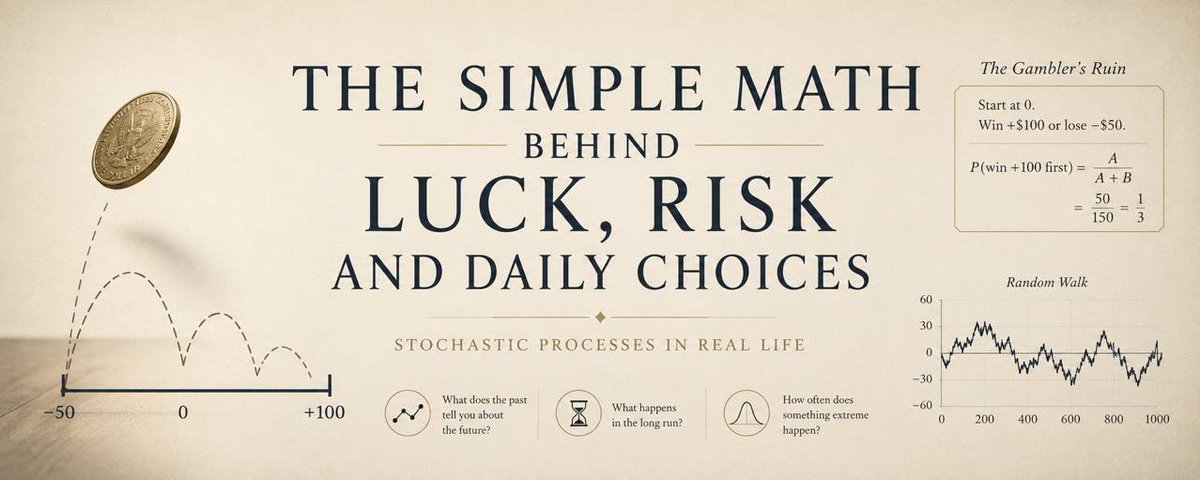
Goldman's CFO said in 2007 they were seeing 25-sigma moves, several days in a row. Under the bell curve one of those happens once every 10^135 years. The universe is 10^10 years old.
Goldman wasn't unlucky. The curve was wrong.
In 1963 Benoit Mandelbrot looked at cotton prices and found tails way too fat for a bell curve. The same shape shows up in earthquakes and city sizes. POWER LAWS - giant events are rare, but nowhere near impossible.
Markets follow one too:
P(move > x) ∝ x^-3
Double the move and it gets 8x rarer. Not billions of times rarer.
I ran it on 69 years of S&P 500 data. The bell curve says a 5-sigma day comes once every 6,900 years. There were 47.
October 19, 1987 was a 23.8-sigma day. Odds of 1 in 10^125.
Your risk model is built for normal days. Accounts die on the other ones.
Full paper below.


Quantex retweeted
in 1961 an MIT mathematician walked into a casino with $10,000 and walked out with $21,000 in one weekend
counting cards gave him the edge. but what made him rich was a formula from 1956 that told him HOW MUCH to bet
his name was Ed Thorp and the formula was Kelly
most people think having an edge is enough. it isn’t
take a coin that pays +50% on heads and −40% on tails. that’s +5% expected value per flip, so you should take it, right?
go all-in for 100 flips and the median player loses 99.5% of his money, because 1.5 × 0.6 = 0.90
bet 25% each time instead and the same coin turns $1 into $498
same edge. the only thing that changed was SIZE
Thorp later took the same idea to Wall Street and made 20% a year for 28 years
wrote up the full math below


Quantex retweeted
I still don't understand why bettors read 5,000 things before a slate by hand
my spider sorts them. I read 1:
odds from 14 books → plain python. finds the stale line before the book fixes it
injuries → Jev checks every one against its source. fake "QB out" tweets die here
sharp money → Sonnet 5.5 cuts the touts and the "lock of the year" threads
weather → python flags anything over 20 mph wind
line moves → Opus 5.5 reads the weird stuff, like a reverse move against 70% of tickets
everything that survives gets scored. most nights 3 things make it
then they become 1 bet for me, sized at half Kelly
I'm out of 5 of the 6 jobs on my own slate. the one I kept is the only one that moves money
which feed are you still reading by hand?