


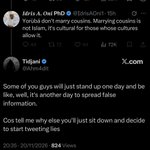





Mr.Kyari retweeted

Is it mandatory to marry your cousin? No
Is it recommended to marry your cousin? No
Is it permissible to marry your cousin? Yes
What if your culture abhores it... that is your problem. Make your choice according to what will make your marriage work.
If you fear for dangers associated with inbreeding, stay away
If you fear for rejection/division among your family, stay away
Just like marrying your cousin is sunna so also is marrying someone from a different lineage sunnah.
Choose the sunnah you are comfortable with in this case and do not blame who choses a contrary one.
Again, do not speak down on what Allah has made lawful just the same way you shouldn't applaud what Allah has forbidden
May Allah guide us
Mr.Kyari retweeted

I don’t know if you have talked about this fiqh principle
“In matter of ibadah (core worship) don’t do anything except there is an instruction from Allah and His messenger to do it, and in the matter of our life, do everything and anything except there is clear text not to do it”
That is why we can tweet, we can have a conversation, we can live and enjoy life. Enjoy your wife anyway and anywhere you like except anus, during menstruation. Is that not what make life easy for Muslims to live?!
Marry (do it) any women of your choice except (those Quran listed).
Is the above not Islamic legislation?! Besides is there any part of Muslim’s life that is not Islamic regulated?! Ife inu ti n wo ri tegbon taburo on that position. This is a matter that is direct naa. May Allah rectify us all. Jazakhumllah khayr Alfa wa on this street.
Mr.Kyari retweeted

4) Your Yoruba hair-plaiting analogy does not even hold up in Usul. You keep hammering on العادة محكمة, yet you are misapplying it.
You claimed there is no text against Yoruba men plaiting their hair, so custom alone made it haram. That is false. Yes, it is.
Yoruba culture did not invent a prohibition out of nowhere. Plaiting hair is haram for a Yoruba man because an explicit prophetic text (nass) already forbids men from imitating women (tashabbuh).
Custom ('urf) is not acting as the lawmaker here. It only tells us what counts as a female style in Yorubaland, which triggers a ban that already exists in the Sharia.
Now bring that back to cousin marriage. Where is the prohibitory text in the Quran or Sunnah that Yoruba custom is supposed to be triggering? There is none. What we have is an explicit Quranic permission.
Using custom to identify where an existing prohibition applies is how al-'adah muhakkamah works. Using custom to override a clear Quranic permission is a flat-out misapplication of the principle.
Putting cousin marriage in the same box as men imitating women is mixing up two totally different rulings.
Finally, I take your reminder on gentleness (rifq) wholeheartedly. I am gentle in my approach, yet unapologetic. I have nothing personal against you. The Deen just matters more to me than any friendship on here.
Even with all gentleness, my stand remains plain and unchanged. Yoruba people generally avoid marrying cousins, and anyone who stays away from it out of custom, preference, or medical caution has done nothing wrong.
What we must NEVER do is hand culture the authority to decide whether a Quranic permission is permitted or not. May Allah grant us both beneficial knowledge and precision in His Deen.
Allah knows best.
Mr.Kyari retweeted
Alfa Fagba, you calling sharp corrections "abuses and disjointed ramblings" will not save your weak argument. Mind you, I did not abuse you in my last post, and I will not abuse you here either. I will just walk you through the errors you piled up in your reply.
1) Let’s start with Surah Al-Ahzab.
You called my reference to 33:37 a "heavy miscarriage," and claimed the verse ends with "خالصة لك من دون المؤمنين" to argue cousin marriage was exclusive to the Prophet, and then boldly told me to go check the verse.
This is laughable, and it shows clearly that you did not open the Quran before typing that.
"خالصة لك من دون المؤمنين" is not in 33:37 at all. Please check your Quran. It is in 33:50, thirteen verses later.
In 33:37, Allah states the very opposite of what you claimed, telling us the Prophet's marriage to Zaynab bint Jahsh was enacted for the believers when He says:
لِكَيْ لَا يَكُونَ عَلَى الْمُؤْمِنِينَ حَرَجٌ
"so that there would not be upon the believers any discomfort concerning the wives of their adopted sons".
Even in 33:50 where that phrase appears, major mufassirun including al-Tabari, Ibn Kathir, and al-Qurtubi agree that "خالصة لك من دون المؤمنين" applies strictly to the category right before it: a believing woman who gifts herself to the Prophet without a dowry (hibah).
Look at the start of that same verse 33:50, where Allah lists his wives to whom he gave their dowries (أَزْوَاجَكَ اللَّاتِي آتَيْتَ أُجُورَهُنَّ). By your reading, marrying women with a dowry would also be haram for the rest of the Ummah. Is that the correct tafsir of that verse Alfa Fagba?
In of this, calling my point a "heavy miscarriage" while mixing up two different verses and missing basic tafsir tells everyone all they need to know.
2) You shifted the goalposts. Now you want to redefine "Islamic" to mean something unique only to Muslims. Okay. Fine.
Stop and think about that for two seconds. Non-Muslims marry, trade, honor their parents, and give charity. Does that mean regular marriage, trade, and charity are not Islamic? Is that the right logic and understanding Alfa Fagba?
Nobody said cousin marriage is a ritual pillar like Salat, or that Abyssinians playing with spears turns spear dancing into an act of worship.
Again notice what you quietly ran away from in your own first post: "Depending on your culture, it's permitted or not." This was the real blunder you made in that post, and it is only honorable you admit you erred.
And again, bringing up Banu Arfidah does not cover it. No culture on earth gets to decide whether a Quranic permission is permitted or not.
3) Asking "where are the Prophet's words on cousin marriage? Crickets!" shows you still missed how the sources of Sharia work.
Why are you demanding a separate hadith to validate permissibility when Allah's own explicit words in the Quran (4:23-24) already settled it? Does the Quran need a second stamp before it stands?
Beyond that, every word the Prophet spoke governing Nikah (wali, mahr, witnesses, choosing a spouse for deen) regulates cousin marriage too, and he and his daughters practiced it. So what are you saying?
Again, bringing in Umar ibn al-Khattab's statement (اغتربوا لا تضووا) does not help you either. You know why?
Because Umar gave practical advice to Bani al-Sa'ib because they kept intermarrying strictly inside their clan generation after generation until their children grew weak.
That was social and health counsel, not Umar declaring cousin marriage outside Islam. This is a false equivalence Alfa Fagba.
1/2 🧵

Thank you Mallam Yusuf, for your submission. I take it you didn’t take a critical look at this before you jumped on it.
So let me start with the first submission that I “cannot call something Mubah in one breath and then say it is "not an Islamic thing" in the next. That is a textbook contradiction.”
Something can be a Mubah and not necessarily be Islamic. If it’s Islamic, it’s a practice that’s unique to us—even if we adopted it. But if it’s Mubah, it’s for anyone but we can do it, too, which is exactly my point that you missed.
To drive my point home, I think it’s best to bring an example from the time of the prophet.
عن عائشة، قالت: دَخَلَ عليَّ رَسولُ اللهِ صلَّى اللهُ عليه وسلَّم وعِندي جاريَتانِ تُغَنِّيانِ بغِناءِ بُعاثَ، فاضطَجَعَ على الفِراشِ، وحَوَّلَ وجهَه، ودَخَلَ أبو بَكرٍ، فانتَهَرَني وقال: مِزمارةُ الشَّيطانِ عِندَ النَّبيِّ صلَّى اللهُ عليه وسلَّم! فأقبَلَ عليه رَسولُ اللهِ عليه السَّلامُ فقال: دَعْهما، فلَمَّا غَفَلَ غَمَزتُهما فخَرَجَتا، وكان يَومَ عيدٍ، يَلعَبُ السُّودانُ بالدَّرَقِ والحِرابِ، فإمَّا سَألتُ النَّبيَّ صلَّى اللهُ عليه وسلَّم، وإمَّا قال: تَشتَهينَ تَنظُرينَ؟ فقُلتُ: نَعَم، فأقامَني وراءَه، خَدِّي على خَدِّه، وهو يقولُ: دونَكُم يا بَني أرفِدةَ. حتَّى إذا مَلِلتُ، قال: حَسبُكِ؟ قُلتُ: نَعَم، قال: فاذهَبْي.
"The Messenger of Allah came to me while I had two young girls with me who were singing songs about the Battle of Bu’ath. He lay down on the bed and turned his face away.
Then Abu Bakr came in and rebuked me, saying: 'Musical instruments of Satan in the presence of the Messenger of Allah?!'
The Messenger of Allah turned towards him and said: 'Leave them alone.'
When Abu Bakr was distracted, I gestured to the two girls, and they went out.
It was the day of Eid, and the Abyssinians were playing with shields and spears. Either I asked the Prophet (to let me watch), or he said to me: 'Would you like to watch?'
I replied: 'Yes.'
So he positioned me behind him, with my cheek against his cheek, while he encouraged them, saying: 'Carry on, O Banu Arfidah!'
He continued until I became tired of watching.
Then he asked: 'Have you had enough?'
I replied: 'Yes.'
He said: 'Then go.'"
Mallam, are you following?
Abbysinians playing with shields and spares make playing with shields and spare Mubah; not necessarily an Islam thing. You would not look at anyone playing with shields and spares on stage today and scream “that’s Islam.”
Something can be Mubah, and not necessarily be ours. Your inference from my post is watery at best.


Mr.Kyari retweeted

You just did Istihlāl with a ruling that is mansookh.
The hadīth of Abu Hurayrah abrogated that of 'Uthmān.
I hope you're not giving fatwa with this make you no go misguide people. Toh.
😂 ?And Salafiyah agreed on everything.
Different verdicts exist because different interpretations exist, and Ta’arud exist between a lot of Nusus.
Abu Najeeh Al-Makkiy says
سافرت مع أصحاب النبي صلى الله عليه وسلم، فمنهم من يقصر ومنهم من يتم، ومنهم من يصوم ومنهم من يفطر، وكان لا يعيب هذا على هذا ولا هذا على هذا.
Differences in understanding of text or holding on to different text is something that’s been since the time of the Sahabah.
And this is exactly why you must find someone to follow.
For example, Abu Hurayrah head the prophet say:
إذ قعد بين شعبها الأربع وجهدها، فقد وجب الغسل.
But when Usman Bn ‘Affan was asked about a man
جامع أهله ولم يمن
He said:
يتوضأ وضوءه للصلاة، سمعته من رسول الله.
In short, both of them heard it from RasuluLlah.
lol, there’s a thousand examples of this.
Thanks Hajj Assim. I’ll go with Maliki.


Mr.Kyari retweeted
The funniest thing about your submission is the quick leap from admitting cousin marriage is Mubah to concluding that it is "not an Islamic thing." Let me point out some things to you, Alfa Fagba.
1) First of all, anyone who has gone past the first page of Usul al-Fiqh knows that Al-Ahkam al-Taklifiyyah (the five legal rulings in Islam) are Wajib, Mandub, Mubah, Makruh, and Haram.
Mubah is a ruling inside Islamic law, established by revelation. You cannot call something Mubah in one breath and then say it is "not an Islamic thing" in the next. That is a textbook contradiction.
2) Saying "Islam did not introduce it" and "the Prophet did not legislate it" confuses inventing a custom with legislating its permissibility.
Jsyk, the Sharia did not have to invent pre-existing practices like trade, mudarabah, or forward sales (salam) before they became part of Islamic law. Once revelation affirms an existing practice (Iqrar) or regulates it, it is legislated.
Allah left cousins out of the forbidden list in Surah An-Nisa (4:23) and declared in 4:24:
وَأُحِلَّ لَكُم مَّا وَرَاءَ ذَٰلِكُمْ
"And lawful to you are all others beyond these". Such permissibility is part of the Sharia.
Even the Prophet's own marriage to his first cousin, Zaynab bint Jahsh, happened by Allah's direct decree in Surah Al-Ahzab (33:37). Calling that "not legislated" does not hold up.
3) You threw in "العادة محمكة" to argue that "depending on your culture, it's permitted or not." That is a serious misapplication of Qawa'id Fiqhiyyah.
Every student of knowledge knows the first condition of al-'adah muhakkamah: custom only applies where there is no explicit text (nass), and custom can never prohibit what Allah declared halal.
Yoruba culture can shape your personal preference. Fine. You are free to avoid marrying your cousin because of family norms or medical caution, and you earn zero sin for leaving a Mubah.
Nobody is forcing any Yoruba Muslim to marry their cousin. What culture cannot do is sit above revelation and decide whether a Quranic permission is "permitted or not."
4) Dragging بالمعروف (bil-ma'ruf) from Surah Al-Baqarah and Surah At-Talaq into this does not rescue the argument either.
In those chapters, bil-ma'ruf governs fair treatment, financial maintenance, kindness in marriage, and honorable conduct during divorce. No scholar of tafsir ever stretched bil-ma'ruf to give local tradition veto power over the marriage permissions established in Surah An-Nisa.
5) Ending your submission with a line of Al-Buhturi’s poetry that suggests that those who disagree with you are cows is laughable.
I do not need to abuse you to answer your points. When a submission contradicts the five categories of Islamic rulings, and misapplies al-'adah muhakkamah, dropping Arabic poetry to insult people does not cover the gaps.
Next time, keep it plain. Saying Yoruba people avoid cousin marriage out of custom is a fact. Calling what Allah made halal "not Islam" is wrong, no matter how much Arabic you wrap around it.
Allah knows best.
Islam did not introduce cousin marriage. The prophet did not legislate it.
It’s a cultural thing that Islam left open to your cultural interpretation norms, but did not prohibit.
Therefore, it’s not an Islamic thing. It’s just Mubah. It’s like deciding if your attire should be red or white.
You’re not going to be earning reward by doing it, neither are you committing any sin by not doing it.
Depending on your culture, it’s permitted or not. But it’s not disapproved or disallowed in Islam.
Custom is an authoritative determinant of legal rulings in Islam, what they call
العادة محمكة.
I do not understand why a simple discussion like this needs to spin out of control. Do not marry your cousin if it’s against your cultural norm.
There’s a reason Allah keeps saying
بالمعروف
In the Qur’an, meaning “according to what’s reasonable.”
Many of it in the context of dealing with women. Check Surah Al-Baqarah and Talaq.
Is it reasonable to marry your cousin in your tradition? Then, by all means, Islam says yes.
Is it unreasonable? Then it’s best to stay away from it. If it doesn’t negate the Islamic teachings, then do not violate your culture.
And you’re quick to turn it to a sect thing.
But I can understand.
علي نظم القوافي من مقاطعها
ولا علي إذا لم يفهم البقر.


Mr.Kyari retweeted

This response in isolation has no issues, but in the context of the discussion, he's denying the permissibility.
Cousin marriage is customary, and at the same time permissible in the Sharī'ah.
ما لكم كيف تحكمون؟

Mr.Kyari retweeted

It is dishonest to claim that cousin marriage is forbidden in Islam when Prophet Muhammad himself married his first cousin, and the Quran (33:50) explicitly recognises such marriages as permissible.
This is why it is important for people to make research and not blindly follow


This man is beyond a nonentity as far as I’m concerned.
It’s excusable for someone who’s new into the religion but for someone who claims to be a religious leader to be this clueless about the religion he claims to have a PhD in.
This is the consequence of freedom of speech


It is dishonest to claim that cousin marriage is forbidden in Islam when Prophet Muhammad himself married his first cousin, and the Quran (33:50) explicitly recognises such marriages as permissible.
This is why it is important for people to make research and not blindly follow
1
82


