Raimundo Rodriguez (@R_X_Rodriguez) profile picture

PhD student in neuroscience @Yale

Joined October 2021
Photo by Raimundo Rodriguez (@R_X_Rodriguez)Photo by Raimundo Rodriguez (@R_X_Rodriguez)Photo by Raimundo Rodriguez (@R_X_Rodriguez)Photo by Raimundo Rodriguez (@R_X_Rodriguez)Photo by Raimundo Rodriguez (@R_X_Rodriguez)
Resting-state FC has long been a source of debate. Recent evidence suggests that task-like patterns dominate its signal. To study less dominant components, we introduced a caricaturing method to project the data to a subspace orthogonal to these patterns. rdcu.be/eN1gJ
1
3
5
202
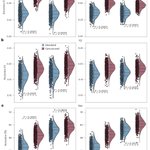
We first ensured the method truly caricatures the data according to the definition proposed by Finn et al., 2017 (NeuroImage). By demonstrating decreased between-individual similarity and increased fingerprinting accuracy, we showed that the caricaturing definition is satisfied.
1
28
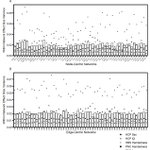
1/5 Remember when @sNeuroble went Super Saiyan? nitter.gq/sNeuroble/status/15552… We made it edgier, addressing a question that arises from her cNBS work–how to pool edges? In our new work, we explore the use of edge-centric, rather than node-centric, networks. doi.org/10.1016/j.neuroimage…
Do you use cluster-level inference to pinpoint effects? 🧠🎯 Are you concerned about power? 🔍 Then we have a simple message for you: Level Up 💪🏾 pnas.org/doi/10.1073/pnas.22… w/ @DScheinost @mandyfmejia @AndrewZalesky @PNASNews 1/6
1
8
9
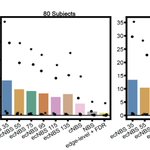
2/5 Using edge-centric partitions in the network-level inferential procedure, we observed up to a ~3.5-fold average increase in power compared to the complementary node-centric approach. An even larger increase in power was seen compared to edge-level FDR correction and NBS.
1