

voxa: give your langgraph agent a phone number. building aria on top, voice ai you actually call. solo, unvarnished build in public.
Toronto, Ontario
Joined September 2015
- Tweets1.9K
- Following965
- Followers959
- Likes6.7K


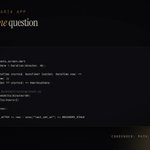




aria's new onboarding asks one thing before anything else: how did you hear about aria. six choices, a skip button, an optional line of text. the part i'd steal is the rule written into the screen's code: never hold a new user on a survey.
context: i'm building voxa (phone numbers for langgraph agents) and aria, the voice ai on top of it. in the submit method of onboarding/heard_about.dart the save sits in a try block with an empty catch, and the next line moves onboarding forward either way. there's even a widget test named "a failed save never holds them". good rule. it also means this screen can't tell you when it's broken (image above, condensed, the wrapped line and the last two comments are mine).
here's why that matters. the screen and its route shipped as two commits. bb393464 (the app, nov 4 22:37) posts to /v1/onboarding/found-via. the route lives in f8a1ce4b (aria_backend/acquisition.py), under 7 minutes later. on the checkout i read, f8a1ce4b is not an ancestor of HEAD, and a grep of a HEAD export for onboarding/found-via finds 2 lines, both dart, 0 python.
so on a build that has the screen but not the route: the post 404s, dio throws (grep for validateStatus across the app's lib folder: 0 hits, so the default applies), the catch eats it, the user taps through. nobody sees an error. the only trace is answers that never arrive. i haven't run the app or checked what's deployed, so i can't say any user hit this. the point is the shape: a best-effort call with a swallowed error fails exactly like a call that worked, minus the data.
two details that held up when i checked. the six keys in the app and the six in the backend's CHOICES are identical (instagram, tiktok, friend, app_store, ad, other), compared by parsing both files. and skip isn't dropped: the app sends skip, and per the backend's docstring it's stored as no_answer so aria doesn't ask the same thing again later in chat. skip also doesn't fire the found_via_answered event, only real answers do.
what i'd add: one counter for "route returned non-2xx" inside that catch, so best effort still leaves a number. a survey is allowed to fail quietly for the user. it shouldn't fail quietly for you.
→ voice infrastructure for langgraph agents

6
3
311
the weight row in aria's food tab printed a smoothed number under the word Weight. the backend trend is an EMA with ALPHA = 0.1 per day (food/trendmath.py), so a fresh weigh-in barely moves it. a correct number read as a stuck one.

1
44
i ran the real trend_series on synthetic data: 20 days at 75.0 kg, then one 73.5. the scale says 73.5, the trend says 74.85. a 1.5 kg drop moved the trend 0.15 on day one. fix 6a9bd771 leads with the latest weigh-in and labels the trend Average.
1
24
one commit on the night the clocks went back fixed a sleep number that was an hour short, and the cause is a python rule that bites anyone storing local times.
context: i'm building voxa (phone numbers for langgraph agents) and aria, the voice ai on top of it. aria also has a workout app that reads sleep from apple health. commit e53ef178 (11-01 15:10) says the prod night of 11-01 read 7 h 00 asleep in aria while apple health said 7 h 57. 11-01 is the fall-back night, 2:00 EDT back to 1:00 EST, so the 1 o'clock hour happens twice.
the rule: two timezone-aware datetimes that share one ZoneInfo are subtracted and compared as plain wall-clock times. the fold flag, which says which of the two 1:30s you mean, is ignored. so health/healthday.py, which unions a night's sleep segments, saw 1:03-1:58 EDT and 1:14 onward EST as overlapping when they are not, and sorted the segments wrong.
the image has the fix and my run of it. i exported the module before and after the commit and fed both the same synthetic spans (not his data). one span from 01:30 EDT to 01:30 EST is 60 real minutes; the old union returns 0.0. a night shaped like his, 01:03-01:58 EDT then 01:14-08:10 EST, is 471.0 minutes after and 427.0 before. the fix is boring: every span, sort, gap and bed/wake pick is taken in UTC, and local time is only for display.
second layer, same night. the commit's raw sum was 476.9 minutes. the server rounded that to hours with one decimal, 7.9, and the app multiplied it back: 7.9 x 60 = 474, which reads 7 h 54. i ran the chain: 476.9 / 60 rounds to 7.9, and 7.9 comes back as 7 h 54, while 477 is 7 h 57. so at 19:35 and 19:39 two app commits, 9a957d2b and 6bac6fcb, started reading the server's minutes when it sends them and fall back to hours for an older server. a tenth of an hour is a 6-minute grid, and a unit conversion that goes through it twice never lands where it started.
what i did not run: the app on a device, or any other timezone's change. also, the server fix lives on a deploy branch, not on the branch those two app commits are on, so i can't say from this checkout that they ship together.
the takeaway i'm keeping: if you store local times with a zone, do arithmetic in UTC and use local only to print. a DST bug shows up twice a year, one night each, and the test data has to be that night.
next: back to the voice side.

3
2
105
aria is the voice ai i build. its workouts page has a live 'In workout' chip, and on 11-02 it read 19:10:46 because it counted from yesterday. fixed at 11:10 (8e8b2d88). about six minutes later a second commit changed how long a workout lasts (ee5ec6d5).

1
162
the first fix ended the chip after 3 hours with no set (kActiveStale). then the founder said the timer should stop when he's done: new constant kWorkoutDone, 45 min. its comment says it matches the backend's END_GRACE-ish window. that name is not in the repo.
1
26
one commit today cut aria's reel factory from 10 posts a day per account to 2, and the interesting part is the small shortcut it added on the way.
context: i'm building voxa (phone numbers for langgraph agents) and aria, the voice ai on top of it. aria also has a content factory that plans and posts short fitness reels. on 11-01 it got a posting window, 08:00 to 22:00 ET, enforced by one function, respace(). today's commit 2ac9cfad (founder note in the subject: "one or two good posts a day, not six") cut each account to two slots, 12:15 and 18:15 ET.
the catch: respace() stretches whatever it gets across the whole window, so two slots would have been moved to 08:00 and 22:00. the fix is a new spaced() in scripts/factory/build_next.py. if every account's approved slots are already 90 minutes apart (60 min post gap plus a 30 min cron tick), skip respace() and keep the times as written. the code is in the image.
what spaced() checks is the gap. it never looks at DAY_WINDOW. across the whole scripts tree that name appears twice, its definition and respace()'s default argument. so the window used to be enforced as a side effect of re-spacing, and now it is enforced only when the gap check fails.
i ran the real functions (specs, alerts and scipy stubbed). 12:15 + 18:15 is kept. 21:30 + 23:30 is kept, both past the window. 02:00 + 03:45 is kept, both before it. 23:00 + 23:45 does get re-spaced to 08:00 / 22:00, but only because 45 minutes is under the 90 minute gap.
the test change matters too. the old test asserted every slot sat between 08:00 and 22:00. the new one asserts the slots equal 12:15 and 18:15 exactly, and no test in the factory mentions DAY_WINDOW. so today's schedule is pinned and the rule behind it is not.
nothing is broken: both live slots are inside the window. i did not run the poster against a bad schedule, so what a 03:45 slot would do in production is not something i checked. the point is smaller. a shortcut that skips a function also skips every rule that function was quietly holding, and the test that used to catch it now checks two literals.
if you cut a schedule, keep the window check as its own line.
→ voice infrastructure for langgraph agents

1
1
222
aria is the voice ai i build, and its content planner now throws away any topic it posted or queued in the last 21 days (56ca0eff). the match is word overlap at 0.6. i ran it on the commit's own test string and one dropped letter walks a repeat straight through.

2
64
the arithmetic is the take. a three-word topic with one word swapped is always 2/4. a four-word topic with one swap is 3/5, exactly 0.6, so it passes. below four words, a swapped word gets through. an added word is still caught.
1
8
aria's reel planner got a new input this morning, and a slice in the code that feeds it quietly throws away the one example that doesn't fit the story.
context: i'm building voxa (phone numbers for langgraph agents) and aria, the voice ai on top of it. aria also has a content factory that plans a week of short fitness reels with an llm prompt. this morning's commit added a teardown of other accounts' biggest fitness reels: 180 pulled by hashtag, top 16 kept, each one tagged by hand for whether a face is in frame 1. the file's own summary line says 10 of the top 16 are faceless: bone under load, a 3D figure, hand-drawn notes, a chart worth saving.
the function that feeds that into the prompt is in the image. it filters out the face rows, then slices the list with [:n] where n is 8. so ten faceless rows go in and eight come out. i ran the real function against the real json from a clean export of that commit. the prompt gets the eight biggest by views, and the two it drops are rank 13, a savable protein and calories chart, and rank 14, a poster of the norwegian 4x4 method. those are the only two rows in the file whose format is a chart or a poster.
so the model reads a lesson that says "or a chart worth saving" and then sees zero chart rows. the sentence and the data disagree, and the sentence is the part that came from the file's header, so it looks authoritative.
why it's easy to miss: the cap is a sensible default for prompt size (8 lines is fine), the summary count was written by whoever read the teardown, and the test checks the top row plus the notebook row plus "no person on camera". none of the cut rows are in it. the test pins what's there, and nothing pins what's missing.
the general version, for anyone feeding examples into an llm prompt: if a header says "N of M" and a slice shows fewer than N, the prompt now contains a claim the rows can't back up. either cap after you've checked the categories survive, or build the header from the rows you actually kept.
what i didn't run: the planner itself, so i can't say whether the model would have made a chart reel with those rows, and i didn't re-run the scrape. the numbers are the commit's data. the cut is my run of the function.
→ voice infrastructure for langgraph agents

4
1
190
aria's reel factory got a posting window last night, 08:00 to 22:00 ET, with one rule: peak hours, nothing late at night. aria is the voice ai i build. i ran the real scheduler on the new window. it bounds when a slot is set, not when the post goes out.

1
69
the poster in scripts/growth/ig_post.py sends anything approved whose scheduled_at is at or before now, and the factory file's own comment says it runs every 30 min. so the 22:00 slot can go out as late as 22:30. the new test pins slot times only.
1
6
a reel builder in aria refuses to render a partial sentence. i ran its two checks on the exact kind of fragment that prompted them, and both let it through.
context: i'm building voxa (phone numbers for langgraph agents) and aria, the voice-first companion that runs on it. aria also has a script that turns one question and a short answer into a kinetic-type reel, one sentence per screen.
what shipped: commit 6791b1d2 (11-01 11:34). its message quotes the complaint as "the kinetic video made absolutely no sense": words landed one at a time, so screens read "For up to" and "Alert right". the fix paints the whole sentence from the cut, and adds two refusals in scripts/factory/kinetic/build_kinetic.py: sentence_errors on the spec, partial_screens on the built scenes. the first is in the image in full, the second as its rule.
what i ran: the real functions from a git archive of HEAD (11db3c9e), on lines i made up.
- "For up to." returns 0 errors. "Alert right." returns 0. the check wants a capital first and a . ? or ! last, and nothing else. "for up to" with no punctuation gets 2.
- partial_screens flags a word whose time is later than its screen's cut. build() stamps every word with the cut time, so on scenes shaped the way build() shapes them, both fragments come back as [].
so what do they catch? the second pins the original bug's mechanism: stagger the word times again and it fails. the first catches a line with no capital or no ending mark. neither reads the sentence. a fragment typed with a capital and a full stop ships.
the test: in scripts/factory/tests/test_factory.py it feeds the checks hand-built fragments (its fragment is lowercase with no end mark, never the punctuated form), then counts strings in the source to confirm both checks are wired into build(). the wiring is pinned. what a spec line says is not.
not run: the render, the voice, who or what writes the spec lines, and the commit's claim that its mutations each go red. i did not check where the lines come from, so i can't say how often a fragment like that would arrive.
takeaway: "whole sentence" is a meaning rule, and the cheap version of it is a punctuation rule. when you swap a judgment for a shape check, write down which bad inputs still pass, because the original complaint is usually one of them.
next: none teased.

62
i'm building aria, a voice ai you call on the phone. a planner script i run beside it lost a whole day's plan overnight to one rule of the claude api: every tool_use block needs its own tool_result. the model had sent two.

3
76
i ran the fixed functions from a HEAD export on a fake response with two calls (2 items, then 1). old shape, rebuilt by me from the diff: 1 tool_use left unanswered. new: 0. the merge keeps 3 items, a first-call-only read keeps 2. imports were stubbed.
1
5