

Content Creator ।। NFTs ।। Find Early Opportunities ।। NFA।। Building @CairnNTWRK
Joined July 2024
- Tweets62.1K
- Following3.8K
- Followers4K
- Likes90.5K









DropForge retweeted

🎁 GIVEAWAY
10 GTD Spots for @SoulsClubInc
How to join:
Follow @SoulsClubInc @Hafo1991
Like + RT
Drop your EVM address ⬇️
Winners soon.
Good luck

Digital Humans: your hero in a multiplayer open-world strategy.
Free mint October 27 on @opensea
10,000 Humans on @RobinhoodCrypto
The game 🧵
DropForge retweeted

Early Alpha 🔥
Play-to-earn gaming season is here 🫠🎮
Here are some early gaming projects to keep on your radar across Robinhood Chain and beyond.
Do your own research before minting. NFA / DYOR.
◇ @minehood_rh by @ufukless1
A mining game launching on Robinhood Chain. Mine, battle bosses, and compete with other players. Developed single-handedly by @ufukless1.
• 4,444 supply | Mint price TBA | Robinhood Chain
◇ @RaidLords by @0xOziK
A multiplayer strategy game on Robinhood Chain. Build your village, train troops, and raid other players, with a personal champion knight.
• 888 supply | Free mint
• WL: raidlords.com/waitlist
• Collab contact: @Naruto8720
◇ @Tinylegends_io by @Tiger_aspect06
An auto-arena game coming soon to Robinhood Chain.
• Supply TBA | Free mint
• WL: tinylegendsgame.io/
• Collab contact: @WayneL_
◇ @LootPlanetsRH by @TollanUniverse
Built by @im_mkx, founder of @TollanUniverse, whose team has already generated significant volume on Abstract. Now they’re bringing something new to Robinhood.
• 2,222 supply | Price TBA
• Website: lootplanets.com
• Collab contact: X DM
◇ @SectorOneWorld by ZenZen Studios
A play-to-earn project where you can buy, build, and upgrade while earning through an in-game economy that combines its own currency with real-world asset (RWA) tokens.
• 999 supply | Free and paid mint details TBA
• WL: sectoroneworld.com
• Collab contact: @nft_acekings
◇ @PlayJadebound
An onchain fantasy adventure where players can explore, compete, and interact with spirit-beast creatures. THE UNBOUND is its first and only NFT collection.
• 2,222 items | Free mint | Robinhood Chain
◇ @ascendantsgames by @just_cythny
Formerly Seiyans, The Ascendants is a free-to-play floating-island strategy game. Recruit and train warriors, then send them to raid.
• 10,000 supply | Free mint
• Website: theascendants.io
• Collab contact: X DM
◇ @PRDCTR_IO
A prediction-market AppChain built on Aventus and powered by the native PRD token. It turns trusted media into live markets across sports, crypto, politics, technology, finance, and AI. Users can submit predictions, run validator nodes, or build apps on the network.
• 700 supply | Free mint | Ethereum
• Collab contact: @thejasich
◇ @Tera_Map
Own land, create a world, and earn on Robinhood Chain.
• 3,333 supply | Free mint
• WL: teraworld.xyz
• Collab contact: X DM
◇ @playwanderfores by @bazzicrypto
An onchain degen city-builder where you collect token yields, compete in mini-games, and outplay rivals. The project lists a $20K Season 1 prize pool.
• 1,111 supply | Free mint
• WL: wanderforest.com/waitlist
• Collab contact: @bazzicrypto
◇ @brawlers_nft
A browser-based 2D fighter on Robinhood Chain where NFT holders battle in PvP, arcade, training, or private rooms. Each NFT has unique moves, but rarity doesn’t affect power.
• 1,111 supply | Free mint
• Early access: brawlersgame.com/early-acces…
• Collab contact: X DM
◇ @egglorh by @fredincrypto
Incubate eggs, earn $EGG, and use Dragon NFTs to speed things up in this onchain game on Robinhood Chain.
• 2,888 supply | Free mint
• WL: egglo.online
• Collab contact: X DM
◇ @robtown_rh by @wingmanrh
Raid other players’ houses, collect loot, or build and defend your own in this Robinhood Chain game. Earn tickets toward a free NFT mint.
• Supply TBA | Free mint
• WL: rob.town/join/
• Collab contact: X DM
◇ @Fishesrh by @VapeciETH
Create a fishing town and manage its economy using $FISHESRH.
• 3,333 supply | Free mint
• WL: farmfi.fun/whitelist/
• Collab contact: X DM
◇ @BlockStateGame by @brotherlyme
A business strategy game where blocks are scarce, rivals are real, and smart empires compete to reach the top.
• 4,444 supply | Free mint
• Early access: playblockstate.io/early-acce…
• Collab contact: X DM
◇ @Binzonft
A web game launching soon on Robinhood Chain, where you can farm and earn $CASH.
• 3,333 supply
• WL and website coming soon 🎮
◇ @RHMintix
Mintix is creating Aftertrace, an NFT collection set in a world of 3,000 characters.
• 3,000 supply | Free mint | Mint date TBA
• Collab contact: @jackrockz77
◇ @catfomofamily
The battle between the cats and the scamming rats is coming to Robinhood Chain! The collection features 3,333 cat NFTs and a village-building game where cats hunt down the rats.
• 3,333 supply | Free mint
• WL: play.catfomo.net
• Collab contact: X DM
Which one are you watching? 👀

DropForge retweeted

Something is digging under the town ⛏️
Minehood is coming. Dig six mines. Break six bosses. Keep every gem you swing for 💎
The waitlist is open 👀
Connect your X, drop your wallet, complete the tasks, and climb the leaderboard 🏆
👉 minehood.io
DropForge retweeted

🤝 SAGE × DIGITAL HUMANS
We are giving away few spot of DIGITAL HUMANS to our SAGE FAMILY 🎁
@SoulsClubInc is launching a free mint on @OpenSea on October 27, bringing a multiplayer, open-world strategy experience where players can build, raid, defend, and compete.
To Participate:
1. Follow @SoulsClubInc & @SAGEAIRDROPS
2. Like & RT this post.
3. Drop your EVM wallet
Winners will be announce in 4hr 🏆
Good luck, SAGE fam! 🤝

DropForge retweeted

Relentless combat at racing speeds.
On motorbikes.
On @Solana.
What's not to love?
DropForge retweeted

We're excited to announce our collaboration with @RaidLords
RaidLords is an upcoming multiplayer strategy game on Robinhood Chain where you raid, loot, and fight for control
- Supply: 888
- Mint: Free
Raffle will be live in our Discord server.
discord.gg/YTTmAQaJV3

DropForge retweeted

gm all ....
let's assume a DeFi lending protocol wants to know whether a user exchange account balance has exceeded $10,000.
the information is stored on a centralized website, but the final decision must be made on the blockchain without requiring the user to disclose all their account information.
this is where the infrastructure provided by @primus_labs becomes valuable.
however, generating a valid proof does not depend on cryptography alone, several different steps must work correctly for web data to become a trustworthy input for a smart contract.
the first step is establishing a valid session. the user logs into the website with their own account, and a secure TLS connection is established.
using zkTLS, Primus attempts to prove the information received through this connection in a verifiable way, without requiring the website's cooperation or changes to its infrastructure.
in the next step, the required field, such as the account balance, must be correctly extracted from the web response.
Primus supports two methods, MPC and Proxy, which differ in terms of speed and trust assumptions.
if the field is extracted incorrectly or the session is not processed properly, even a cryptographically correct process will not necessarily produce the result the application needs.
in the third step, the proof must demonstrate that the data came from the intended source and has not been tampered with.
Primus also uses TEE to protect the execution integrity of the Attestor software. however, this layer does not eliminate all trust assumptions; the security of the TEE and its supporting infrastructure also matters.
the contract must verify the proof and use the result according to the application's logic. if the contract validation is incomplete, the wrong field is checked, or the data is no longer valid for the intended decision, the correctness of the previous steps alone is not enough.
this is the key point, the validity of a system does not depend solely on the strength of its cryptographic proofs, but also on the correctness of the entire process of generating and using those proofs.
to evaluate this kind of infrastructure, we need to examine not only protocol security, but also the correctness of data extraction, trust assumptions, contract implementation, and system behavior under failure conditions.
s.kaito.ai/7F6dI7N


happy sunday all :)
in cryptography , a mathematical proof of an idea can be a major achievement, but several important questions remain before it can be used in a real product.
does the method work correctly under practical conditions ???? how much does it cost to run ?? and can developers and users work with it without unnecessary complexity ??
this distinction is especially important for projects like @primus_labs , because the value of technologies such as zkTLS does not depend solely on the correctness of their cryptographic foundations, but also on the quality of their implementation and how they perform in the real world.
the first criterion is implementation. a paper may explain the security of a protocol under specific assumptions, but the implementation must preserve those same properties in actual code.
details such as error handling, communication between components , and unusual conditions can affect the outcome.
the second criterion is measurable performance. without independent and reproducible benchmarks, it is difficult to judge the speed, computational cost, or scalability of a solution with confidence.
even if a method is efficient in theory, it may have limitations in real world applications.
the third criterion is auditing and operational use. an audit can help identify vulnerabilities within the scope of the review, but it does not guarantee that the entire system is free of flaws.
similarly, releasing a product or running a test implementation does not , by itself, demonstrate that the service is reliable at scale and over the long term.
to evaluate Primus, it is better to examine these forms of evidence separately , scientific research, code and implementation , independent test results, and evidence of sustained use in real world products.
the main point is this: a scientific paper shows that an idea may be theoretically sound, but product readiness requires more evidence.
the true value of a technology becomes clearer when its performance, cost, security, and reliability can be measured under practical conditions.

DropForge retweeted

Free mint giveaway for the community
3 GTD + 5 FCFS spots for @playwanderfores
1111 supply, free mint on Robinhood Chain, built by @bazzicrypto
To enter:
Follow me + @playwanderfores + @MirStriker
Like + RT
Drop your EVM wallet in the comments
Join for WL ($20,000 Season 1 prize pool for players):
wanderforest.com/waitlist
DropForge retweeted

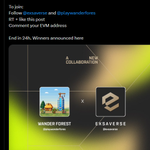
We’re announcing our collaboration with @playwanderfores
We’re giving away 5 GTD spots and 15 FCFS.
To join:
Follow @exsaverse and @playwanderfores
RT + like this post
Comment your EVM address
End in 24h. Winners announced here

DropForge retweeted
🌲 SAGE × WANDER FOREST GIVEAWAY IS LIVE!
We're bringing the SAGE fam 7 GTD + 5 FCFS spots for the upcoming Wander Forest NFT mint!
🏡 Free mint with 1,111 NFTs supply
🎮 Onchain gaming coming soon to @RobinhoodApp
How to enter:
1. Join Wander Forest Early Access.
wanderforest.com/waitlist?re…
2. Follow @playwanderfores & @SAGEAIRDROPS
3. Like & RT this post.
4. Drop your EVM address.
Get early access and take your first step into the forest! 🌿
Keep an eye on @playwanderfores for the more details...
Good Luck SAGE FAMILY 🤝

DropForge retweeted
One thing I appreciate about onchain transparency is being able to check things for myself
@grvt_io has a public buyback dashboard where anyone can track the buyback activity
You can check
✅ Amount of GRVT purchased
✅ Percentage of circulating supply
✅ Cumulative tokens burned
✅ Transaction hashes
I like that users don't have to rely only on a post or announcement to know what's happening
Grvt also has an independent execution partner handling purchases on behalf of the Foundation's token issuer
For me, this kind of transparency is worth having especially when a project is building a long term token buyback program
You can track $GRVT buybacks here 👇
grvt.io/exchange/buybacks

DropForge retweeted
What if your money could keep earning even when you're waiting for your next trade?
I've always found it a bit odd that money prepared for trading often earns nothing while waiting
That's why @grvt_io upcoming Grvt 2.0 caught my attention
Here's what's planned 👇
✅ Grvt Earn
Coming in late October with tokenized fixed income strategies targeting yields of up to 11% (not guaranteed)
✅ Stable Funding Perps
Planned for November with stocks FX commodities and indices plus zero trading fees and once daily funding. The goal is 1,000+ markets by December 2026
✅ Yield as Margin
Also planned for November. Eligible earn balances could back trading positions while continuing to earn yield
✅ Grvt 2.0 App
Expected in late November with a redesigned app a unified self custodial balance and the 2027 roadmap
Personally, I'm most curious about Yield as Margin because it could change how traders manage capital instead of keeping separate funds for earning and trading
And bringing all these products together in one app is what makes the roadmap worth following for me
I'm really excited for Grvt 2.0 and looking forward to seeing these new features go live 🫡

DropForge retweeted
happy sunday all :)
in cryptography , a mathematical proof of an idea can be a major achievement, but several important questions remain before it can be used in a real product.
does the method work correctly under practical conditions ???? how much does it cost to run ?? and can developers and users work with it without unnecessary complexity ??
this distinction is especially important for projects like @primus_labs , because the value of technologies such as zkTLS does not depend solely on the correctness of their cryptographic foundations, but also on the quality of their implementation and how they perform in the real world.
the first criterion is implementation. a paper may explain the security of a protocol under specific assumptions, but the implementation must preserve those same properties in actual code.
details such as error handling, communication between components , and unusual conditions can affect the outcome.
the second criterion is measurable performance. without independent and reproducible benchmarks, it is difficult to judge the speed, computational cost, or scalability of a solution with confidence.
even if a method is efficient in theory, it may have limitations in real world applications.
the third criterion is auditing and operational use. an audit can help identify vulnerabilities within the scope of the review, but it does not guarantee that the entire system is free of flaws.
similarly, releasing a product or running a test implementation does not , by itself, demonstrate that the service is reliable at scale and over the long term.
to evaluate Primus, it is better to examine these forms of evidence separately , scientific research, code and implementation , independent test results, and evidence of sustained use in real world products.
the main point is this: a scientific paper shows that an idea may be theoretically sound, but product readiness requires more evidence.
the true value of a technology becomes clearer when its performance, cost, security, and reliability can be measured under practical conditions.
happy weekend all...
in the design of cryptographic infrastructure, a single approach is not always the best choice for every situation.
sometimes speed matters more, while at other times , preventing data manipulation is the main priority. the challenge is that every choice comes with its own costs and limitations.
this becomes particularly important in zkTLS, a technology that allows data from a web service to be made available to other applications in a verifiable form without revealing sensitive information.
@primus_labs offers two methods for running zkTLS sessions . MPC and Proxy. both are available to developers through a single API, but they work differently.
in the MPC method, the user and the observer or Attestor participate in a secure multiparty computation process to generate the information needed for the TLS session.
this design limits the user ability to manipulate data before the Attestor returns the key share. for this reason, it is a notable option for scenarios where data integrity is highly important.
in the Proxy method, the Attestor sits between the user and the server and records the communication traffic.
the user then uses a cryptographic proof to demonstrate that they know the plaintext of the recorded messages.
this method is faster and has lower computational overhead, but it also comes with an important assumption: we need to be confident that the Attestor has actually established a connection with the intended server.
Primus uses QuickSilver in both methods to reduce computational and communication costs.
in the Proxy method, optimizing the proofs for TLS key derivation functions also helps improve performance.
however, explaining a technical optimization is different from proving a product actual performance.
in the reports reviewed, no independent and reproducible benchmark comparing the speed and cost of these two methods was available.
the value of Primus design is not that MPC is always better than Proxy, or vice versa. rather, these two methods are designed for different priorities.
one application may prefer to limit opportunities for fraud, while another may need higher speed.
ultimately, a unified API is valuable when the choice between these methods is made based on clear criteria.
to make a more accurate judgment, we need to compare the performance of both methods under real world conditions, in addition to examining their cryptographic architecture.

DropForge retweeted
Been seeing a lot of token buyback announcements lately but @grvt_io now has an actual completed one to show
1.1M ethereum:0xad29f2723fcdbcf665f210f25e06f97477e417cf bought from the open market and permanently burned in its first buyback
The amount was nearly 1% of circulating supply at the time
For me, this is what real execution looks like.
A few details caught my attention:
✅ The buyback used a portion of the app's gross profit
✅ The tokens were burned through the GRVT contract's burn() function
✅ The first purchase represented nearly 1% of circulating supply at the time
✅ Every round can be checked through the public buyback dashboard
What I find worth following is the connection between actual product activity and the token
Grvt is allocating a portion of app gross profit toward buybacks. Future rounds are intended to happen monthly, but they're still discretionary
Of course, a burn alone doesn't tell the whole story
I'll be watching how it grows its product and whether it can keep generating the business activity behind this program
A promising start from Grvt and I'm rooting for the team to keep delivering

DropForge retweeted
EverMagic Giveaway — Season 0!
🎁 Join @PlayEverMagic for a chance to win exclusive WL spots and in-game benefits!
💰 Season 0 Prize Pool: $11.5K
🎮 Official Launch: October 20
🎟 15x GTD Spots
🎫 30x FCFS Spots
📜 How to enter:
✅ Follow me + @MirStriker + @PlayEverMagic + @evervaluecoin
❤️ Like & Retweet this post
👥 Tag 3 friends
📩 Drop your Arbitrum (EVM) address in the comments
➡️ Join our Discord: discord.gg/GrtBJt4Ct


DropForge retweeted
Honestly, feels like only jeeters are winning in the NFT space lately
I minted Everdraw for $120, and it never came back to its mint price, current top offer is just $24
Recently minted PTSD for $30 too, and it’s already down around 50%
The worst part is that I actually put time and effort into getting WL for both projects. After all that grinding, watching your mints lose this much value is frustrating
Gaming NFTs are looking especially rough lately. Holders are taking heavy losses, and it’s getting harder to stay optimistic
I think free mints are the only ones worth it nowadays, while paid mints feel too risky
Wdyt?


DropForge retweeted
happy weekend all...
in the design of cryptographic infrastructure, a single approach is not always the best choice for every situation.
sometimes speed matters more, while at other times , preventing data manipulation is the main priority. the challenge is that every choice comes with its own costs and limitations.
this becomes particularly important in zkTLS, a technology that allows data from a web service to be made available to other applications in a verifiable form without revealing sensitive information.
@primus_labs offers two methods for running zkTLS sessions . MPC and Proxy. both are available to developers through a single API, but they work differently.
in the MPC method, the user and the observer or Attestor participate in a secure multiparty computation process to generate the information needed for the TLS session.
this design limits the user ability to manipulate data before the Attestor returns the key share. for this reason, it is a notable option for scenarios where data integrity is highly important.
in the Proxy method, the Attestor sits between the user and the server and records the communication traffic.
the user then uses a cryptographic proof to demonstrate that they know the plaintext of the recorded messages.
this method is faster and has lower computational overhead, but it also comes with an important assumption: we need to be confident that the Attestor has actually established a connection with the intended server.
Primus uses QuickSilver in both methods to reduce computational and communication costs.
in the Proxy method, optimizing the proofs for TLS key derivation functions also helps improve performance.
however, explaining a technical optimization is different from proving a product actual performance.
in the reports reviewed, no independent and reproducible benchmark comparing the speed and cost of these two methods was available.
the value of Primus design is not that MPC is always better than Proxy, or vice versa. rather, these two methods are designed for different priorities.
one application may prefer to limit opportunities for fraud, while another may need higher speed.
ultimately, a unified API is valuable when the choice between these methods is made based on clear criteria.
to make a more accurate judgment, we need to compare the performance of both methods under real world conditions, in addition to examining their cryptographic architecture.
Happy Friday guys ;)
in technologies based on cryptographic proofs, the main focus is usually on whether the validity of data can be verified without revealing the data itself to others. but from a product perspective, that's not the whole story.
every proof has to be generated, and this process can require computational resources, information exchange, and time. so even if the result is cryptographically valid, one important question remains, how much does it cost to generate this proof ???
this also matters for @primus_labs . improvements in cryptographic methods become practically valuable when they are not just faster on paper, but also reduce actual execution time and costs. because ultimately, technology that cannot keep up with a product needs will struggle to be adopted at scale.
Join us
s.kaito.ai/7F6dI7N

DropForge retweeted
Happy Friday guys ;)
in technologies based on cryptographic proofs, the main focus is usually on whether the validity of data can be verified without revealing the data itself to others. but from a product perspective, that's not the whole story.
every proof has to be generated, and this process can require computational resources, information exchange, and time. so even if the result is cryptographically valid, one important question remains, how much does it cost to generate this proof ???
this also matters for @primus_labs . improvements in cryptographic methods become practically valuable when they are not just faster on paper, but also reduce actual execution time and costs. because ultimately, technology that cannot keep up with a product needs will struggle to be adopted at scale.
Join us
s.kaito.ai/7F6dI7N
gPrimus guys ;)
one of the challenges in designing the economy of a crypto project is why people should want its token. is it because they actually need it to use the network , or because they hope it will become more expensive in the future ???
these two types of demand can exist side by side, but there is an important difference between them. demand that comes from actual product usage depends on how useful the product is, while demand based on expectations can decline quickly when market sentiment changes.
in the design proposed for @primus_labs , there are two potential uses for the token, paying fees for services and staking tokens by Attestor node operators.
in the first case, demand depends on the use of data verification and computation services. in the second, nodes need collateral to participate in the network. if these use cases are implemented in practice and actual network usage grows, they could create sources of demand tied to the protocol operations.
but there is an important point, according to our research report, at the time it was prepared, the PRIM token had not yet been officially introduced, and no official tokenomics document had been published. so these should be viewed as the project proposed design, not as an economy whose details have all been finalized and implemented.
points campaigns can attract a lot of users, but the number of participants alone doesn't show whether they will continue using the product after the incentives end.
for Primus, the main test is whether services such as data verification and PoR can generate sustainable demand, demand that exists even without the promise of rewards or the expectation of an air d rop.
a strong token economy doesn't just need people who want the token, it needs a product whose use creates actual demand.
that is why, before judging PRIM economy, we need to wait for official tokenomics information and clearer evidence of the protocol usage and revenue.
