

Changing the future requires understanding the present. Email us: [email protected]
VBA Code Editor
Joined January 2024
- Tweets5.9K
- Following289
- Followers9.4K
- Likes12.1K





Waller (Fed), 28 Jul: "If core inflation keeps climbing, the Fed's rate-setting committee will need to consider hiking rates in the near term."
Fed funds futures price +45 bps of hikes over 12 months, per CME. That keeps mortgage rate relief off the table through 2026.

China-to-US container rates hit a 2-year high at $7,500/FEU on the West Coast lane, per Freightos, as shippers frontload ahead of tariff changes.
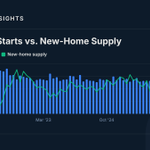
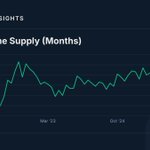
The 21st Century ROAD to Housing Act became law July 10, the most significant federal housing legislation in 36 years, per NACo. Housing starts fell 8.7% YoY to 1.18M units in May, per Census via FRED. New home supply stands at 10.3 months. The 30-year fixed sits at 6.49%.

Trump's 20% Hormuz toll lasted less than 24 hours. He scrapped it Tuesday after Gulf talks, replacing it with trade agreements. The naval blockade continues, per SCMP.
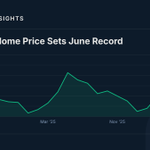
Existing home sales fell 2.4% in June, per NAR. The median sale price hit $440,600, a record for the month.

California AB 179 signed Monday cuts affordable housing costs by $60,000 to $70,000 per unit, per Gov. Newsom's office.
June CPI came in at 3.5% YoY, per BLS, down from 4.2% in May. The 0.7-point deceleration precedes the Hormuz-driven oil gains that have yet to show up in CPI.

Active listings hit 1.10M in June, up from 948K in March, per Realtor.com via FRED. Months' supply for existing homes is 4.6, within range of pre-pandemic norms after two years below 3.
The shortage narrative that dominated housing coverage in 2024 has largely resolved on the supply side. Inventory is rising and the listing bottleneck that kept prices firm is loosening.
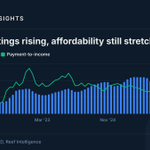
What hasn't changed is what buyers can afford to finance. At a 30-year rate of 6.49% and a median existing home price of $440,600, the nominal monthly payment is $2,037, per Reef Intelligence. Reef's affordability index shows that payment at 29.2% of median household income.
Transactions won't recover through inventory alone. The affordability gap closes through income growth or a meaningful rate drop. Neither is imminent.

The Strait That Froze the Rate Path
The US-Iran ceasefire collapsed over the July 7-8 weekend when Iran struck three commercial vessels in the Strait of Hormuz. US Central Command launched roughly 170 strikes over two nights; Iran retaliated against US installations in Kuwait and Bahrain. Tanker owners are clearing the Gulf as Hormuz transits stall.
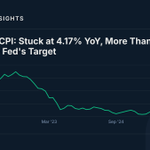
Headline CPI already sits at 4.17% year-over-year through May, per BLS, more than twice the Fed's 2% target. The Fed has held rates since January, and a sustained Hormuz energy spike compounds the inflation problem, pushing any rate cut further off.
That pressure appeared in Treasury markets within days. The 10-year yield moved from 4.38% on June 29 to 4.56% on July 8, per FRED, an 18-basis-point climb. The 30-year fixed for the week ending July 9 came in at 6.49%, per Freddie Mac. Reef's affordability index, the monthly mortgage payment as a share of median household income, stands at 29.2%, a level that has kept transaction volumes near cycle lows for most of the past two years.

University of Michigan consumer sentiment hit 44.8 in May, per FRED, its lowest since at least 2000, below the 2022 rate-shock trough (50.0) and the 2008 GFC low (55.3).


New-home supply hit 10.3 months in May, per Census, well above the roughly six months that marks a balanced market and a level historically tied to housing downturns.

Connecticut's active listings are down 69% since May 2019, the steepest drop of any state, per Realtor.com. Home values rose 72% over the same span, per Zillow.

Capping Credit Card Rates
President Trump has ordered credit card companies to cap credit card interest rates at 10% beginning January 20th, 2026.
Here are five reasons why this is nonsensical:
1. Capping interest rates on credit card debt would require explicit statutory authorization from Congress.
2. Credit cards are unsecured, which is why interest rates are set so high. Capping rates does not remove risk; it simply forces lenders to reevaluate their underwriting standards.
3. Even if this were to go into effect, which would require Congress to pass legislation, credit card companies would simply reduce the amount of credit they issue. After all, a company is not going to retain the same level of risk for a lower level of return.
4. If President Trump were to issue an executive order, it would be immediately challenged in court, and any reasonable judge would find the order unconstitutional, as this authority resides with Congress.
5. Again, even if this were to go into effect, because credit card companies would restrict access to credit for millions of Americans, many of these individuals would seek out other forms of credit, such as payday loans or buy-now-pay-later (BNPL) products. These sources of credit also carry high interest rates.
This post on Truth Social reflects a well-understood reality: President Trump either does not understand, or does not respect, the constitutional separation of powers that limits presidential authority, particularly with respect to regulating the private sector.

Fannie Mae, Freddie Mac, and MBS
President Trump has ordered these government-sponsored agencies to purchase $200 billion in mortgage-backed securities (MBS).
As of today, the Federal Reserve holds roughly $2 trillion in MBS on its balance sheet.
In other words, if this were to take place, the U.S. government would increase its stake in MBS by nearly 10%.
Unfortunately, this does not tackle the real issue: home prices are simply overvalued.

Reef Insights retweeted
If a price rises in the woods, but no economist is there to record it, does it count as inflation?
The Cold Labor Market
Since peaking at 12 million in March 2022, job openings have continuously declined.
In fact, dating back to 2000, we have never seen such a prolonged period of decline in job openings.
Not to mention that sites like Indeed and LinkedIn host ghost jobs, which are job postings that are not real or are no longer open.
A report from ResumeUp found that 27.4% of all U.S. job listings on LinkedIn are likely ghost jobs, while an internal review from Greenhouse, another online hiring platform, found that 18% to 22% of job posts were ghost jobs.
Although it might seem that the job openings chart below could be skewed by the rise of ghost jobs, that’s unlikely to be the case.
Official statistics on job openings in the United States are compiled by the Bureau of Labor Statistics through the Job Openings and Labor Turnover Survey (JOLTS). The survey counts only job openings that meet the following criteria:
- A specific position exists and work is available for that position
- The job could start within 30 days
- The employer is actively recruiting outside candidates
Here is an excerpt from from the Bureau of Labor Statistics:
"These criteria mean that if employers answer the JOLTS questionnaire honestly, the job openings measured in JOLTS are unlikely to be ghost jobs. Many of the potential incentives for ghost job postings do not apply to JOLTS reporting. For example, JOLTS reporting is confidential, so signaling or messaging through reporting would be fruitless. The Bureau of Labor Statistics monitors survey data for discrepancies between job openings and new hires. There may be ambiguity, however, in the intensity of active recruiting to fill a position."
This isn’t to say that ghost jobs haven’t become problematic for job seekers, or that the labor market hasn’t significantly cooled, as it has over the past few years.
What're your thoughts on the current state of the U.S. labor market?

The Impact of AI on the Job Market
This video segment is from a video posted ten years ago, and its message is more relevant than ever.
Over the past year, numerous forecasts have suggested that AI will replace millions of jobs, so we wanted to take a look at how things have already begun to change.
Researchers at the AI startup Anthropic are warning that the next decade could be challenging for some workers, as AI rapidly advances and begins replacing desk jobs. They predict that widespread automation of white-collar work could occur within just a few years.
So, what are we seeing so far?
Tech Jobs
Ironically, software developers—the very people who helped create AI—may be among the first to see their jobs impacted by its adoption.
Many tech companies—as well as the IT divisions of firms across various industries—are now hiring about half as many software developers as they once did, according to Kye Mitchell, head of Experis U.S., the tech hiring arm of staffing giant ManpowerGroup.
In many cases, AI is taking over basic software development tasks, while data architects, data scientists, and AI coaches are responsible for setting up the data and training the AI to work with it, Mitchell explained. Although many developers are being retrained for these more advanced roles, the shift is resulting in fewer entry-level positions in the short term and fewer opportunities for recent graduates.
In March, Shopify’s CEO told his managers that he was implementing a new rule: before requesting additional headcount, they had to prove that AI couldn’t do the job as well as a human.
A few weeks later, Duolingo’s CEO issued a similar directive and went even further, announcing that the company would gradually phase out contractors and replace them with AI.
Blue-Collar Jobs
Because robotics has not kept pace with the rapid development of AI, blue-collar jobs are currently more insulated from replacement.
This isn’t to say such work can’t be automated in the future—but for now, it’s easier to have AI program a web application or analyze 10,000 documents than to have a robot shingle a roof.
Notably, this comes at a time when the trades are already facing challenges due to an inadequate supply of workers. The construction industry, in particular, needs to attract about half a million new workers in to balance supply and demand, according to a recent report by Associated Builders and Contractors.
The Need for Policy
What solutions have been proposed to support workers displaced by AI?
That’s a question policymakers need to be seriously considering, as this potential outcome may soon begin to take shape.
At present, several approaches have been proposed to support displaced workers. Some of the most discussed include:
- Universal Basic Income (UBI)
- Negative Income Taxes
- Job Guarantee Programs
- Taxing AI and Automation
Conclusion
Over the next decade, if AI begins displacing segments of the workforce, we need to start planning now.
If you still believe that displaced workers will simply transition into new roles, we encourage you to watch the full video by @cgpgrey titled Humans Need Not Apply.
The widespread adoption of AI could have profound implications for our future and fundamentally reshape the employment landscape. Without proactive planning, millions of individuals could face job loss through no fault of their own.
Home Construction Contraction
Our Housing Pipeline Index has been contracting since December 2023.
The only other time since 1995 that we’ve seen this type of contraction was during the Great Financial Crisis.
Additionally, this indicator typically precedes a housing downturn, as it began contracting nearly two years before the previous one.
The Housing Pipeline Index is derived by subtracting the 3-month rolling average of housing completions from the 3-month rolling average of housing starts.
In other words, it reflects homebuilder sentiment by comparing new housing starts with new housing completions.
As of September 2025, the index measured -219,000. Again, the only other time it has been this low was during the Great Financial Crisis.
Due to affordability challenges and a buildup in supply, many homebuilders have been reducing new housing starts, leading the index to contract for nearly two years.
In our view, this is a problem that won’t be resolved anytime soon, as affordability issues persist. Additionally, new tariff policies have increased the cost of new home construction, while mortgage rates remain elevated compared to 2021 levels.
Ultimately, as home prices continue to decline over the next year, this will place additional pressure on homebuilders as margins erode. Unless median household incomes rise meaningfully or mortgage rates decline substantially, homebuilders will likely continue to pull back on new housing starts.
What're your view on the current state of the U.S. housing market?
