

Repacked Wax is vintage baseball, basketball and football cards in classic wax wrappers. Follow us on Twitter and visit https://nitter.gq/t.co/u529Co22Ku to see more and buy.
Ohio
Joined November 2019
- Tweets6.2K
- Following3.5K
- Followers1.7K
- Likes1.2K




🔫🍺 In a move that would make Boba Fett proud, Bob Kammeyer was once said to have collected a cash bounty to drill former New York Yankee Cliff Johnson with a pitch.
And even though he didn't know it at the time, it was his final game as a Major Leaguer. So why the hell shouldn't he have taken the money and gotten drunk? It's what Billy Martin said he wanted, after all.
On September 18, 1979, the Yankees were getting absolutely destroyed by Cleveland. Johnson, who had been traded away earlier that season after a clubhouse fight with Goose Gossage left Gossage with an injured thumb, had already homered twice against his former team. And by the fourth inning, Cleveland was up 10-0.
Enter rookie Bob Kammeyer, who at this point had just 21 innings of big league experience under his belt. Kammeyer proceeded to have one of the more spectacularly disastrous pitching appearances you'll ever see. He faced eight batters, allowed seven hits, hit Johnson with a pitch and was eventually charged with eight earned runs all while getting nobody out.
As Kammeyer left the game, manager Billy Martin reportedly handed him five $20 bills.
Witnesses later claimed Martin had ordered Johnson knocked down and that the $100 was a reward for following orders. Martin admitted giving Kammeyer the money but denied it was a bounty.
His explanation? He wanted Kammeyer and two other Yankees pitchers who had been shelled that night to go out, “get drunk and forget about today,” then come back ready to pitch again.
If you ask us, this sounds completely plausible consider we're talking about Billy Martin.
Cleveland won 16-3, and Kammeyer never appeared in another Major League game. Kammeyer returned to Triple-A in 1980, went 15-7 with a 2.91 ERA, threw 13 complete games and was named International League Pitcher of the Year. Then he retired.
Glasses up in memory of Bob Kammeyer. 🍻
#BillyMartin #Yankees #MLBhistory #BaseballHistory #BaseballCards #RepackedWax

Most players would be flattered to be traded for a future Hall of Famer. Eric Plunk maybe felt a little differently the second time he was traded for Rickey Henderson.
Plunk, who turns 63 today, was originally drafted by the Yankees in 1981 and developed into a strong pitching prospect in their farm system. In December 1984, New York sent him to the Oakland organization as part of the five-player package that brought Henderson to the Yankees. Fair enough. Rickey was already one of baseball’s biggest stars and Steinbrenner wanted to bring in more superstar talent alongside guys like Mattingly and Winfield to build a contender (good luck with that, George).
Then, four and a half years later, it was like déjà vu all over again. By June 1989, Plunk was in his fourth season with the A's, but Oakland wanted Henderson back to beef up its already potent lineup. And once again, Eric Plunk was part of the deal, this time going from the A’s back to the Yankees while Rickey headed home to Oakland. Plunk later joked that if Rickey would just retire, maybe he could finally stay in one place.
Thus is the life of a journeyman middle reliever. Plunk wound up pitching 14 Major League seasons, appearing in 714 games with a 3.82 ERA and more than 1,000 strikeouts. He also pitched in four postseasons.
What is the strangest or most memorable player trade you can recall?
#EricPlunk #RickeyHenderson #Yankees #OaklandAs #BaseballHistory #1980sBaseball #BaseballCards #RepackedWax

⚾ Mike Greenwell 9, Seattle 8.
On Sept. 2, 1996, Greenwell drove in every single Boston run in a 9-8, 10-inning win over the Mariners.
2-run HR. Grand slam. 2-run double. Then the game-winning RBI single in the 10th.
Nine RBI. All nine Red Sox runs.
What makes it even more memorable is that this came near the end of Greenwell’s final MLB season. Injuries had taken their toll, and after a brief stint in Japan in 1997, he retired at just 33.
Greenwell passed away last year at only 62, but the Gator won’t be forgotten.
What’s your favorite Mike Greenwell memory?
#MikeGreenwell #RedSox #RepackedWax

⚡ If you've ever joined a two-strike clap, Ron Guidry may be part of the reason.
On June 17, 1978, Guidry struck out 18 Angels at Yankee Stadium. As the strikeouts piled up, fans began standing and clapping whenever he got to two strikes on a hitter. The rhythm caught on, became part of the atmosphere at Yankee Stadium, and eventually spread throughout baseball.
Guidry finished that season 25-3 with a 1.74 ERA and won the Cy Young unanimously. Topps commemorated the 18-strikeout game on this 1979 Record Breaker card.
Happy 76th birthday to Louisiana Lightning. #RonGuidry #BaseballCards #RepackedWax

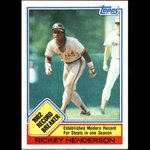
On Aug. 27, 1982, Rickey Henderson stole No. 119, breaking Lou Brock’s MLB record - even after Milwaukee called for a pitchout. He finished the night with 122 and the season with 130. His 1983 Topps Record Breaker captured the moment. #RickeyHenderson #BaseballCards #RepackedWax

For a few remarkable weeks in the summer of 1980, baseball fans were watching something they hadn’t seriously seen in decades: A legitimate run at .400.
On August 26, George Brett went 5-for-5 against the Milwaukee Brewers, collecting four singles and a double as Kansas City won 7–6. The huge day pushed Brett’s batting average to an astonishing .407 - the highest point of his season.
And this wasn’t just a brief hot streak. Brett had already put together a 30-game hitting streak, during which he batted .467, and he remained at or above .400 deep into September. As late as September 19, he was still hitting exactly .400.
By the end of his career, Brett would have 3,154 hits, three batting championships in three different decades, an MVP Award, a World Series championship and a place in Cooperstown. But on August 26, 1980, none of that was finished yet. Baseball fans were simply wondering: Could George Brett actually hit .400? For a while, it sure looked like he could.
He ultimately finished the season at .390, winning the American League batting title and MVP Award while leading Kansas City to its first World Series appearance. No American or National League player since Ted Williams hit .406 in 1941 has finished a season at .400.
Our question for you is, do you foresee anyone ever again flirting with (or finishing above) .400 as summer turns to fall in the final month of the season? #baseballcards #MLBhistory #baseballhistory #RepackedWax

Do you need or do you got it?
Few baseball cards from the junk-wax era are instantly recognizable from across the room. 1990 Score #BoJackson card 697 is one of them. The card shows Bo in full football shoulder pads and eye black, casually holding a baseball bat across his shoulders against a stark black background.
No action shot. No stadium. No elaborate design. Just Bo.
The photograph, taken by Richard Noble, became one of the defining images of the entire #BoKnows era, when Jackson seemed almost superhuman - a Major League Baseball All-Star with the Kansas City Royals who was simultaneously running over defenders for the Los Angeles Raiders. Score understood exactly what it had.
The front combined Bo’s two sports into one unforgettable image. Then they doubled down on the back, where instead of making his statistics the centerpiece, the card simply screamed: BO - The “B” was Royals blue and the “O” was Raiders black, and it was perfect.
In the summer of 1990, when most new cards were worth pennies, the Bo Jackson #697 reportedly reached double-digit prices in Beckett and became one of the cards kids desperately hoped to pull from packs of 1990 Score. There was even a rumor that the card was short-printed, although it wasn't. Like most cards from the #junkwax era, there were plenty made. But scarcity wasn’t what made this card special. The image did.
Bo Jackson was unlike almost any athlete America had seen. In 1989 he had been an MLB All-Star and All-Star Game MVP. That same year, he rushed for 950 yards for the Raiders despite playing only 11 NFL games. For a brief period around 1989–90, Bo wasn’t simply a star athlete, he was a cultural phenomenon.
Nike’s famous “Bo Knows” campaign turned him into one of the most recognizable athletes in the country, and this card captured that moment about as perfectly as cardboard possibly could. Then came the devastating hip injury in January 1991 that effectively ended his NFL career and changed the trajectory of his baseball career.
That makes #697 almost a time capsule - a snapshot of the brief moment when it seemed there was absolutely nothing Bo Jackson couldn’t do. More than 35 years later, the card remains enormously popular. It isn’t valuable because it’s rare. It’s valuable because collectors still want it, and that may be the best definition of an iconic baseball card.
What do you say? Is 1990 Score Bo Jackson the most-recognizable (and desirable) card of the era? #baseballcards #baseballhistory #MLBhistory #RepackedWax

🐝🐝 On August 23, 1998, #BarryBonds became the first player in Major League history to record 400 home runs and 400 stolen bases. Facing Florida Marlins pitcher Kirt Ojala in the third inning, Bonds drove a 1–1 pitch into the right-field seats at Pro Player Stadium for career home run number 400. He entered the game with an incredible 438 stolen bases, creating a statistical combination baseball had never seen before.
He was already a three-time National League MVP, one of baseball’s premier power hitters, an elite base stealer and an eight-time Gold Glove-caliber outfielder. He had essentially combined two different superstar archetypes - the middle-of-the-order slugger and the dangerous base-running threat - into one player. But, as you know, Bonds was nowhere close to finished.
Bonds eventually became the only member of the 500-home run/500-stolen base club, finishing with 762 home runs and 514 stolen bases. No other player has ever reached even 400 in both categories.
And there was much more still ahead:
⚾ In 2001, at age 36, Bonds hit a Major League-record 73 home runs.
⚾ In 2002, he finally reached the World Series, hitting .471 with four home runs and an astonishing 1.994 OPS in the seven-game loss to Anaheim.
⚾ He ultimately won a record seven National League MVP Awards.
⚾ He became MLB's all-time leader with 762 career home runs.
⚾ Pitchers increasingly chose not to challenge him at all. Bonds finished with MLB records of 2,558 walks and 688 intentional walks, including a staggering 120 intentional walks in 2004 alone.
His career remains one of baseball's most debated because of his connection to the performance-enhancing-drug era, and that controversy has (perhaps unfairly) kept him out of the Hall of Fame to date. But the breadth of his ability - power, speed, patience, defense and longevity- remains undeniably extraordinary.
So, what do you think? Is the call to the Hall for Barry way overdue? #baseballcards #MLBhistory #baseballhistory #OnThisDay #RepackedWax

🎂⚾ Happy Birthday to #PaulMolitor, who celebrates number 70 today. For such an iconic rookie card featuring a pair of Hall of Famers (Alan Trammell, bottom left pane), Molitor's 1978 Topps RC has to be one of the all-time worst looking rookie cards of any superstar in the last century.
Card #707 was part of Topps’ “Rookie Shortstops” subset and somehow managed to squeeze four players onto one card: Molitor, Trammell, Mickey Klutts and U.L. Washington. In hindsight, having two future Hall of Famers on the same rookie card should have made this one of the most visually memorable cards of the 1970s.
Instead, it looks almost like Topps was trying to hide them.
Molitor’s tiny portrait is especially rough. His image was dark and airbrushed, and even the National Baseball Hall of Fame has described the result as giving him a somewhat “zombie-like” appearance. Trammell doesn’t fare much better, and the cramped four-box layout leaves very little room for any of the players to have much visual presence.
Then there’s the printing.
The entire 1978 Topps set is notorious among collectors for poor centering, miscuts, diamond cuts, print defects and smudging, but the Molitor/Trammell rookie is one of the worst offenders. The black “ROOKIE SHORTSTOPS” printing across the top is especially prone to smearing, and collectors have long noted how difficult it is to find an otherwise clean copy without some kind of print flaw. (To quote Michael Scott on The Office "and there's the smudgeness...")
That was fairly typical of the 1978 issue. The set expanded to 726 cards, was printed in one series and featured a relatively plain design compared with some of Topps’ more colorful 1970s releases. The basic look - white border, large photo area, cursive team name and small position baseball - was clean enough on regular cards, but it did the crowded rookie cards no favors.
Ironically, the set itself was loaded with rookie talent: Eddie Murray, Jack Morris, Lou Whitaker, Lance Parrish, Dale Murphy, Molitor and Trammell all appear as rookies or rookie prospects in 1978 Topps. That makes it one of the more important baseball sets of the decade, even if Topps’ quality control left plenty to be desired.
And Paul Molitor certainly deserved better. He went on to collect 3,319 hits, win a World Series MVP award and make seven All-Star teams. Yet his rookie card looks like four passport photos accidentally printed on the same piece of cardboard. Maybe that’s just part of its charm. #baseballcards #MLBhistory #baseballhistory #baseballbirthdays #RepackedWax

Looking more like Frank Zappa's brother from a different mother than a fireman pitcher, on August 21, 1982, Milwaukee Brewers legend #RollieFingers recorded the 300th save of his career, becoming the first pitcher in Major League history to reach the milestone. Fingers closed out Milwaukee’s 3–2 victory over the Seattle Mariners, adding another chapter to a career that helped redefine the importance of the relief pitcher.
A 7-time All-Star who led the league in saves three times, Fingers finished his 17-year career in 1985 with a then-record 341 saves and a 2.90 ERA. He also was a key member of the Oakland A’s dynasty that won three consecutive World Series championships from 1972–74, and he was named World Series MVP in 1974.
In 1981, his first season with Milwaukee, Fingers produced one of the greatest seasons ever by a reliever: 28 saves, a 1.04 ERA, the American League Cy Young Award AND the AL Most Valuable Player Award.
And, of course, there was that unmistakable Zappa-esque handlebar mustache, originally grown as part of an Oakland A’s promotion in 1972 before becoming one of the most recognizable looks in baseball history.
Fingers was elected to the Baseball Hall of Fame in 1992. #baseballcards #baseballhistory #MLBhistory #OnThisDay #RepackedWax

🚂🔥⚾ On August 20, 1974, #NolanRyan turned in one of the most dominant losing performances in baseball history. Pitching for the California Angels against Detroit, Ryan went 11 innings, allowed just four hits and one run, and struck out 19 batters. And somehow, he still lost as the Angels were shut out, 1–0.
Even more remarkable: it was already the third time that season Ryan had struck out 19 batters in a game. Just eight days earlier, he had fanned 19 against Boston. Games like this are an important part of the Nolan Ryan story.
We remember Ryan for the seven no-hitters, 5,714 strikeouts and blazing fastball. But for much of the early prime of his career, he pitched for Angels teams that simply did not score many runs. Consider this - in 1972, Ryan went 19–16 with a spectacular 2.28 ERA and 329 strikeouts. Yet the Angels scored only 454 runs - just 2.93 per game, the fewest in Major League Baseball. In 1973, Ryan went 21–16 with a 2.87 ERA and an incredible 383 strikeouts, finishing second in Cy Young voting. In 1974, he won 22 games despite playing for a 68–94 last-place team whose offense ranked near the bottom of MLB in runs, RBI, slugging percentage and OPS.
The August 20 game tells the story perfectly: Ryan pitched 11 innings of one-run baseball, struck out 19…and received zero runs of support. And it raises one of baseball’s great “what if?” questions. How many games would Nolan Ryan have won if the prime years of his career had been spent pitching for a powerhouse?
Ryan ultimately finished with 324 career victories, already one of baseball’s legendary totals. But put the young Ryan behind the offenses of clubs like the 1970s Reds, Orioles, Dodgers or Yankees, and it isn’t difficult to imagine dozens more wins. That doesn’t mean every loss was the offense’s fault. Ryan’s wildness and walks could hurt him, too. But the numbers make one thing clear: during several of his best pitching seasons, Ryan often had an extraordinarily small margin for error. #baseballcards #baseballhistory #MLBhistory #OnThisDay #RepackedWax

🪮💈⚾ Who had most fantabulous hair in the history of the game of baseball? The 1970s had some of the best of the best. But the 80s and 90s had some real American heroes, too.
Our nominees: #RonWashington #EddieMurray #NeonDeionSanders #PeteRose #GormanThomas and #OscarGamble. But tell us who you think wears the crown for the best do. Maybe we missed someone!
Be sure to include a pic of your favorite, preferably in baseball card form. But the winners really are all of us because they're all absolute gold. These are men of style and distinction with hair of such caliber we may never see grace the field again. #baseballcards #vintagebaseball #baseballhistory #vintagebaseballcards #RepackedWax

One of the most significant stories of the 1987 Major League Baseball season was 23-year-old #MarkMcGwire, who became one of the biggest superstars in baseball that summer, breaking the rookie home run record held by #FrankRobinson and Wally Berger on August 14, and going on to smash a devastating 49 bombs by season's end, a number he wouldn't reach again until 1996 (and 97 and 98 and 99!).
The mark has since been passed by #AaronJudge in 2017 and #PeteAlonso in 2019, not that either event generated the kind of fanfare that McGwire earned.
Every kid was scrambling to get their hands on McGwire's cards back then. Of course, we loved this 87 #Donruss for its closeup in an #OaklandAthletics uniform, but the real holy grail was the 1985 #Topps Team USA card, preferably a Tiffany version. #Baseballcards #Baseballhistory #MLBhistory #RepackedWax

🐍 Was it a curse? Big #BobHorner was tearing up the National League in 1983, batting .303 with 20 home runs and 68 RBIs when, on August 15, he broke his wrist while sliding in a game against the San Diego Padres at Atlanta's Fulton County Stadium, ending his season.
Fans quickly blamed the curse of Chief Noc-A-Homa (apologies for the insensitive mascot name), which, legend had it, would bring misfortune to the #AtlantaBraves and their players if the chief's tipi was ever removed from the outfield stands.
For example, in 1982, the Braves opened the season with a 13-game winning streak. Looking to boost ticket sales and seating capacity, owner Ted Turner had the tipi removed and the Braves promptly lost 19 of their next 21 games. It so happened that the chief's domicile was missing the day Horner was hurt, too.
Who's to say what causes bad luck in baseball? For more than a century there have been rumors of curses across the league, from Fenway to Wrigley.
Do you believe in sports curses, and, if so, which one is your favorite to talk about and/or do you believe in? #baseballcards #baseballhistory #MLBHistory #RepackedWax

⚾ On August 12, 1964, #MickeyMantle hit home runs from both sides of the plate in the same game for the 10th time in his career, setting a new Major League record.
Batting left-handed against Ray Herbert at Yankee Stadium, The Mick launched an absolute MONSTER over the 461-foot marker in center field, landing some 15 rows into the bleachers - an estimated 502 FEET from home plate. Later, Mantle turned around and batted right-handed against Frank Baumann…and homered again.
Mantle's career home runs 443 and 444 helped the Yankees to a 7–3 victory and gave him yet another place in the record books. One game. Two sides of the plate. Two home runs. Just another day at the office for Mickey Mantle.
In a way, it was a bittersweet moment. 1964 marked the final season where the Mick still performed like a superstar. It was the last year he batted .300, hit 30+ HRs or had 100+RBIs. Just 32 years old, Mantle also led the American League with a .423 on-base percentage. He'd play four more seasons but never recapture the spark that made him a legend.
Who do you feel is the greatest switch-hitter of all time?
#baseballcards #Justthe60s #Yankees #BaseballHistory #MLBHistory #Sportshistory #RepackedWax

🏀 When you're absolutely hammered and you and your buddies are arguing over who's the greatest of all time. #basketball #basketballcards #waxpacks #RepackedWax 🏀

In our opinion, 1975 #Topps was the last truly visually stunning/beautiful set the company produced until 1987, which itself was a polarizing design that you either love or hate, just like the 75 set.
It also was one of the last sets with a bunch of stars from the 1950s who were in the twilights of their careers, like #HankAaron, #AlKaline, #BobGibson and #HarmonKillebrew. We just love the use of color and the variety of color schemes. It's one of our all-time favorites.
We also figured out why Hank is shown in profile instead of facing the camera. After breaking Babe Ruth's HR mark in 1974, Aaron returned to Milwaukee and signed with the Brewers for the 1975 season. We had never really considered they used the shot so they didn't have to try to airbrush a poorly rendered Brewers logo onto Aaron's cap.
Which vintage (pre-2000s) sets do you think are the most visually spectacular? #baseballcards #waxpacks #RepackedWax

A two-hit day is no big deal for most players not named Mario Mendoza. But two hits in the same day for two different teams? That's a little unusual. But that's what #JoelYoungblood managed to do with the #NewYorkMets and #MontrealExpos on Wednesday, August 4, 1982.
Youngblood - who played 14 seasons of big league ball between 1976 and 1989 - cracked his first single in the third inning of the Mets' game versus the #ChicagoCubs at Wrigley Field, a game the Mets ultimately won 7-4, thanks in part to Youngblood's 2 RBIs.
Shortly after driving in those two runs, Youngblood was traded to the #MontrealExpos for pitcher #TomGorman and removed from the game (#MookieWilson would take his spot in center field and go 1 for 3 on the rest of the day).
So, Youngblood caught a flight to Philadelphia in time for the Expos' night game against the Phillies. The Expos pulled Jerry White from right field and Youngblood managed to get one at-bat during the game, a single.
The Expos lost, but not for lack of effort from Youngblood, who traveled 785 miles just to get his second hit of the day!
Do you recall any unique situations created by mid-game trades? Share a story if you do. #baseballcards #baseballhistory #MLBhistory #RepackedWax

⚡🐦 It's really difficult to fathom how great of a base stealer #VinceColeman was if you weren't there to witness it. Coleman exploded onto the scene at age 23 in 1985, burning up the base paths en route to winning the National League Rookie of the Year.
By August 1, 1985, Coleman had already broken the rookie stolen base record as a member of the #StLouisCardinals, picking up his 73rd and 74th sweeps against the Cubs that day. He had two months left to play though and would go on to swipe 110 bases that season, followed by 107 in 1986 and 109 in 1987.
He remains the only player in the modern game to steal 100 or more bases in 3 consecutive seasons. Not even #RickeyHenderson could match that accomplishment.
Coleman also led the NL in stolen bases for six consecutive seasons (1985-90)! It was a shame to see injuries and some really stupid behavior basically derail his career trajectory starting in 1991, after which he would never again play a full season.
Coleman retired in 1997 at age 35. His 758 career stolen bases are still good enough for sixth all-time. Had he kept his head on straight and not had to deal with injuries, he certainly could have caught Lou Brock in second place and even could have challenged Henderson's 1,406 mark, although we aren't sure anyone is capable of catching Rickey.
Who was your favorite speed demon back in the day, and would you like to see the stolen base play a bigger role in the modern game? #baseballcards #MLBhistory #baseballhistory #RepackedWax
