

CEO & co-founder @Serellium. Federal market intelligence for American industry.
Washington, DC
Joined July 2022
- Tweets1.7K
- Following1.2K
- Followers2.4K
- Likes2.4K





Last week, the White House issued a proclamation warning that the U.S. lacks sufficient domestic production capacity for industrial machinery critical to national security.
We decided to look at what the federal govt itself is buying in this space.
@serellium analyzed ~$880M in federal contracts for metalworking machinery and related equipment from FY23–FY26. About 89% came from the Dept of War.
A few findings that stood out to me:
35% ($310M) involved foreign participation. $163M went toward foreign-made equipment, while another $147M went to foreign-owned or registered firms supplying U.S.-made equipment.
The domestic market is highly concentrated. Of 789 domestic vendors, just 52 captured 80% of the $571M in domestic obligations.
The median domestic vendor received just $52K in total obligations over the four-year period. Hundreds of companies participate, but a relatively small group captures most of the dollars.
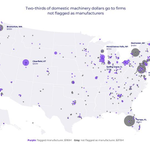
Two-thirds of domestic spending ($376M) went to firms not flagged as manufacturers in federal contract records. Some may manufacture equipment, but others are distributors, resellers, or integrators.
Awarding a contract to an American company doesn't necessarily mean we're building more equipment in America.
And if we're serious about strengthening our defense industrial base, we need to understand who actually manufactures these products, where they're made, and whether those companies can increase production.
I also think there's a significant opportunity here for American manufacturers that have never considered supporting federal missions.
Many already have the capabilities. What they often lack is visibility into which federal agencies buy what they produce, who currently supplies it, and how to break into those purchasing channels.
That's a big part of what we're working to solve at Serellium.
We published the full analysis, including a geographic look at the domestic supplier base, here:


The defense industrial base is carrying more demand right now than at any point in recent history. Meeting today’s national security priorities will take far more American businesses & capabilities than the ones currently in the market.
Here’s the gap I see slowing progress.
A lot of American companies want to contribute to the DIB, support national security, and support federal missions. Most of them can’t see where they fit. They know what they build or what service they deliver. What they don’t have is a clear view of which agency buys it, how it gets bought, and who already holds that work.
At the same time, the govt cannot deliver on its priorities without more participation from American industry. The demand is there. The willing businesses are there. The connection between the two is weak.
That’s the problem @Serellium is solving.
We’re building a capability map of the federal market. We take a company’s discrete capabilities and match each one to real federal demand: the agencies and buying offices that purchase it, the dollars moving, how they buy it, and where a new entrant has a realistic path in.
The goal is to dramatically increase the amount of American businesses contributing to national security, pointed at the right buyers faster.
DOE just dropped its Fall 2026 SBIR/STTR Phase 1 topics, with more than $200M in funding available to small businesses building in energy + national security. Here's a look at the 25 topics:
Topic 1: Advanced technologies for domestic critical mineral extraction, midstream processing, and recycling: small-market minerals like vanadium, hafnium, zirconium. Each proposal must pair a real feedstock provider with a processor
Topic 2: Innovations in manufacturing scale-up for energy applications: production bottlenecks, modular/retrofit platforms, smart manufacturing tools
Topic 3: State-of-the-art tech for industrial competitiveness: energy-intensive industries, cross-sector processes, data center and large load integration
Topic 4: Next-generation building technologies: dual-fuel HVAC, SI/ML controls
Topic 5: Cutting edge generation and power management technologies: hydro, marine, wind and PV recycling, solar thermal, space PV, interconnection, permitting
Topic 6: Advanced transportation and fuels production: fuels from alternative feedstocks, MW-scale fuel cells for data centers, heavy-rare-earth-free motors, off-road and mining powertrains
Topic 7: Battery technologies for dual-use applications: cell-level demos w/ commercial markets and defense uses like UAS, UUV, soldier-carried power
Topic 8: Advanced cybersecurity, resilience, and energy system risk mitigation technologies: OT/ICS security, supply chain assurance, recovery tools
Topic 9: Innovative technologies for hydrocarbons and geothermal energy: modernizing coal mines and plants, oil and gas recovery, produced water sensors, geothermal targeting and storage
Topic 10: Reactor concepts: HTGR/MSR components, liquid metal, sCO2, digital twins, construction cost reduction
Topic 11: Fuel cycle R&D: domestic fuel supply chain, TRISO and advanced fuels, used fuel recovery, materials accounting
Topic 12: Nuclear energy enabling tech: reactor sensors, advanced materials, modeling tools, post-irradiation exam
Topic 13: Advanced technologies for used nuclear fuel and high-level waste disposition: standardized waste packages, dry storage modeling, licensing pathways for DOE’s nuclear lifecycle campuses
Topic 14: Grid innovations to strengthen the electric system's capacity: grid cyber, grid-enhancing tech, microgrids, stationary storage, large load interconnection
Topic 15: Commercializing ASCR/ECP-funded HPC software
Topic 16: Cybersecurity for scientific high-performance computing
Topic 17: Novel instrumentation for X-ray and neutron facilities: permanent magnet accelerator elements, in-situ optics cleaning, neutron mirrors and detectors
Topic 18: Data, synthesis, and characterization strategies for SI-driven materials and molecular systems discovery: ML-guided membranes for critical mineral/REE separation, SI data platforms
Topic 19: Enabling technologies for bioengineering and quantum science-based sensors: field-deployable quantum sensing, quantum bioimaging, Super Intelligence for bioenergy crop engineering, big biological data
Topic 20: Fusion fuel cycle and enabling technologies: tritium handling, fueling, exhaust processing, detritiation
Topic 21: Advanced particle and radiation detectors: ultra-radiopure materials, high-rate detectors, vibration-free cryogenics
Topic 22: High-performance electronics and data acquisition systems
Topic 23: Accelerator science and tech: superconducting magnets, RF power, sources and lasers, diagnostics
Topic 24: Proliferation detection: entangled-photon remote sensing, hyperspectral imagery over water to support monitoring of nuclear-powered ships, radiation detection, radiological source replacement
Topic 25: Nuclear detonation detection: field data acquisition, calibration tools, rad-hard microcircuits
Pitches due Dec. 16.
Yesterday, the Department of Labor opened applications for direct apprenticeship payments, and shipbuilding is front & center.
The shipbuilding piece is a $40M fund dedicated to shipbuilding and the defense industrial base, administered by the Florida Department of Commerce.
Projected to produce nearly 10,000 new apprentices over the next 4 yrs, roughly $4K per apprentice.
Sponsors get $2,000 for each new apprentice who stays 90 days, and up to $6,000 if they meet a strategic priority area.
Applications are rolling until the money runs out.
The reason this is so interesting is because of the sheer growth and opportunity in the federal market for shipbuilding over the coming decades.
The Navy plans to go from 395 ships in FY27 to 450+ by FY31, and wants to move distributed shipbuilding work from 10% to 50%. The FY27 request alone included $65.8B into Navy shipbuilding. The Navy’s own plan says none of it works without major workforce development.
For scale, this $40M fund is about 0.06% of one year of that shipbuilding request. Small $$, but aimed right at the bottleneck.
And that 50% distributed target means machine shops, fabricators, and smaller yards across the country picking up work the primes simply can’t absorb. A $2K to $6K offset per apprentice means a lot more to a 40-person shop than to a prime.
For context, $71B was obligated in shipbuilding and repair federal contracts over the past 3 yrs, and about 66% went to just 5 companies. The demand is about to skyrocket.
Workforce money paid directly to sponsors is one of the few levers that helps new entrants build capacity fast enough to compete.

Quick roundup of Dept of War’s Office of Strategic Capital’s major conditional loan commitments this past month:
1. Wolfspeed (Oct 7): $1.5B for silicon carbide (SiC) wafers, SiC power devices, and gallium nitride (GaN) on SiC wafers. DoW ties these to propulsion, directed energy, drones, electronic warfare, radar, and missile defense
2. PsiQuantum (Oct 8): $150M to expand U.S. advanced manufacturing & prototyping capacity for quantum computing
3. Antheia (Oct 17): $80M to scale domestic production of key starting materials and active pharmaceutical ingredients for generic drugs
4. Stoke Space (Oct 26): $150M toward a second launchpad at its existing Cape Canaveral Space Force Station complex, tied to rising Space Force launch demand
5. Neros (Nov 2): up to $450M to expand vertically integrated U.S. production of small drones, ground control systems, and components like motors, radios, flight electronics, sensors, & batteries
The Dept of Energy's Office of Electricity just opened a $237M funding opportunity called GRID SCALED. It's the 1st round of a Grid Supply Chain Program authorized for up to $375M, aimed at getting more grid equipment into service faster, and to make less of it depend on foreign suppliers.
The money is split into 2 lanes. One's for utilities & refurbishes who can get use equipment back on the grid faster. The other's for manufacturers & suppliers who can replace imported materials w/ U.S.-made ones.
Quick breakdown:
1. Refurbishment & Reuse ($50M, 3-20 awards, $2.5M to $15M each, up to 24 months): Take transformers, breakers, switchgear, reclosers, bushings & other gear that was retired or storm damaged, recertify it & put it back in inventory. This lane also covers recovering copper, aluminum & electrical steel. TRL 8+
2. Alternative Materials & Subcomponents ($187M, 7-50 awards, $1M to $25M each, up to 48 months): Get domestically sourced electrical steel, ceramic bushings, insulation, CTC & copper windings, or battery storage precursors into U.S. production lines. TRL 6+
What's interesting about this one:
Both lanes require at least 50% cost share. Every federal $$ needs a nonfederal $$, & that has to be verifiable when you submit.
This is a demonstration program. Dept. of Energy says plainly that it won't review early-stage R&D or lab work.
Lane 2 requires a team. Applications need a signed letter of commitment from an upstream supplier (feedstock or manufacturing equipment).
This is a quick turn for 7-page concept papers, due Nov. 20, which are required to submit a full application (Feb 2027).
Link in comments:


Quick look at what the federal govt itself buys in this space. Pulled the federal contracts since FY23 that align with the proclamation's scope (machine tools, metalworking, industrial machinery). Here's what stands out to me:
1. $878M in federal contract dollars -- about 92% is dept of war
2. 35% ($310M) went to foreign-made products or foreign-owned firms. $163M paid for equipment made outside the U.S. and $147M went to foreign-owned or foreign-registered firms selling U.S.-made equipment.
3. Product origin alone makes the foreign share look like it's fading, down to about 6% in recent years. But if you count the ownership too it was 51% in FY23, 31% in FY24, 34% in FY25, and 21% so far in FY26.
4. The domestic side is thin at the top. $570M went to 789 domestic vendors. The top 52 vendors hold 80% of the market. The median vendor received only $52k in contract awards.
5. Two-thirds of domestic dollars ($375M) went to firms not flagged as manufacturers in the contract data. One-third ($195M) went to flagged manufacturers.
In fact, the largest single domestic vendor, at 14.5% of domestic dollars, is not flagged as a manufacturer.
So what?
The proclamation points to a domestic base that can’t meet national security demand on its own, with surge production as the test.
In this federal market segment, a handful of firms carry most of the volume, and most of the money flows to firms that sell equipment rather than build it.
Short bench


Yesterday, Dept of Energy released its national battery strategy, along with a new manufacturing consortium. Their targets:
- Fully integrated domestic battery supply chain by 2030
- U.S. leadership in battery tech & manufacturing by 2035
- Faster commercialization of safe, affordable, reliable energy storage
DOE projects U.S. battery demand across transportation and energy storage going from 179GWh in 2025 to 707 kWh in 2035. Nearly 4x in ten years.
The strategy has 6 pillars:
1. Targeted investment in upstream & midstream supply chain
2. Faster commercial deployment of lab discoveries
3. Manufacturing process innovation
4. Mission-driven deployment for grid modernization
5. Coordination with international partners
6. Investment in American talent
DOE also launched the Battery Manufacturing Accelerator (BattMan, why not!), a consortium of national labs, industry & academia led by Pacific Northwest National Lab. Its focus is lowering manufacturing costs, speeding lab to production, and developing battery materials from more abundant domestic elements.
For those in mineral processing, precursors, or component materials: you're at the top of DOE's list.
Process monitoring, quality control, automation & manufacturing data firms, integrators, training providers all have a lane here too.

There's been a pretty significant push by the federal government this year to bring more American manufacturers into the defense industrial base.
We looked at 9 of the biggest moves made in 2026 to expand domestic manufacturing capacity, attract new suppliers, and make it easier for commercial businesses to participate in defense production.
Some of these are getting very little attention outside the defense contracting community. Quick summary:
- Office of Industrial Base Growth: Expanded focus on identifying and developing new defense suppliers, including commercial manufacturers with no previous federal experience.
- LYNX: New digital platform to help businesses assess their readiness for defense work, identify gaps, and connect with potential partners.
- Civil Reserve Manufacturing Network: ~$177M in FY26 funding to identify commercial manufacturers capable of adapting existing production capacity to defense requirements during national emergencies.
- Made in America Loan Guarantee: SBA expanded its International Trade Loan guarantee to 90% for eligible manufacturers, helping improve access to financing for equipment, facilities, and production expansion.
- Reduced SBA Loan Fees: Certain manufacturing loan fees waived in FY26 to lower financing costs for qualifying businesses.
- Smaller War Plants Commission: Established in August to help identify smaller manufacturers, expand access to capital, & address barriers to defense production.
- Priority 8(a) Processing: SBA is prioritizing eligible applicants in 10 defense critical manufacturing industries, including ammunition, shipbuilding, machine shops, electronics, and aerospace components. Only about 1% of current 8(a) participants operate in these sectors
- New SBA/DoW Capital Agreement: Signed in Oct to coordinate financing and potential investment support for businesses expanding critical defense manufacturing capacity.
- Army Manufacturing Rodeo: Planned for early 2027 to stress test manufacturing capacity and supply chains, identify production bottlenecks, and expose weaknesses across the industrial base.
A few major challenges govt is trying to solve at the same time: finding manufacturers outside the traditional defense supplier base, helping them access capital, and figuring out how to expand production capacity when national security requirements demand it.
Most importantly, the full potential supplier base is much broader than companies making weapons or military equipment. It's precision machining, metal fabrication, industrial automation, electronics, batteries, castings, forgings, specialized equipment, and the many commercial capabilities required to support defense production.
These are excellent steps in the right direction, but there's still a serious barrier to entry.
A manufacturer can qualify for a loan guarantee, register on a supplier platform, or pursue a federal certification and still have no idea who actually buys what it makes.
Which agencies are purchasing those capabilities? Which prime contractors control the market? Where is demand growing? How concentrated is the competition? Where could a new supplier realistically get its first opportunity?
These are the problems my company's solving.
Full breakdown of the 9 initiatives in link -- worth a quick read if you're building, investing in, or advising American manufacturing businesses.
Space Force just released Volume 1 of its Space Access Portfolio Vision & Requirements, covering the Eastern & Western Ranges (Cape Canaveral and Vandenberg). 27 requirements, deadlines FY29 thru FY36, and 19 of them due by FY31.
The context is that launch demand is about to outpace what the ranges can handle. In Space Force's own words, the surge "risks turning our ranges into a bottleneck rather than an enabler."
My quick takeaways for investors & companies outside the space sector that might not realize they have a play here:
- The doc says requirements can be met thru commercial assets & commercially procured services, alongside govt-owned systems; as-a-service business models have a door here.
- Commercial providers will have opportunity to plug their own capabilities directly into the range architecture.
- They want to combine private money with public funds using airport & seaport style financing. That needs statutory & policy changes first, but it's worth watching.
- There's no budget, solicitation or contract vehicle in the doc. Treat it as a roadmap. The $$ that follow will tell you how real it is.
Especially interesting for adjacent industries. A big part of range modernization has nothing to do with rockets:
- Energy & water: run multiple major operations without commercial utilities (FY36)
- Construction, rail, port & logistics: receive hardware up to 10m by road, rail, air & sea, and move multiple pieces of flight hardware at once (FY36)
- Industrial gases & commodities: replenish fast enough to support a 12 hr launch recycle, with contractor-supplied commodities named specifically (FY34)
- Counter-drone & security: detect, identify & disable unauthorized air vehicles over the spaceport (FY31)
- Software, data, & cyber: automation for flight safety, onboarding and analytics, one data architecture across both coasts, everything open and native IP by FY36
- Workforce: staffing and training are named as part of how these requirements get met
FY31 will be a significant milestone, with 17 of the 27 requirements landing there, planning & buying decisions happen well before.
Link in comments --

Absolutely wild (in a great way) what SBA did with 8a for small manufacturers last month. This was a huge one a lot of people missed, and I bet most manufacturers have no idea it applies to them. So breaking it down:
On Sept 10, SBA announced that it will prioritize review & processing of 8a applications from small businesses in 10 critical defense areas:
- small arms ammunition
- ammunition (except small arms)
- guided missiles & space vehicles
- other aircraft parts & equipment
- search, detection, navigation, guidance instruments
- other electronic components
- iron & steel mills & ferroalloys
- machine shops
- all other misc. fabricated metal products
- shipbuilding & repairing
8a is an SBA 9-yr federal contracting and business development program for small businesses owned by socially & economically disadvantaged U.S. citizens. As of Sept 10, any citizen who can document that disadvantage can apply. 8a is such a big deal because it offers potential access to sole source awards (up to $8.5M on manufacturing contracts, options included), and limited competition (only among 8a firms) above that.
What's crazy is that of nearly 4,000 active 8a firms, 47 list one of these industries above as their primary NAICS. That's only 1.2%.
In fact, 3 of the NAICS above have ZERO 8a firms: guided missiles, iron & steel mills, and non-small arms ammo.
The $$ tells a similar story. Federal agencies obligated $120.8B in govt contracts across these 10 industry areas in FY26 yet only $120.2M -- million -- went to 8a. For comparison, 8a firms in commercial building construction pulled $1.63B. Billion. Computer systems design pulled $1.62B. Each one, by itself, represents 13X all 10 defense manufacturing industries combined.
So the 8a competition pool in these manufacturing industry areas is tiny, and in 3 of them it's empty, sitting against a $120B+ market the Dept of War is actively trying to add suppliers to.
And the fast track for eligible small manufacturers matters. SBA approved only 65 new 8a firms btw Jan 2025 and June 2026. About 4,190 firms applied in FY25 alone. That wait's been brutal. Defense manufacturers in this codes now get priority.
Small manufacturers still have to qualify for 8a -- 51% owned & controlled by disadvantaged U.S. citizens, personal net worth under $850k, and 2 yrs of revenue in your primary industry (waivable under certain conditions).
Super interesting time to be a small manufacturer relevant to the defense industrial base. Especially for firms in sectors SBA & Dept of War have flagged as priorities: munitions & components, drones, microelectronics, critical minerals, shipbuilding & repair components, sensors, batteries, castings & forgings, textiles.
Here's a snapshot of the major federal moves this yr aimed at pulling more small manufacturers in to meet national security needs:
1. Office of Industrial Base Growth: In January, Dept of War stood up the Office of Industrial Base Growth, which absorbed the Office of Small Business Programs and widened its mandate to new entrants, mid-tier firms & nontraditional suppliers.
2. LYNX: On January 29, DoW launched LYNX, a platform built for new entrants, small businesses & nontraditional suppliers that have the technical chops but struggle to navigate defense requirements & find partners.
3. Civil Reserve Manufacturing Network - $131 million pilot: Created in the FY26 NDAA, CRMN builds a network of commercial manufacturers willing to convert production capacity to defense work during a crisis.
4. Made in America Loan Guarantee - up to $5 million at a 90% guarantee: On March 31, SBA announced a 90% federal guarantee for small manufacturers (vs. the standard 75% under 7a) to finance equipment, facility modernization, inventory, acquisitions & capacity expansion.
5. Manufacturer fee waivers - 0% upfront fees: SBA, 7(a) & 504 loan programs. Through Sept 30, manufacturers paid 0% upfront fees on 7(a) loans up to $950K and 0% upfront & annual fees on 504 loans. The FY27 fee schedule, effective Oct 1, keeps a 0% upfront fee on 7(a) loans to manufacturers up to $700K.
6. Smaller War Plants Commission: SBA & Dept of War, joint MOU, central coordinating body for small defense suppliers. On August 25, SBA & DoW established the SWPC, named after the WWII-era Smaller War Plants Corporation. The mandate is to pair enhanced SBA guarantees with investment & contracting opportunities, build an inventory of small business production capacity for CRMN, deploy joint teams to remove regulatory barriers, and report regularly to the President.
7. 8(a) fast track for critical defense manufacturers: SBA, 8(a) Business Development Program, 10 priority NAICS codes. On September 10, SBA began prioritizing 8(a) applications from firms in 10 defense-critical manufacturing codes, including:
- ammunition (small arms & other)
- guided missiles & space vehicles
- aircraft parts
- navigation & guidance systems
- electronic components
- iron & steel
- machine shops
- fabricated metal
- shipbuilding & repair
The gap is significant. Only 1.2% of active 8(a) firms are registered in those codes, and three of them have zero 8(a) firms.
8. SBA & Dept of War capital agreement: On October 12, SBA & DoW signed an MOA putting money behind the SWPC. DoW's Economic Defense Unit will identify small defense suppliers that need financing & refer them into SBA's 7(a) & 504 lender networks. SBA will also handle diligence, underwriting & portfolio management for DoW-funded redeemable preferred equity in small & mid-sized firms.
9. Army Manufacturing Rodeo: On October 12 at AUSA, Acting Army Secretary Adam Telle announced a "Manufacturing Rodeo," a race between industrial base partners early next year that will strain the Army's organic industrial base & the broader manufacturing network to find the weak links, fix them & keep iterating.
How many promising technologies never make it into the hands of our warfighters because the companies building them can't figure out how to sell to the govt?
I think about this a lot.
Yesterday, DOE announced nearly $11.1M for 8 energy workforce training projects for jobs supporting oil, natural gas, coal, & geothermal energy industries.
The program is PACT (Partnerships for Academic-Industry Career Training). DOE's Hydrocarbons and Geothermal Energy Office funds 6 projects (almost $8.8M) and the Office of Indian Energy funds 2 (about $2.3M).
Quick summary of the 8 projects:
- New Mexico Junior College, $1.9M: 4-week Digital Field Operations Technician credential covering SCADA, artificial lift diagnostics, and radio/ networking. Devon Energy and Mewbourne Oil are employer partners
- Southern Methodist University + Dallas College, $1.93M: 225-hour field data and infrastructure operations certificate covering oil/gas operations, produced water, GIS/CAD, and field data QA/QC. Diamondback Energy is among the employers
- Somerset Community College (KY), $1.5M: geothermal drilling training from field technician to driller, with the Geothermal Drillers Association, aimed at Appalachia
- UT Rio Grande Valley + South Texas College, $1.5M: produced water technician training in treatment/ recycling, saltwater disposal, and process controls. NGL Energy Partners, Texas Pacific Water Resources, and Western Midstream are partners
- University of Alaska Fairbanks + AVTEC, $1.66M: a 2-yr pathway to train technical education instructors, with Alaska Village Electric Cooperative and Sitka Electric
- San Jacinto College (TX), $298K: energy logistics and GIS, with LyondellBasell, INEOS, and Port Houston
- Leech Lake Tribal College (MN), $2.0M: new GIS certificate plus geothermal instruction in its carpentry program
- Navajo Technical University (NM) + ASU, $300K: nondestructive testing training and an ultrasonic testing lab, for oil and gas, pipelines, power generation, and manufacturing

Veterans Affairs published its approved $2.68 billion in infrastructure projects for Q4 of FY26. I went through the full list, it's ~700 projects at 140 VA facilities, in 49 states plus DC & Puerto Rico. By my count of project descriptions, here's the work that shows up most:
- HVAC, boilers, chillers, and steam: 100+
- Elevator modernizations: 90+
- Infrastructure for the electronic health record rollout: 85+
- Roofing, windows, building envelope: 40
- Electrical: 35
- Fire alarm, security, and nurse call: 33
Biggest states by project count: CA (57), FL (46), PA (44) TX (35), NY (34). Philly and Seattle each have 18 projects.
All part of VA's non-recurring maintenance program, which covers significant repairs & upgrades at existing VA medical facilities. The FY27 NRM budget was $4.8 billion, the largest in VA's history, and VA says it obligated all of it.
Major market for commercial firms with capabilities to support.