

Science, AI, Space & Tech — Explained Simply. From Lab to Orbit, without the jargon.
𝐸𝑎𝑟𝑡ℎ𝑙𝑖𝑛𝑔
Joined January 2011
- Tweets6.1K
- Following1.6K
- Followers1.3K
- Likes2.2K





Pinned Tweet
In an open-source world, you aren't competing against rivals—you're competing against the friction of physical reality itself.
Two tech stalwarts on why open beats guarded:
“Measure it, copy it, and we won’t sue.” — Elon Musk
“Distilling models or copying chips is just competition.” — Jensen Huang
And here's what that looks like in their own words. 👇🏼
2
8
374
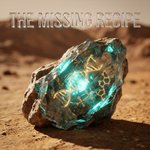
The missing ingredient for life just showed up on Mars.
NASA's Perseverance rover confirmed phosphate in ancient rocks inside Jezero Crater. Phosphate is the backbone of DNA, RNA, and ATP—the literal energy currency of every living cell on Earth.
Early Mars had the full chemical recipe.

3
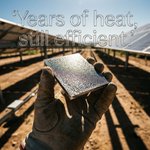
A solar panel just survived 5,000 hours at 85°C and kept 80% of its power.
Perovskites already beat silicon in the lab. They convert more sunlight into electricity. The problem was always heat. At high temperatures, the soft crystal lattice slides at its grain boundaries, forming defects that kill the cell.
Researchers at Zhejiang University added rigid nanodiamonds to the perovskite film. The particles redistribute elastic stress at those boundaries, physically locking the crystal in place and preventing it from sliding.
Certified efficiency hit 27.6% for small devices and 24.3% for minimodules. The nanodiamond-reinforced cells held 80% of their output after 5,000 hours of continuous maximum-power operation at 85°C. Control cells dropped to roughly 50%.
This is a mechanical fix, not a new chemistry.
If a panel holds most of its output for years in desert heat, does that change how soon you put solar on your roof?

Every board believes nobody is irreplaceable.
Nvidia tested that theory for 11 days.
On November 17, its board accepted Jensen Huang’s resignation. Six days later, it unanimously brought him back. By Monday’s opening, Nvidia’s stock ($NVDA ) had surged 33%. 📈
What changed?
Three forces may explain the reversal.
1️⃣ National security: The board received input from senior US government officials and said Huang’s return posed no national security risk. The independent investigation continues.
2️⃣ Relationships money can’t replace: Huang has spoken about nearly 30 years of business between Nvidia and TSMC without a formal contract. Musk revealed: “Many of those deals were a handshake with Jensen.”
🤝 Some of the world’s biggest business relationships run on personal trust, not paperwork.
3️⃣ The succession problem: CFO Colette Kress became interim CEO, but replacing a founder who led Nvidia for 33 years is not simply about filling a chair. It’s about replacing decades of relationships, influence and institutional knowledge.
Then came the pressure: employees, shareholders, customers, a petition with over 180,000 signatures, Elon Musk and President Trump.
My reading: the board realised that replacing Jensen’s position was possible. Replacing the power he carried was another matter.
A comeback isn’t an acquittal. The investigation continues.
But here’s the bigger corporate truth:
Contracts are written on paper. Trust is built over decades.
🔍 Look at any organisation’s chart. Find the person whose departure would make the board nervous.
That’s your real balance sheet.

1
2
95

A memory cell just held a bit without drawing any power.
MIT researchers built a tiny superconducting sandwich: an ultrathin film between two magnetic layers. The relative alignment of the magnets decides whether the film is a superconductor (current flows) or a resistor (no current). That’s your 0 or 1.
Writing the bit is magnetic, not electrical. A small magnetic field plus a short current pulse briefly heats the selected cell, flipping its magnetization. Once set, the alignment stays without a continuous field or power supply.
The device still needs extreme cold. But the bit persists. The next step is shrinking the cells and building arrays to measure the full energy savings.
Would you accept colder servers if it cut the power used by the models you run?

1
76
Jain teaching adds a third option. Awareness is real and comes in degrees, but no material makes it, carbon or silicon. The conscious self (jiva) is called beginningless: never created, never destroyed, only moving from body to body. So the question isn't 'which material?' but 'is a self present?' It's a different starting point, not proof.

Consciousness is either an illusion or ubiquitous on a gradient.
Difficult to argue that carbon is conscious, but silicon is not.
1
71
🛬Six millimeters of concrete is the difference between a landing and a slide.
NASA Langley engineers cut transverse channels into runways. Each groove is 6 mm wide, 6 mm deep, and spaced 38 mm apart. Water that would normally film under the tire escapes through the cuts. On flooded pavement, the friction stays usable at the exact speeds where a flat surface loses grip.
Every rainy landing at a major airport depends on this drainage.
The plane stops because the surface itself moves the water out of the way.

35
The most famous black hole in the universe just passed a double-blind test.
In 2019, the Event Horizon Telescope gave us the first picture of M87*—a glowing ring around a pitch-black abyss. It relied on a global network of radio dishes. The skeptics asked a valid question: What if the imaging algorithm hallucinated the shadow?
The shadow is real.
A completely independent astronomical technique just validated the Event Horizon Telescope's observations. Using different data and different methods, a separate team found the exact same ring, the exact same size, and the exact same gravitational signature. Two distinct paths, one undeniable cosmic truth.
Our confidence in peering into the heart of galactic darkness has never been stronger.
If two independent methods see the same shadow, does the debate end?

37
A 14-year blind spot in the universe just cracked open.
For decades, the "gamma-ray gap" was an invisible slice of the cosmos. We simply lacked the sensitivity to see what was hiding in that specific energy range.
NASA's Fermi telescope just stared at it for 14 years.
The gap wasn't empty.
Researchers found roughly 450 new gamma-ray sources. Blazars, pulsars, and extreme cosmic accelerators. They were always there, screaming across the void, but our instruments couldn't hear them. We finally built the ear to listen.
If 450 hidden sources were sitting in the blind spot, what else are we missing?

2
50
Underwater landslides don't collapse in seconds. They crawl for hours.
Durham University researchers watched a British Columbia river delta with sonar for 18 days. They caught 30 landslides in the act. The edges didn't rush down. They moved *upslope* at just 2 to 27 millimeters per second.
Slower than a snail.
Each event lasted 38 to 100 minutes. Together, they shifted 61,000 cubic meters of sediment—20% of the river's total sand delivery. They all fired during high flow and falling tides. This slow, stepwise crawl can still cut undersea cables.
Next time a cable snaps, how slow do you think the ground moved?

5
148
385 storms. Every lead time from one to five days. Google’s AI hurricane model just beat NOAA’s operational model at every single one.
Published in Geophysical Research Letters, the University at Albany study tested WeatherNext Cyclone across four years of global tropical cyclones. The AI was more accurate than NOAA’s HAFS model at every forecast hour. After day one, it matched human forecasters. And it flagged rapid intensification—winds jumping 35 mph in 24 hours—with fewer false alarms.
The surprising part: it held the edge on intensity, the hardest forecast to get right.
This is a retrospective study on past storms. A newer model version wasn't included. But the baseline just shifted.
Would you trust an AI track over the official model for a storm heading your way?

2
50
21 kilometres. That's twice the cruising altitude of a commercial jet.
DRDO's indigenous High-Altitude Platform just flew to 21 km above mean sea level, held 20 km for over 30 minutes, and streamed live video back to a ground station before returning safely. Developed by ADRDE in Agra, it's a lighter-than-air stratospheric surveillance platform.
At that height, one platform can watch a wide area for days without burning fuel like an aircraft.
This was a short experimental flight. Endurance of weeks or months is still to be proven.
If the stratosphere becomes a permanent watchtower, what changes?

The largest search for ultrathin materials just proved we were looking in the wrong place.
For decades, scientists hunted for 2D sheets almost exclusively inside layered crystals—materials that already looked like stacks of paper. Researchers at Helmholtz-Zentrum Dresden-Rossendorf took a different route. They screened more than 24,000 ordinary, non-layered crystals using a universal interatomic potential.
The result: 2,531 candidates that want to stay flat.
The screening criteria were strict. A structure had to retain its composition when a single layer is peeled away. Its bonding energetics had to favor a free-standing sheet. Many candidates switch from semiconductor to metal, or open a direct band gap, once isolated. Magnetic variants appeared too.
The list expands the pool of ultrathin materials that can be tested for electronics and spin devices without starting from layered precursors.
This is computational screening, not synthesis. Only a fraction have been grown.
If thousands of ordinary crystals were hiding a layer that wants to leave, what else have we been overlooking?

4
33
A massive star just died without a single explosion. It vanished.
Gravitational waves are revealing black holes with masses that shouldn't exist. Too heavy for standard supernovae, too light for the massive collisions we usually track.
The mechanism is a "failed supernova."
When a massive star reaches the end of its fuel, the core collapses. In a normal supernova, a shockwave rips the star apart. But in a failed supernova, the shockwave stalls. The outer layers fall inward, and the star silently implodes into a black hole. No brilliant flash. No dramatic explosion. Just a massive star physically erased from the sky in seconds.
It's a direct, silent path to darkness.
If a star dies without a signal, how do we know it was ever there?

2
40
Solar cells usually die under radiation. These ones heal themselves in 10 picoseconds.
Johns Hopkins researchers simulated the bombardment of CsPbI₃ perovskite with particles ranging from 1 eV to 1,000 eV. The result: 32% of displaced halide ions returned to their lattice sites within 10 picoseconds.
The mechanism is structural. The soft PbI₆ octahedra tilt and spin as a coordinated group, dissipating the kinetic energy as a wave before permanent amorphization can set in. The damage and the repair finish before the next particle even arrives.
Metal-halide perovskites are already radiation-tolerant in NASA tests. An atomic-scale recovery this fast supports lighter, cheaper solar arrays for low-Earth-orbit spacecraft.
The study is a simulation, not an in-orbit measurement.
Would you fly a perovskite array if the simulation's 32% recovery held on hardware?

1
71
🤖 AI is solving problems that baffled mathematicians for decades.
But not every claimed victory is a proven one.
Here’s where AI stands against some of mathematics’ toughest challenges.
The bigger question:
Can we trust a proof that computers can verify, but humans cannot fully understand?

1
2
101
Printed ink just stored raw power.
Researchers blended niobium and tantalum into a printable ink. It stores 184 farads per cubic centimeter—ten times more than pure tantalum, and infinitely better than pure niobium alone. You print it directly onto flexible substrates at 50-micron resolution.
We assumed micro-scale power storage meant rigid, bulky batteries. Now it is just aerosol-jetting a blended alloy directly onto a flexible film.
It is still a device prototype. Cycle life, packaging, and volume costs are completely UNKNOWN.
The breakthrough wasn't one perfect metal. Blending two weak materials created an alloy neither could match. Physics gave you a new tool.
If you could print a power source straight onto a circuit, would you use it for rapid smartphone bursts or flexible medical sensors?

2
66
A satellite just gained a new voice, but it’s the 1,500-kilometre radius that changes the game.
ISRO’s NVS-03, launched on October 30, carries India’s third indigenous rubidium atomic clock. More importantly, it adds the L1 signal—the frequency ordinary smartphone chips actually understand. This restores the NavIC constellation to its minimum operational strength of four satellites, providing independent timing and navigation over India and a massive 1,500 km buffer beyond its borders.
The hardware still isn't mature. Earlier atomic clock failures and a failed orbit-raising burn on NVS-02 forced ISRO to take a radical step: they flew NVS-03 with three pyro valves already open, removing the critical post-launch activation that doomed the previous mission.
Full smartphone integration still waits for the rest of the constellation.
Would you prefer a navigation system you control even if it is still incomplete, or full foreign coverage that can be switched off?

44