
Professor of Psychology; Samford Univ; I study cognition, teaching & learning; See https://xitter.cf/t.co/t8m1IGToF9 and https://xitter.cf/t.co/dfgDPQyfD1; Handbell Ringer
Alabama
Joined January 2014
- Tweets8.6K
- Following215
- Followers3.4K
- Likes13.4K






Stephen Chew retweeted

When students use generative AI to complete academic tasks, they may produce stronger-looking work while quietly skipping the harder processes that build understanding: monitoring, evaluating, questioning, and checking what they actually know.
teachingprofessor.com/topics…

Stephen Chew retweeted

The most important briefings of the day.
Karl Deisseroth, professor of bioengineering and of psychiatry and behavioral sciences, shares the news of his Nobel Prize with his kids.
Stephen Chew retweeted

Sunday Scary’s: if you think you are the only one who has increased anxiety on Sunday evening you are not alone. It’s an interesting phenomenon, I’ve had it for decades and I explain to my medical students and graduate students and postdocs and residents many experience this. Now the @IHME_UW at the University of Washington has measured it and it’s off the charts mhstats.org/blog/global-anxi…
Stephen Chew retweeted

What do highly inclusive teachers actually do? Researchers followed six teachers for a full school year. Much of what they found is surprisingly familiar from research on simply good teaching.
One of the more impressive studies I’ve read lately!
wp.me/p2nWPo-6e7

Stephen Chew retweeted

From LSE
How do students solve unfamiliar biology problems?
This study found students who used core biological principles to guide their reasoning were more successful at developing mechanistic explanations.
lifescied.org/doi/10.1187/cb…

Stephen Chew retweeted
Research on AI and education is exploding. Stanford's repository has already passed 1,500 studies, and even the number of meta-analyses is becoming hard to keep up with.
But are we really learning that much more? This blog has an AI problem.
wp.me/p2nWPo-69H

Stephen Chew retweeted

Does size really matter when it comes to memory? University of Minnesota researchers William Gronewald, Vanessa Lee, and Roger Remington tested how the scale of an object shapes our visual short-term memory.
buff.ly/W7ay19S

ALT Dr. Vanessa Lee and Roger Remington
Stephen Chew retweeted
From grade 1 to grad school, academics have shifted to become mostly virtual. But with online assessments comes online proctoring. Psych emeritus Thomas Brothen created a scale to measure students’ experiences with online exam proctoring.
buff.ly/0YE7Y3k

ALT Dr. Tom Brothen
Stephen Chew retweeted

Police detectives are less accurate than college students at spotting false confessions.
They're also more confident about their assessments of guilt.
What a study reveals about truth, lies, and the criminal justice system. 🧵
Stephen Chew retweeted
Harvard just capped A grades at 20% to fight grade inflation. Is this policy measuring intelligence, or is it secretly doing the exact opposite?
The hidden flaws behind this policy will surprise you.
🔗 Read the full blog post here: teachingprofessor.com/topics…

Stephen Chew retweeted
Teaching isn't just about delivering information, it's about creating the right conditions for learning.
Teaching isn't just about delivering information, it's about creating the right conditions for learning.
👇
teachingprofessor.com/topics…

Stephen Chew retweeted
After more than 40 years in higher education, one professor revisited the advice he gave first-year students over three decades ago and discovered something remarkable: it still holds true today, even in the age of AI.
Read the full blog:
teachingprofessor.com/topics…

Stephen Chew retweeted
Do accessible fonts improve readability? UMN researchers Gordon Legge, Rachel Gage, and collaborators found font choice matters less than text size and contrast for low-vision readers. buff.ly/8t0AeSx

ALT Dr. Gordon Legge and Rachel Gage
Stephen Chew retweeted

A famed police interrogation technique led to infamous false confessions in Nebraska. We still use it. Terrific piece by JJ Harder discussing the declining use of the Reid Technique everywhere (but not in Nebraska). @flatwaterfreep 1011now.com/2026/07/09/famed…

Stephen Chew retweeted

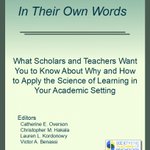
Great teaching adapts as students grow. The Science of Learning, Second Edition, dispels common misconceptions about how students learn and offers practical examples for integrating learning science principles into instruction. deansforimpact.org/tools-and…
Stephen Chew retweeted

The best way to teach complex subjects (like, say, statistics)?
@SChewPsych teaches stats without sophisticated "stats packages." The goal: his students can develop a gritty sense of the specifics on their way to deeper understanding. Check out his thinking here:
bit.ly/4uv1zIm

Stephen Chew retweeted

AI changes feedback on student writing when it knows student race, gender edweek.org/technology/ai-cha…

Stephen Chew retweeted
🎓 Are we teaching for understanding or just racing through the syllabus?
Real teaching isn't about how many topics you cover. It's about what students actually retain, connect, and use.
Depth beats coverage every time. 👉 teachingprofessor.com/topics…

Stephen Chew retweeted

Having said that, I think these diagrams from Prof Stephen Chew at Samford are amazing. SO helpful.
@SChewPsych
theeconomyofmeaning.com/2022…

Stephen Chew retweeted
Cramming works.
That’s the problem.
Students often see it as effective because it delivers short-term results. Enough to pass. Enough to move on.
Read the full blog to rethink how students study and how you structure learning.
teachingprofessor.com/topics…
