

#Sensorimotor #Neuroscience Lab at Simon Fraser University. We study how the brain🧠 uses what it sees👁️. Lab Director: Dr. Dan Marigold. Tweets by Trainees.
Vancouver, British Columbia
Joined April 2018
- Tweets145
- Following762
- Followers831
- Likes535




Sensorimotor Neuroscience Lab retweeted

Brain research is getting a boost at #SFU with a new Institute led by BC Leadership Chair and @SFU_Science professor @ar0mcintosh. This announcement marks a new phase of engaged and impactful #neuroscience and neurotechnology research at SFU. ow.ly/BKvp50Hxegi
#SFUResearch

Overall, we show that experiencing an adverse physical consequence during errors enhances motor memory. This suggests the brain considers the potential physical consequences of movement error when learning and that balance-threatening consequences serve to enhance this process
Furthermore, the consequence group showed increased recall and savings of the learned visuomotor mapping one week later despite exposure to a competing mapping during initial learning—evidence of greater motor memory consolidation

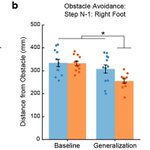
Crucially, we found that learning generalized to a greater extent in the group who experienced the adverse physical consequence. Specifically, this group demonstrated (a) increased interlimb-transfer on a precision walking task and (b) generalization to an obstacle-avoidance task

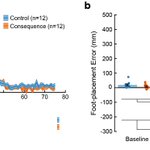
Because of our innate drive for safety, and the fact that balance is fundamental to movement, we hypothesized that the physical consequence would enhance motor memory. We found that both groups experienced similar magnitude foot-placement errors and adapted at similar rates

2 groups adapted to (a) a new prism-induced visuomotor mapping during (b) a precision walking task. Notably, 1 group experienced an unexpected slip perturbation during foot-placement errors. We tested how this physical consequence affected (c) generalization and (d) consolidation

Motor learning involves correcting actions that lead to errors. In most lab settings, such errors have no physical consequences and simply indicate the progress of learning. Here we asked how experiencing a physical consequence during movement errors affects motor learning 🤔
New #preprint from @AmandaBakkum and @SMNLab: “Learning from the physical consequences of our actions improves motor memory.” Mini 🧵👇Please see paper for more details. biorxiv.org/content/10.1101/…

Overall, our results demonstrate the robustness of motor memories formed during walking and highlight the potential influence of balance control on sensorimotor learning.
See the paper for more details doi.org/10.1152/jn.00627.202…
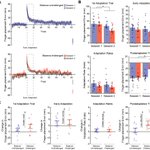
For reaching, we found evidence of initial recall, though neither group demonstrated savings (Fig.1). In contrast, both walking groups showed recall and savings. Additionally, we found that challenging balance enhanced savings during walking (Fig.2).


We found that challenging balance did not disrupt visuomotor adaptation during reaching (Fig.1) or walking (Fig.2). We then probed initial recall and savings (i.e., faster relearning) by having participants repeat the adaptation protocol one week later.


We had four groups of participants (n = 12 each) adapt to a novel visuomotor mapping induced by prism lenses while performing a standing-based reaching or walking task, with and without a manipulation that challenged balance.

Check out our new paper (now in print) with @AmandaBakkum, @maxdonelan, and Dan Marigold in @JNeurophysiol. We asked how the necessity to control balance during adaptation affects savings of learning. Thread👇
Link to paper for more details doi.org/10.1152/jn.00627.202…
Sensorimotor Neuroscience Lab retweeted

#ArticlesInPress "Savings in sensorimotor learning during balance-challenged walking but not reaching"
Amanda Bakkum, et al.
#Locomotion #Adaptation #Neuroscience
@AmandaBakkum @SFU
doi.org/10.1152/jn.00627.202…

Now published in print in @CurrentBiology our latest work with @javidomzam: Motives driving gaze and walking decisions.
Thank you @ssukumar92 and @AlayaAAhmed for their great dispatch (cell.com/current-biology/ful…).
Link to article: sciencedirect.com/science/ar…

Huge congratulations to @AmandaBakkum for successfully defending her PhD yesterday! We are so proud and can’t wait to see what the future holds for you.
This Post is from an account that no longer exists. Learn more
Sensorimotor Neuroscience Lab retweeted

Walking while blindfolded shows the importance of visual cues needed to manage precise foot placement & avoid falling. But how do we make decisions when there is an abundance of visual cues to choose from? Exciting new research from the @SMNLab bit.ly/3qbRz4M @javidomzam

This work formed part of Javier Domínguez-Zamora’s doctoral thesis: @javidomzam
