

Providing inclusive and engaging STEM programming to children and their families from equity seeking groups.
- Tweets46
- Following22
- Followers37
- Likes18





ALT Check out: https://www.earthday.org for more info!


ALT On the first post, the top of the post has the STEMovation logo, and right below is the title “International Day of Persons with Disability” in large text with a graphic of people who are disabled in the middle. On the far right, there is a speech bubble that says, “Let’s focus on a person with disability in the STEM field!.” At the bottom, “December 3” is written in smaller font.

ALT On the top of the post is the title of “Wanda Díaz-Merced.” On the right side, right below the title it says “Astrophysicist from Puerto Rico.” There is a shape in the middle that has two pictures of Wanda on it. Between the pictures, the following is written: “Díaz-Merced was studying math and physics when she first started experiencing blind spots, and by 30, she was blind. It was caused by diabetic retinopathy. Losing her sight could have ended her exploration of space data, but she discovered another way to access, analyze, and interpret space data. She listened to it. Now, Díaz-Merced works with the sonification of digital data. Sonification converts visual data, such as the brightness or frequency of radiation, into audible data, such as pitch, volume and rhythm.” In a small area towards the right is written, “Achievements 2011, won one of Google's first annual European Scholarships for Students with Disabilities.”

ALT On the top of the post is the title of “Learn More!” Underneath there is a yellow box that has multiple resources. The first resource is titled “How a blind astronomer found a way to hear the stars” with the link “https://www.ted.com/talks/wanda_diaz_merced_how_a_blind_astronomer_found_a_way_to_hear_the_stars” and description “Listen to Wanda Díaz-Merced talk about her journey as an astrophysicist who is blind.” The second resource is titled “STEM is for Everyone: Wanda Díaz-Merced, Astrophysicist” with the link “https://www.sciencebuddies.org/blog/stem-for-everyone-wanda-diaz-merced?from=Blog” and description “Learn more about Wanda Díaz-Merced and how she listens to the universe. Many more resources are provided to further educate your students.” The third resource is titled “This Blind Astrophysicist 'Sees' the Universe in the Most Amazing Way | Short Film Showcase” with the link “https://www.youtube.com/watch?v=S8qMpohp23k” and description “Learn more about Wanda Díaz-Merced!”

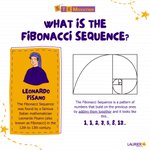
ALT On the first post, the top of the post has the STEMovation logo, and right below is the title “Fibonacci Day” in large text with a graphic of Fibonacci in the middle. At the bottom, “September 23” is writtin in smaller font.

ALT On top of the post is written “Fibonacci Sequence in Real-Life (Examples)”. Below on the right it shows examples of “shells,” “flower petals” and “pinecones.” It then states the following questions, “Can you see the Fibonacci Sequence visual representation in the pictures of the examples above?Can you think of more examples?” On the right it says “Visual representation of the Fibonacci Sequence” with a picture below of the visual and numbers to associate the numbers with the drawing. Below it says, “The numbers are part of the sequence, and start with 1 as the smallest in the centre of the image.”

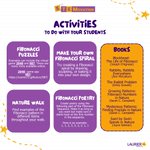
ALT On the top of the post is written “Activities to do with your students.” The first box says “Fibonacci puzzles” & “Examples can include the virtual game 2048 and 987." The second box says, “Make your own Fibonacci spiral” & “Try creating a Fibonacci spiral by drawing, sculpting, or baking it into your own design.”. The third box says, “Nature Walk” & “Find examples of the Fibonacci pattern in different items throughout your walk.”. The fourth box says “Fibonacci Poetry” & “Create poetry using the following part of the Fibonacci Sequence. Make it as long as you want but make sure it starts back at the first number in the sequence. Here is an example: 1, 1, 2, 3, 5, 3, 2, 1, 1”. The books in the list include the following: Blockhead: The Life of Fibonacci, Rabbits, Rabbits Everywhere, The Rabbit Problem, Growing Patterns: Fibonacci Numbers in Nature, Mysterious Patterns: Finding Fractals in Nature, and Swirl by Swirl: Spirals in Nature.


ALT The top of the post is the STEMovation logo, and right below is the title “Happy World Teachers Day” in large text. This is written on top of a chalk board. Below the chalk board is written “October 5.”

ALT On the first post, the top of the post has the STEMovation logo, and right below is the title “Truth and Reconciliation Week” in large text with “September 25-30” written below in smaller font. In a box below, it is written "This week is to take time to honour and commemorate all the survivors and residential schools and all those who did not make it home. Take the time to learn and commemorate the truth of our history from First Nations, Métis, and Inuit knowledge keepers this week. Visit www.orangeshirtday.org to learn more about Orange Shirt Day which is on September 30.” Underneath the box, in smaller font is written, “Orange Shirt Day” and “September 30” with an arrow pointing to an orange shirt.

ALT On the top of the post is the title of “Learn More!” Underneath there is an orange box that has multiple resources. Here are the following resources given, “FNMIEAO: FIRST NATIONS, MÉTIS & INUIT EDUCATION ASSOCIATION OF ONTARIO” with link “https://fnmieao.com/”, "Indian Residential School Survivor Society (IRSSS)” with link "https://www.irsss.ca/“, “Aboriginal Access” with link “https://www.aboriginalaccess.ca/resources/teaching-links/aboriginal-math-and-science”, “RCIScience” with link “https://www.rciscience.ca/indigenous-stem-resources”, “Indigenous Books” with link “https://goodminds.com/”, “IndigeSTEAM” with link “https://www.indigesteam.ca/”, and “Indigenous STEAM” with link “https://indigenoussteam.org/”. In a smaller box, there are Instagram accounts referenced as "Educational Resources" which are “ndncollective”, “illuminative”, “indigenouspeoplesmovement”, and “iiycfamily” which you can find in the description of this post.

ALT On the top of the post is the title “What Can We Do To Prevent Pollution?” Underneath are multiple sticky notes that have illustrations and words which are, “Use less energy”, “Reuse & Recycle”, “Drive less”, “Buy local foods or grow on your own”, and “Use renewable energy.”

ALT On the top of the post is the title of “Learn More!” Underneath there is a yellow box that has multiple resources. The first resource is titled “Pollutions” with the link “https://education.nationalgeographic.org/resource/pollution/ ” and description “Learn more about pollution and pollutants from National Geographic.” The second resource is titled “What is Pollution and The Types of Pollution” with the link “https://www.youtube.com/watch?v=7qkaz8ChelI” and description “Learn more about what pollution is and the types of pollution from an animated show great to show to your students!” The third resource is titled “Pollution Prevention Week” with the link “https://www.epa.gov/p2week” and description “Learn more about Pollution Prevention Week and how you can help!”

ALT On the first post, the top of the post has the STEMovation logo, and right below is the title “Pollution Prevention Week” in large text. Below it is written “September 18-22”. Underneath is an illustration of Earth covered by smoke clouds to show the effects of pollution.

ALT On the top of the post is the title “What is the Pollution?” Underneath is the definition of pollution which is “Pollution is introduces harmful materials into the environment.” There is an arrow that points harmful materials to the word “Pollutants” which has a definition under it, “Pollutants is another name for harmful materials.” Beside it is a picture of an earth with pollutants surrounding it. Under both these items it says “What are some effects of pollutants?” In scattered bubbles is a list which has the following: “global warming”, “animal extinction”, “harmful to human health”, “water pollution”, “reducing sunlight”, and “climate change.”

ALT On the top of the post is the title “What is the Pollution?” Underneath it states the subtitle, “Examples of Pollutants.” It then states the following in the centre of the post, “Pollutants can be both natural and human-made. Natural pollutants are made by the environment. Human-made pollutants are made by humans.” Then “Natural Pollutants” has an arrow to the examples that are shown in illustrations which are “volcanic ash” and “forest fires.” The same is done with “Human-made Pollutants” which has an arrow to the examples that are shown in illustrations which are “factories pollution”, “car exhaust” and “water pollution.”