

Publisher of medieval texts and Christian classics
Joined November 2023
- Tweets4.9K
- Following67
- Followers3.9K
- Likes7.5K



Pinned Tweet
NOW AVAILABLE!
When were the angels created? What kind of fruit did Adam eat from in Paradise? What will the signs of the Antichrist be?
The most celebrated collection of its kind in the Middle Ages, the Questions and Answers to Antiochus the Duke leave no stone unturned. They are now made available in English for the very first time.
Also included in this edition is a translation of the Teachings to Antiochus the Duke, an adaptation of the Shepherd of Hermas for medieval monastics.
Get your copy now:
scriptoriumpress.ca/#antioch…

Did the Council of Elvira preach iconoclasm? 🧵
The Council of Elvira was held in the year 303 in Spain. Since the early 20th century, its canon 36 has been used as evidence that the early church was aniconic. But is this really the case?

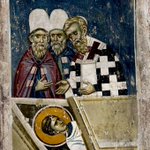
Augustine also recognized the positive use of icons. In a sermon given before the martyrium of Saint Stephen, he exclaims:
"Such a lovely picture this is, where you can see Saint Stephen being stoned, can see Saul keeping the coats of those doing the stoning!" (Sermon 316.5)

Scriptorium Press retweeted

With the Norman conquest of Sicily in the 11th century, the Normans started building magnificent cathedrals, abbeys and castles, as they did in Normandy and everywhere else.
And so, the Norman King William II, called the Good, commissioned the massive Monreale Cathedral on a hill above Palermo in 1174.
His reasons were also strategic. He wanted to display royal authority over the ambitious Archbishop of Palermo, Walter Ophamil, formerly the young king’s tutor, following political rivalry and a dispute over a royal burial.
William II wanted Monreale to be a grand royal pantheon and a powerful religious centre directly tied to the crown, reducing Palermo’s influence.
And indeed, Pope Lucius III elevated Monreale to a metropolitan archdiocese in 1183, giving it authority over territory previously controlled by Palermo.
And so there are two magnificent cathedrals in and above Palermo to admire today.


Scriptorium Press retweeted

Certain sections of even the hostile Libri Carolini, in Book III, Ch. 17, the author suggests that the 'learned' can venerate icons properly, but not the 'unlearned', which admits the theoretical point, at least, of the Seventh Ecumenical Council.
archive.org/details/libricar…

Scriptorium Press retweeted

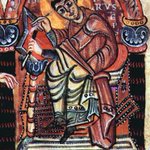
One of the coolest images in any Old English manuscript is that of King David in the Vespasian Psalter, who is depicted holding a lyre.
It’s interesting per se, but becomes doubly important when we compare it to actual Germanic lyres we’ve found, which look identical to his!


👇👇
"The veneration of the saints (including their relics and icons of them) is part of the sacramental nature of the universe and to reject it means you are severely distorting reality and salvation. (i.e. If you get Genesis 1 wrong on Creation, then you will get Revelation 21 wrong on the New Creation and everything in between)."
This is precisely it. The point of Nicaea II was never to show that the Apostles literally mandated Christians kiss portrait icons or they would go to hell (which is a ridiculous Protestant straw-man); the council was concerned with the broader principle of how matter relates to God. How we answer this question directly informs how we think of the sacraments, the incarnation, the nature of the Church, and salvation itself.
Here is what Louth says:
"John [of Damascus]'s defence of icons and their veneration is both far-reaching and fundamental: it makes the icon part of the fundamental fabric of Christian belief, and argues that iconoclasm is more than simply an objection to an isolated devotional practice, but threatens to undermine Christianity itself. In this his defence of icons and their veneration is like Irenaeus’s defence of Christianity against gnosticism or Athanasios’s defence of the divinity of Christ against Arians, or, to come closer to John’s time, Maximos’s defence of the integrity of Christ's humanity against the Monothelites: all these oppose heresy not as an incidental error, but as something that undermines the whole faith." (St. John Damascene: Tradition and Originality in Byzantine Theology(Oxford UP: 2002), p. 219.)

The veneration of the saints (including their relics and icons of them) is part of the sacramental nature of the universe and to reject it means you are severely distorting reality and salvation. (i.e. If you get Genesis 1 wrong on Creation, then you will get Revelation 21 wrong on the New Creation and everything in between)
Ultimately, this icon debate was about two issues "Were icons used for devotional, ritual purposes (i.e. veneration) in the early church?" and "How does the anathema function in councils in relation to heretics and theirr descendents?" So its about the historical record of Orthopraxy as as well the nature of ecclesial authority in relation to heresies.
Of course, the anathema is attached to all sorts of statements of doctrine. (Roman Catholicism has tons of them on very specific details of doctrine such as the nature of the Beatific vision or the Assumption of Mary). Anathematizing heretics is much more focused on them rejecting the true Church and her ancient beliefs/practices.
At the same time, the truth always relates to our participation in Christ (i.e. salvation). This is why we can anathematize those who have a heretical understanding of the Eucharist even if their version is 'close' because the sacraments relate to our salvation and the apostles taught us the way they are to be performed.
That being said, we do have very strong evidence for the existence of portrait icons of Christ and the saints in the earliest centuries, along with prayer directed TO these images, which suggests that "kissing icons" and related devotional acts was indeed part of the primitive deposit of faith, no different than making the sign of the cross.