

A community of thoughtful people exploring science, society, and the arts; diverse topics and formats; small-group discussions with university guest scholars.
Palo Alto, CA
Joined July 2018
- Tweets63
- Following134
- Followers37
- Likes24


Or you just keep on learning. Also good. #learning tinyurl.com/yscytvhc


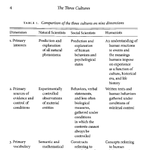
Even as adults, many trained in one discipline are ill at ease with the culture & content of others. But in the right environment, with "cross-training," perhaps this can change. (See Jerome Kagan's 2009 book on Three Cultures, and his interesting chart, christiankull.files.wordpres….)

Semper Curious retweeted

Scott Auerbach, Executive Director of @UMassAmherst iCons, will be presenting 'Can Chemical Complexity Solve the Energy Crisis?' as part of the @SemperCurious seminar series on June 9.

Semper Curious retweeted

What are the greatest stories or biographical facts in philosophy?
Things I have in mind are like the trial and sentencing of Socrates, or out of spite Schopenhauer would schedule his lectures at the same time as Hegel but no one would show up.
Semper Curious retweeted

Today is #WorldPhilosophyDay. Here's one way of thinking about what philosophers do. (Philosophers, please help out by sharing a question.) #philosophy dailynous.com/2019/11/21/phi…
Our first colloquium, "How do relationships get under our skin?" with Dr. Darby Saxbe youtu.be/Oj73Xcjxa-A
Semper Curious retweeted

Better methods can’t make up for mediocre theory nature.com/articles/d41586-0…
Semper Curious retweeted

I got stuck when a student asked if a digital balance measured mass or weight. I wanted to say "mass" - but that's technically not true.
This got me to think about how we make measurements - and most of them are actually distances.
wired.com/story/measurements…
Why is it that we use musical terms to describe feelings and moods? youtube.com/watch?v=0NZCm84t…
Semper Curious retweeted

This amazing graphic shows most of the cognitive biases and organizes them into themes.
But from the lens of evolution, if a cognitive bias increased fitness it it a not a design flaw, but a design feature
onlinelibrary.wiley.com/doi/…

ICYMI: A conversation with Georgetown psychologist Ian Lyons about what it takes to think in numbers youtu.be/q8E3uavJvgw
It turns out that we're most curious when we have just enough background context to make information *significant*, not merely novel. #becurious #alwayscurious
nytimes.com/2019/10/18/opini…

We all know what conscious experience is like, and scientists are getting better at mapping neural activity in the brain—no theory connecting the two has consensus yet, but could a competition help?


In 1919, an experiment pitted Albert Einstein's theory of general relativity against Isaac Newton's gravitational theory and found an ultimate winner.
A new $20 million project is taking inspiration—but with theories of consciousness. fcld.ly/d3hve96
What can yeast tell us about ourselves? Quite a bit, say geneticists.
sempercurious.com/blog/2019/…
This Friday, 3pm PDT, psychologist Ian Lyons discusses the origins of numerical cognition
sempercurious.com/colloquia/…
Questioning the Past: on the use and abuse of ancient texts in modern politics sempercurious.com/colloquia/…
How is the universe like a roll of the dice? @Penn Physicist Jonathan Heckman thinks through quantum probability.
ow.ly/4XJW50vLO28
Tufts economist @LauraKGee on why theoretical models and experimental design really matter.
ow.ly/5f0X50vK3sr
Philosopher Justin Weinberg, @DailyNousEditor, looks at an unusual ethical dilemma and sees an opportunity for philosophical progress.
ow.ly/tPId50vG1bI