
Ph.D. Student @MITEECS. Undergrad @Tsinghua_Uni.
Cambridge, MA, US
Joined October 2023
- Tweets65
- Following413
- Followers713
- Likes90






Pinned Tweet
Excited to co-instruct MIT 6.5940: TinyML and Efficient AI Computing with @songhan_mit this fall!
Looking forward to teaching, learning, and building with an incredible class.
Course site: efficientml.ai


Shang Yang retweeted

Splash 1.3.0 is out, and it's about the wait before your local agent starts answering ⚡
If you switch projects and come back, SSD offloading brings the first token down from 19 seconds to 1.
New tasks start 1.5× faster, thanks to the Neural Engine. All on a 24 GB M6 Mac.
Shang Yang retweeted
⚡ 532 tokens/s!
DeepSeek V4.1 Flash is live on Inco, and it's the fastest provider on Artificial Analysis. #1 output speed. Not close.
Try it: platform.inco.ai/
Results: artificialanalysis.ai/models…

ALT Artificial Analysis output-speed comparison for DeepSeek V4.1 Flash (Reasoning, Max Effort), with 10,000 input tokens, September 17, 2026. Output tokens per second: Inco (FAST) 532, LithosAI 380, Databricks 333, Baseten 289, DeepSeek 211, Novita 174, Fireworks 123, and Parasail 89.
Shang Yang retweeted

Introducing VC-Attention: fast and accurate low-bit attention without retraining.
On MiniMax-H3, VC-Attention speeds up attention by 1.6× on B200 and 1.5× on B300 over FlashAttention-4, with better fidelity than SageAttention2. It also works with existing sparse attention methods.
Two key innovations:
• V-Smooth reduces value quantization error.
• ExpCast-FP8 speeds up softmax.
Nunchux Attention, our proprietary extension, pushes the speedup to 1.9× on B200 and 1.8× on B300.
Blog: nunchux.ai/blog/attention-is…
Technical Report: arxiv.org/pdf/2609.15810
Joint work by researchers at MIT, CMU, UC Berkeley, Stanford, and NVIDIA.
Shang Yang retweeted

Hmm, another inference company topping the leaderboard?
Oh wait, that's us! Speed of light on Artificial Analysis for four major open-source models. ⚡️

Inco AI is entering public beta with the ⚡️ fastest ⚡️ #inference endpoints for #Kimi K3, #MiniMax M3, #GLM 5.3, and #GLM 5.3 Flash.
Ranking Number 1 on the respective @ArtificialAnlys provider leaderboard for output speed.
Read more: inco.ai/blog/inco-platform-a…

Shang Yang retweeted
Nunchux is live at nunchux.ai!
We’re building the frontier of multimodal generative AI inference: fast, affordable, high-quality serving for image, video, and world models.
Our Modelverse brings 30+ image, video, and avatar models behind one API. Use Nunchux-optimized models in Radical Speed and Radical Value tiers, alongside partner APIs. More models are on the way.
We’re opening access through the waitlist now. New accounts get $10 in credits.
Read our launch blog: nunchux.ai/blog/building-the…

Shang Yang retweeted

Open-source video generation is now faster than playback without compromising quality.
Introducing Video Delta Net (VDN): hybrid attention for live text-to-video with near-lossless quality.
VDN accelerates Minimax-H3 by 75 - 90 x, generating 14 seconds of 768p video in 11 seconds on 8× NVIDIA B200 GPUs.
Checkpoints + training/inference code + Technical Blog ⬇️
(1/6)
Shang Yang retweeted
Congrats @Zai_org on the GLM 5.3 open-weight release!
Day 0 from us, in collaboration with the Z.ai team:
⚡ DFlash 2 drafter
⚡ NVFP4 checkpoint
⚡ Live endpoint powered by @TokenRouter_US GB300s
Up to 4.4× the throughput of native FP8 with autoregressive decoding!
inco.ai/blog/glm-5-3

GLM-5.3 is now open-weight.
Our most capable model for agentic coding and cyber defense is now available to download, run, and customize.
Weights: huggingface.co/zai-org/GLM-5…
Tech blog: z.ai/blog/glm-5.3

Shang Yang retweeted

Cool demo from Architect labs. I have been asked a lot on the status of (1) Agent for chip design, and (2) chip design data in mid/post-train. Based on a lot of conversations & experiences, here is the SOTA:
1/N: End-to-End from Spec to an ASIC GDS layout is possible w/ open source PDK and EDA tools. Kimi K3 shows an example at Nangate 45nm; frontier closed source models are equally capable.
2/N: From Spec to FPGA is also no difference as to ASIC GDS as above; also demonstrated in this Architect Labs's demo.
3/N: Frontier model training doesn't really spend efforts on crafting chip design data in mid/post-train; mostly have simple Verilog data (essentially just coding), but no physical design data.
4/N: But all major players are now starting to carefully preparing chip design data in mid/post-train. Because coding is kind of "mature", and STEM is the next. This implies the model next year will be even better on chip design.
5/N: I personally used LLM in 2024, and found it even failed on writing a simple analog Opamp SPICE netlist; similar conclusions drawn by many others. But I encourage people re-try it again now. Based on (4/N) maybe even more in the next year. Things will be very different.
6/N: The bottleneck of agent's capability is not at the front-end writing Verilog, but the back-end using physical design tools, reaching a DRC clean layout satisfying timing. But I don't think this is a fundamental blocker if we incorporate data in post-train.
7/N: The real challenge might be: there is a gap between closed source and open source. For example, can the Kimi K3 demo transfer to TSMC <3nm design? In training, similar issues exist --- Frontier labs mainly can use open source data in the training, and how much it impacts is unknown at this moment.
N=7. Chat with me more if you are interested.

We gave our AI system a spec, and in under 2 weeks, it designed, verified, and deployed a chip that beats NVIDIA.
It’s built for low-power physical AI workloads. We’re running live inference on >B+ parameter models like Llama, Qwen, and Kimi, serving at 3.4x better perf/watt than NVIDIA Jetson.
From just a specification, our AI system autonomously generated all of the RTL Design, UVM verification, formal proofs, firmware, drivers, and kernels, co-designing the model, software and silicon as one optimization loop.
Better AI can now design better chips to run AI, leading to a loop of recursive-self improvement towards our path to abundant intelligence.
Readers added context they thought people might want to know
Architect Labs did not manufacture a physical chip; the design was tested on a commercial AMD Versal FPGA board. Furthermore, the 3.4x perf/watt gain over NVIDIA Jetson is a simulation-based projection for a future 8nm ASIC, not a physical benchmark. businessinsider.com/architect-labs… architectlabs.com/architect-labs…
Shang Yang retweeted

Your gaming PC can now serve frontier models at interactive speed using official checkpoints without extreme quantization!
Qwen3.6 35B → 8GB RTX 4060 laptop @ 39 tok/s
DeepSeek-V4-Flash 284B → RTX 5090 desktop @ 22-25 tok/s
GLM-5.2 753B → RTX PRO 6000 workstation @ 15 tok/s
Run your claude code or codex now with frontier model for $0
Meet FreeToken 🧵
Shang Yang retweeted
DFlash 2 is here! Qwen3.8-27B at 70 tok/s on an M5 Max MacBook Pro.
⚡ Up to 4.6× the speed of autoregressive decoding, with the same output.
This is the next generation of DFlash, seeded at Z Lab and upgraded at Inco AI. Get one more accepted token on every pass, for free!
inco.ai/blog/dflash2/
Shang Yang retweeted

A journey of a thousand Miles is still just getting started...
Over the past few months, we’ve raced to support frontier models on day 0. We’ve worked to give the community recipes that don’t just run once, but can actually be reproduced. We’ve poured a lot of care into building Miles for the long run, keeping the codebase modular, structured, and maintainable as the system and community continue to grow.
Along the way, Miles has been co-evolving closely with @sgl_project and @slime_framework with ideas, lessons, and improvements flowing across rollout, training, and the entire stack.
That’s why we’ve been building Miles around verifiability, correctness, stability, efficiency, and the entire post-training loop.
Proud of the @radixark team and many many community friends. Proud to build this in the open. And very excited for what comes next.
repo: github.com/radixark/miles


Today we're launching Miles v0.1, an open-source RL framework for LLMs and multimodal models.
RL training is easy to start and hard to debug. Miles helps you ensure your run is correct, use hardware efficiently, and keep RL running at scale.
Over the past 9 months, 72 contributors have landed 1,326 commits, 85 GPU E2E CI tests, battle-testing Miles on frontier open models like Kimi K3, DeepSeek V4, Qwen 3.8, GLM 5.2, Inkling, MiniMax H3, etc.
Miles powers frontier-model development and production RL workloads at @humansand, @periodiclabs, @modal, @DecagonAI, @Eigent_AI, @nebiusai, @IBM and more, on both @NVIDIAAI and @AIatAMD hardware.
Here is what we built, and why teams picked Miles🧵
Shang Yang retweeted

Zero Train–Inference Mismatch — now for linear attention, and under async RL 🎯
We got bitwise-exact trainer/generator parity for Gated DeltaNet (Qwen3.5-9B / 35B-A3B) on TorchTitan RL + vLLM, then asked the question nobody had actually tested in open source: does it help async RL?
Two firsts (as far as we know):
1️⃣ First open-source stack to hit train/inference logprob diff = 0 on a
linear-attention model
2️⃣ First to measure what zero mismatch is worth under async off-policy RL
How — smaller than it sounds:
• trainer and generator share one model definition (TorchTitan unified model). No more aligning trainer & generator op by op
• recurrent kernel everywhere on the forward (prefill + decode + trainer), chunked only for backward
• split-K off, batch-invariant GEMM, + a batch-invariant bmm for the MoE router
• we never touch FLA kernel internals — the recurrent kernel is intrinsically batch-invariant: one sequence's own state, fixed order, no cross-sequence reductions
• vLLM's linear-cache management + prefix caching keep working as-is
📊 Qwen3.5-9B + DAPO-Math, async at offpolicy = 4 / 12 / 32:
• logprob_diff = exactly 0 at step 0 ✅ every nonzero after that is staleness, not precision
• at offpolicy=32 the stock stack runs away past 0.065; ours holds ~0.035
• the unified model is free — the entire bill is the kernels
• also verified on MoE 35B-A3B and a 64-turn / 64K-context terminal agent
🤔 Now the honest part: it depends on the config. On math at offpolicy=12, BI leads on train reward and peaks highest on held-out AIME. On the terminal agent it's slightly ahead. On search, and on other math configs, the curves are indistinguishable. What is consistent is the numerics — BI keeps the gap from exploding as you widen the window. Cost: 2–3× trainer throughput (≈5× on the agent).
Our take: bitwise parity is a debugging tool, not a production default. Flip BI on for 20 on-policy steps — if the gap is 0 and your run is still broken, the infra is exonerated and the bug is in your data or your algorithm. That's worth 20 steps, not a whole run.
Next:
• make BI cheap (kill the 2–3×)
• more workloads, more seeds
• stay tuned for more complex agentic training recipes/tests 👀
Full writeup 🔗 yichuan-w.github.io/blog/GDN…
We collaborated closely with the TorchTitan team, and we sincerely encourage everyone to check out TorchTitan RL. With its clean, efficient unified model architecture and native async RL design, we believe it is a strong foundation for your next RL engine.
#LLM #RL #agentic #pytorch #torchtitan

Come check out our work at CVPR! Excited to chat!

We‘ll be presenting ForeAct (🌟Highlight) at CVPR 2026:
📍 Poster: Sunday, 3:30PM, ExHall A #95
📍 NVIDIA Tech Talk: Friday, 12:40PM, Booth #211 @NVIDIAAI
Feel free to stop by and chat! Also find our coffee making demo empowered by ForeAct! (youtube.com/watch?v=kBKJxWUV…)
I’ll be at #CVPR2026 from Jun 4-7. Open to chat about VLA, world models and efficient visual generation!
Shang Yang retweeted

Expert traces can guide RLVR, but full traces may leak key values, executable code, or answer entities — creating an unintended reward-hacking channel.
We propose SMEPO: Semantic Masked Expert Policy Optimization.
Paper: arxiv.org/abs/2605.25198
Code: github.com/mit-han-lab/SMEPO


Shang Yang retweeted

On-policy distillation (OPD) is one of the most effective LLM post-training methods, but it traditionally requires a costly live teacher server throughout training.
In our latest work, Lightning OPD, we show that OPD can be performed fully offline by precomputing teacher log-probabilities before training, reducing OPD to a standard single-model training job.
A key insight is Teacher Consistency: the SFT teacher and OPD teacher must be identical. Otherwise, offline OPD suffers a significant accuracy drop.
Paper: arxiv.org/abs/2604.13010
Code: github.com/jet-ai-projects/L…
Contributors: Yecheng Wu, Song Han, Han Cai


Shang Yang retweeted

Honored to join the MIT President’s podcast. We discussed how Efficient AI and model compression techniques can help break the bottlenecks of AI computing: m.youtube.com/watch?v=XMphi6…

Shang Yang retweeted

We introduce Variance Controlled Policy Optimization (VCPO), a method for explicit variance-targeted controls for policy-gradient objectives in off-policy RL — enabling stable, scalable Async RL training.
✨ Seamlessly integrates into common policy-gradient methods like REINFORCE/RLOO/GRPO 🚀 2.5x faster Async RL training while matching Synchronous RL performance 🧠 Robust training stability under high off-policy settings (at least 128 steps off-policy)
📄Paper: arxiv.org/abs/2602.17616
🔗Code: github.com/mit-han-lab/vcpo
🧵👇

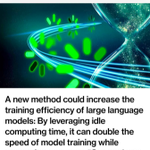
🥳 Thrilled to see our work on TLT featured on the MIT homepage (mit.edu) and the cover of MIT News today! 🏛️✨
🚀 2x faster RL training without losing accuracy.
News: news.mit.edu/2026/new-method…
Paper: arxiv.org/abs/2511.16665
Code: github.com/mit-han-lab/fastr…


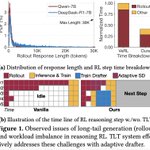
🚀 Introducing TLT (Taming the Long-Tail), an efficient, lossless system that boosts reasoning RL training by mitigating the rollout bottleneck!
🏆 Accepted by #ASPLOS2026
✨ What’s new?
⚡ Enjoy 2× faster end-to-end reasoning RL training
🔒 Lossless on-policy RL — training quality preserved theoretically and empirically
🎁 Get a free, high-quality draft model for efficient deployment
🔗 Github: github.com/mit-han-lab/fastr…
🔗 Paper: arxiv.org/pdf/2511.16665
👇 More in the thread (1/7)
#ASPLOS #EfficientAI #OpenSource #LLMs #Reasoning #ReinforcementLearning

Shang Yang retweeted
Reasoning LLMs generate very long chains-of-thought, so even small quantization errors add up.
With AWQ, Qwen3-4B drops 71.0 → 68.2 on MMLU-Pro (~4% relative loss). 😬
ParoQuant fixes this! It keeps only the critical rotation pairs and fuses everything into a single kernel.
Recovers most of the lost reasoning accuracy with minimal overhead — so 4-bit models stay strong at reasoning. 💪💪