

AI & Robotics curious 🤖 | 3rd grade visual marketer | Pseudo trader | Med Radiographer | Official AMB @Scallop_io | @lofitheyeti
Sui
Joined December 2022
- Tweets45.3K
- Following979
- Followers5.7K
- Likes86.2K




Pinned Tweet
8 speakers.
One question.
"Why Sui?"
Watch what these leaders have to say about sui in the #SuiBasecamp 2026 under 60 seconds:
- @EmanAbio
- @RaoulGMI
- @EvanWeb3
- @linda_adami_xyz
- @Ivantok4
- @HilmarVeigar
- @devrelius
- @LowBeta
Who's pumping $HAEDAL?🚀


What actually happens when you "verify your X account" on @primus_labs AlphaNet?
Step by step ↓
- Open points.primuslabs.xyz?ref=TJ…, connect a wallet, and enable the Primus extension.
For the X task you also follow @primus_labs and repost the campaign post first.
The extension runs the #zkTLS session from your browser.
- You deposit a tiny task fee (~0.000035 ETH on Base) plus gas, because the proof gets stored on-chain.
If the task fails, the docs say the deposit is refunded.
- Primus system contracts take the task and dispatch it to an attestor.
Attestors run inside Phala TEEs, and their signing keys are generated by a key service inside the enclave, so the node software never touches them.
- The attestor and your browser run the zkTLS protocol (MPC or proxy mode) against X's servers.
The proof is generated, stored on-chain, a green icon lights up on your X task card, and your reputation score goes up.
Only whitelisted attestors can join, and the docs say penalties for bad nodes won't arrive on day one of mainnet.
Day 6

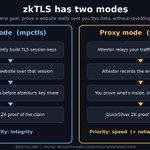
zkTLS isn't one thing.
.@primus_labs ships two modes, and the trade-off matters.
The goal of both is the same: prove that a website really sent you some data, without the website changing anything and without revealing the data itself.
- MPC mode: the attestor and your device jointly create the TLS session keys, so you can't secretly edit the data before the attestor's share arrives.
This mode puts integrity first.
- Proxy mode: the attestor relays your traffic and records the encrypted bytes, and at the end you prove you know what's inside.
It's faster, but it adds an assumption: the attestor must be sure it's talking to the real server.
In both modes Primus uses QuickSilver, an efficient interactive ZK proof system built by its own team.
In proxy mode it also proves the key-derivation step, which Primus says zk-SNARK designs handle inefficiently.
For devs, it's one SDK setting (algorithmType: mpctls or proxytls), and the JS SDK defaults to proxy.
Not everyone agrees on which is enough. Reclaim argues proxying suffices.
Day 6

Silverhard retweeted

Introducing Primus Confidential Finance (dapp.primuslabs.xyz), where privacy meets transfer and yield on-chain.
We're excited to announce a collaboration between Primus @primus_labs, Unitas @UnitasLabs, and United Stables @UTechStables to launch a Confidential Finance Product on @BNBCHAIN, powered by the Fully Homomorphic Encryption (FHE) technique.
This isn't just another confidential transfer or on-chain vault. It's a new standard for how private, compliant, and capital-efficient on-chain finance can work. 🧵

You need "a storage layer, not just the legal receipts layer."
Picture robotics training data: hours of first-person video and touch data recorded by real people, who get paid for it.
A receipt proves who agreed to what.
Keeping the original file is what lets a buyer check that the data they got is the data that was collected.
Trace for the receipt, Walrus for the file.
Rights-cleared data should come with both the paperwork and the proof.
@datafdn @SuiNetwork #DATAonSuiQuest

.@devrelius (Andrea Muttoni, CEO of The DATA Foundation) wrote the case for why DATA is joining Sui.
These lines that stood out to me:
- operating an L1 costs millions annually.
- How much of our engineering effort should go toward maintaining blockchain infrastructure, and how much should go toward advancing the product itself?
- Trace has registered close to 300 million data contributions and now processes over 3 million receipts a day.
- Walrus provides verifiable storage for large datasets and Seal enables secure access control.
- The decision to join Sui is fundamentally driven by what Trace needs to grow.
His analogy: early web companies ran their own servers until cloud providers changed that, and he argues blockchain is reaching the same point.
If every company can become a data company, as he believes, every dataset needs a receipt.
Provenance is what lets data be "verified, licensed, and compensated for."
@datafdn @SuiNetwork #DATAonSuiQuest
Building Trace at scale means making deliberate choices about where we invest our resources.
Joining the Sui stack gives us the infrastructure to grow while keeping our focus on the products and applications driving real adoption.
@devrelius on our next chapter ↓
The whole @datafdn → Sui pipeline in one frame ↓
- Trace: gives every file a receipt (where it came from, what the contributor agreed to).
Live today with 250M+ receipts.
- Seal: encrypts the file behind an access policy checked on Sui, so only an approved buyer can decrypt it.
- @WalrusProtocol: erasure-codes the file across storage nodes, keeping a tamper-proof reference copy.
- Nautilus: runs processing in a secure enclave, with an attestation that can be verified onchain.
- @SuiNetwork: executes it all, then payment goes back to the contributor.
@datafdn @SuiNetwork #DATAonSuiQuest

FYI‼️
Two questions I keep seeing about DATA moving to Sui, answered from the official @datafdn FAQ 👇
❓ What happens to the existing DATA Network?
It will continue operating as usual while we prepare for the transition to Sui.
The migration moves the token and Trace onto Sui infrastructure, and the old standalone chain will eventually be retired.
"No action is required from holders at this time."
❓ When does the migration of DATA to Sui happen?
The transition of DATA to Sui will take place in phases.
@WalrusProtocol is expected to become the default storage layer for DATA Foundation apps within the coming months, with the broader network migration "following a separately announced timeline."
No date has been set yet.
Provenance is only worth something if the record outlives the chain it was written on.
Trace keeps building on the 250M+ receipts already recorded.
@datafdn @SuiNetwork #DATAonSuiQuest

Why is DATA moving to Sui?
.@devrelius, CEO of The DATA Foundation, answered it at Sui Basecamp
His answer is the @SuiNetwork stack:
- @WalrusProtocol to store the original reference file
- Seal so only people with permission can decrypt it
- Nautilus for fine-tuning and inference, further down the line
"All of these components are kind of coalescing to create a full-stack data platform."
My take: a receipt saying data was collected with consent is good.
A receipt you can check against the original file is better, and that is the proof Al training data has been missing.
@datafdn @SuiNetwork #DATAonSuiQuest
DATA is coming to @SuiNetwork.
The DATA Network and Trace are joining the Sui stack, bringing a live supply of rights-cleared AI training data to infrastructure built for AI workloads.
With 250M+ receipts already recorded by Trace, AI labs will be able to source real-world data with verifiable provenance, while @WalrusProtocol provides the underlying storage layer.
Sui Foundation is investing $30 million in the DATA Network, establishing the largest institutional stake in the network, alongside the continuing holdings of PIP Labs and the DATA Foundation. Furthering the alignment, SY Lee, founder of the DATA Network and CEO of PIP Labs, joins Sui Foundation as Strategic Advisor.
In the coming months:
▸ The DATA Network will be upgraded to run as a protocol natively on Sui
▸ Walrus becomes the default storage layer for DATA Foundation apps
▸ $DATA remains the token of the DATA protocol
The next chapter of DATA starts here.

AI learned from everything online.
But nobody kept the receipts.
- Who made the data?
- Who agreed?
- Who got paid?
Usually: unknown.
.@datafdn fixes that with Trace;
An onchain registry where every piece of AI training data gets a receipt showing its source, its rights, and that the contributor was paid.
250M+ contributions are already registered.
Now Trace is joining @SuiNetwork, with Walrus storage coming in the next few months, so data can be checked against the original.
Data with receipts🧾 #DATAonSuiQuest
DATA is coming to @SuiNetwork.
The DATA Network and Trace are joining the Sui stack, bringing a live supply of rights-cleared AI training data to infrastructure built for AI workloads.
With 250M+ receipts already recorded by Trace, AI labs will be able to source real-world data with verifiable provenance, while @WalrusProtocol provides the underlying storage layer.
Sui Foundation is investing $30 million in the DATA Network, establishing the largest institutional stake in the network, alongside the continuing holdings of PIP Labs and the DATA Foundation. Furthering the alignment, SY Lee, founder of the DATA Network and CEO of PIP Labs, joins Sui Foundation as Strategic Advisor.
In the coming months:
▸ The DATA Network will be upgraded to run as a protocol natively on Sui
▸ Walrus becomes the default storage layer for DATA Foundation apps
▸ $DATA remains the token of the DATA protocol
The next chapter of DATA starts here.
zkTLS isn't one thing.
.@primus_labs ships two modes, and the trade-off matters.
The goal of both is the same: prove that a website really sent you some data, without the website changing anything and without revealing the data itself.
- MPC mode: the attestor and your device jointly create the TLS session keys, so you can't secretly edit the data before the attestor's share arrives.
This mode puts integrity first.
- Proxy mode: the attestor relays your traffic and records the encrypted bytes, and at the end you prove you know what's inside.
It's faster, but it adds an assumption: the attestor must be sure it's talking to the real server.
In both modes Primus uses QuickSilver, an efficient interactive ZK proof system built by its own team.
In proxy mode it also proves the key-derivation step, which Primus says zk-SNARK designs handle inefficiently.
For devs, it's one SDK setting (algorithmType: mpctls or proxytls), and the JS SDK defaults to proxy.
Not everyone agrees on which is enough. Reclaim argues proxying suffices.
Day 6
What @primus_labs actually did in the last two weeks:
• 13 Oct: Primus extension updated on the Chrome Web Store
• 14-15 Oct: zktls-js-sdk bumped to 0.3.15 and zktls-core-sdk to 0.3.8 on GitHub, both switching to the production signer address
• 16 Oct: "Transparency proves. Privacy protects." Data hidden by default, only what must be known becomes visible
• 22 Oct: quoted Bankless's Zcash Names episode: "Privacy matters. And so does making onchain data useful without compromising privacy."

Every move counts.
Every item is yours. 🪖
The first fully on-chain tactical MMORPG on sui → @AresRPG
Your adventure starts here ⚔️: aresrpg.world
What @primus_labs actually did in the last two weeks:
• 13 Oct: Primus extension updated on the Chrome Web Store
• 14-15 Oct: zktls-js-sdk bumped to 0.3.15 and zktls-core-sdk to 0.3.8 on GitHub, both switching to the production signer address
• 16 Oct: "Transparency proves. Privacy protects." Data hidden by default, only what must be known becomes visible
• 22 Oct: quoted Bankless's Zcash Names episode: "Privacy matters. And so does making onchain data useful without compromising privacy."
2023: "decentralized credit."
2024: "zkFHE computation network."
2026: "confidential infra for institutional onchain finance."
@primus_labs changed the pitch three times.
The engine under it (MPC-TLS proofs + FHE) stayed the same.
Day 4


2023: "decentralized credit."
2024: "zkFHE computation network."
2026: "confidential infra for institutional onchain finance."
@primus_labs changed the pitch three times.
The engine under it (MPC-TLS proofs + FHE) stayed the same.
Day 4
Your stablecoin works 24/7.
So does everyone checking your balance 👀
@primus_labs fixes the second part: encrypted eU on BNB Chain.
Day 3

Weekly Robotics Dump
- @Tesla started production of Optimus on high-volume lines in Fremont.
These are the first production-quality bots they’ve built.
- @Figure_robot 04 has reached design lock.
Adcock detailed a multibillion-dollar AI push, including 37.5 million human-video uploads and a Helix 3.0 teaser.
- A @Figure_robot 03 walked 348 miles and 1.2 million steps over nine days on a treadmill. Started as a stress test.
- AGCO will pilot @agilityrobotics Digit at its Hesston, Kansas factory starting in 2027.
First tasks: sorting parts, stacking, and tote storage.
- @agilityrobotics is standardizing Digit 5 on @nvidia IGX Thor for onboard compute and human detection.
- @UnitreeRobotics H2-X claims up to 8 hours of runtime.
Demos include kung-fu style moves and security/guardian scenes.
- @GoogleDeepMind used Gemini 4 Argon to teach @Apptronik Apollo new skills by watching video.
- Mitsubishi Electric developed a physical AI system that coordinates a humanoid robot with CNC machines using natural-language instructions.
- @GenerativeBion is planning Europe’s largest physical AI data factory for humanoids, starting with a site in Italy operational by Q4 2027.
- @NEURARobotics showed a 20% lighter 4NE1 Gen 4 and opened RoboGym with TUM.
- @AgileRobots unveiled the ONE SN research humanoid with tactile hands, Jetson Thor, and GR00T software. Availability early 2027.

Weekly Robotics Dump
- @BostonDynamics says it now takes about one day to build an Atlas. Target for 2027 is about one hour.
- @agilityrobotics picked @nyobolt for Digit 5’s battery. 90 minutes of work, 9 minutes to charge. Designed for more than 20 hours in a 24-hour day.
- @agilityrobotics SPAC with Churchill Capital is moving forward. SEC declared the registration effective. Merger vote set for November 2.
- @Tesla filed a patent for touch-sensitive skin that can be molded around robot fingers and palms to detect force, touch and pressure.
- @NEURARobotics released Neuron AI, a multimodal foundation model that gives robots perception and memory.
- @physical_int opened an API beta for robot model training and inference.
- @XPENG_Global says IRON enters mass production late this year, with deliveries in H1 2027 and a European rollout in H2 2027.
- Shanghai set a goal of 8,000 humanoid robots in active factory production lines by 2028.
- @IconBuild raised $200 million for its Titan multi-story construction printing robot. Valuation near $1.4 billion.
- @AGIBOTofficial is reported to be nearing a funding round at a valuation near 50 billion yuan.
- Industry Next opened a 10,000-square-foot Real2Sim2Real Arena with more than 50 robots to generate data for physical AI models. Already partnering with BMW.
- @SkildAI showed robots learning soccer through self-play, using more than 140 years of simulated practice, without human demos.
- @PromiseRobotics signed a multi-year deal with D.R. Horton to support production of 1,250+ homes through its Factory-as-a-Service platform.
Your stablecoin works 24/7.
So does everyone checking your balance 👀
@primus_labs fixes the second part: encrypted eU on BNB Chain.
Day 3
🤖 Made with AI
I checked @primus_labs' own scorecard against public data.
A project that sells verification should be verifiable, so I did the checking myself. Here's what holds up and what doesn't.
Primus published a 10-minute brief for creators with its own progress numbers. I went through them one by one.
The rebrand checks out.
The PADO to Primus rebrand post is dated 3 Dec 2024, and PADO originally stood for "Privacy-Preserving Attestation Data Operator."
Reserves are partly verifiable.
The brief claims $72M+ of proof-of-reserves TVL across 4 projects. That's the team's number.
The one I could check myself is Unitas: this morning its dashboard showed about $55.5M in reserves against $53.4M of USDu supply, a 1.04 backing ratio.
Primus is upfront that PoR verifies data the project provides. It's not an audit.
The user numbers need context. The brief says 1M+ total users, counting extension holders, Dev Hub builders and zkTLS app users together.
The Chrome Web Store page for the extension alone shows 60,000.
Both can be true because they measure different things, so know which one you're quoting.
Decentralization is in progress.
AlphaNet launched in Oct 2025 with attestors running in TEEs, and Succinct joined as an official attestor in Nov 2025. But the node guide still says operators have to be whitelisted by the team.
The research is solid. The zkTLS paper (Garble-Then-Prove) was published at USENIX Security 2024, and the HasteBoots zkFHE paper is accepted for USENIX Security 2026. Top security venues, both times.
PS: @UnitasLabs, the project behind the USDu stablecoin, is a Primus client.
Primus runs its proof-of-reserves dashboard using zkTLS to pull data directly from the accounts holding USDu’s backing assets and prove it came unedited from those real sources.
Day 2
