
Debut Author, Family historian,history nut
Gloucestershire
Joined August 2026
- Tweets56
- Following36
- Followers28
- Likes19



⚔️ WANTED BY ROME — TITUS
Centurion, Legio II Augusta.
A formidable fighter with a wicked sense of humour.
Loyal to his men, dangerous to his enemies and always ready with a joke.
REWARD: A hard fighter and a laugh when you need one.
#WantedByRome #RomanBritain
🤖 Made with AI

⚔️ DID ROMAN SOLDIERS HAVE DOG TAGS?
Unlike today’s soldiers, Roman legionaries had no known standard ID tags.
But Rome kept detailed records of its men, units and duties.
Nearly 2,000 years ago, military paperwork mattered!
#RomanBritain #RomanArmy
🤖 Made with AI

2
13
NEARLY 2,000 YEARS APART. NEITHER FORGOTTEN.
Lucius Didius Bassus, veteran of Legio II Augusta, died aged 55.
Kenneth Edmund Sutton-Brown, RAF pilot, died aged 21 in 1945.
Their names remain carved in stone. Their stories still told.
We will remember them.
#CWGC


4
88
⚔️ WANTED BY ROME — DAY 2
SEXTUS, 19. Italian. Legio II Augusta.
Crimes: Sharp tongue, finding trouble and occasionally questioning orders.
Last seen: Britain, AD 43.
Young, reckless, but loyal to the men beside him.
REWARD: A dependable comrade. Patience required.
#Wanted
🤖 Made with AI

1
59
🏛️ WANTED BY ROME ⚔️
CENTURION SPURIUS — LEGIO II AUGUSTA
Crimes:
⚔️ Questioning orders
⚔️ Excessive swearing
⚔️ Keeping his men alive
AD 43. Rome wants Britain. Spurius just wants his men to survive.
📖 The Island Beyond the Sea
amzn.eu/d/05QPMnUt
#RomanBritain
🤖 Made with AI

A ROMAN LEGION WAS MORE THAN INFANTRY!
Just like a modern army, it needed engineers, medics, animal handlers, administrators and craftsmen.
Soldiers generally cooked their own meals.
Legio II Augusta couldn’t conquer territory without the men who kept it supplied and working
🤖 Made with AI

2
12
HONEY, VINEGAR AND MAGGOTS? ⚔️
Researching Roman medicine in Britain, I’ve found that Celsus described honey and vinegar in wound treatments.
Maggots can clean dead tissue, but evidence that Roman army surgeons deliberately used them is uncertain.
wasn’t all primitive
#Roman
🤖 Made with AI

1
24
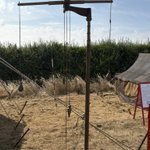
HOW DID ROMANS BUILD SUCH STRAIGHT ROADS?
They used instruments such as the groma, with four weighted cords to establish straight lines and right angles.
My photos show a reconstruction displayed by the Ermine Street Guard.
Simple but clever Roman engineering!
#RomanBritain


2
128
ROMAN ARMY PAYDAY! 💰⚔️
In AD 43, a legionary earned 225 denarii a year, paid in three instalments.
But food, boots, clothing and equipment could be deducted.
One surviving AD 72 payslip records 50 denarii in pay — and deductions accounting for the lot!
#RomanBritain #Roman
🤖 Made with AI

1
38
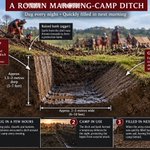
A ROMAN DITCH COULD BE A TRAP! ⚔️
Roman marching camps were protected by a fossa (ditch) and agger (bank).
Some ditches had one side much steeper than the other, making escape difficult under attack.
Their buried remains still help archaeologists identify Roman camps.
🤖 Made with AI

2
12
THE ROMAN LEGION THAT REFUSED TO FIGHT! ⚔️
During Boudica’s revolt, Legio II Augusta failed to join the Roman army.
Tacitus records that its camp prefect, Poenius Postumus, disobeyed orders.
When he heard of Rome’s victory, he took his own life.
Why did he refuse?
🤖 Made with AI

2
47
ROMAN BATHS BENEATH EXETER! ⚔️
Around AD 60–65, Legio II Augusta built a substantial stone bathhouse inside its Exeter fortress.
Its remains were excavated beneath Cathedral Green from 1971.
Nearly 2,000 years later, much of the archaeology remains buried.
#RomanBritain
🤖 Made with AI

📚 It’s wonderful seeing people reading my books on Kindle every day.
But there’s still nothing quite like holding a physical copy of a book you’ve written yourself — or handing one to someone else!
And now there are two.
Back to writing the third! ⚔️
#AuthorLife

A ROMAN EMPEROR IN A GLOUCESTERSHIRE FIELD!
In 1962, a Roman lead ingot was discovered near Cirencester.
Stamped with Vespasian’s name, it dates to AD 79.
The same man had commanded Legio II Augusta during the invasion of Britain in AD 43.
#RomanBritain
🤖 Made with AI

🏅 ROMAN MILITARY MEDALS!
Roman soldiers received decorations for bravery long before modern medals existed.
Phalerae (metal discs), armillae (bracelets) and torques (neck rings) were among the honours awarded.
Some were proudly worn over their armour.
#RomanArmy
🤖 Made with AI

THE ROMAN SOLDIERS WHO ATTACKED WITHOUT BOATS!
Around AD 77–78, Agricola wanted to capture Anglesey but had no fleet.
According to Tacitus, he sent skilled auxiliary troops across the Menai Strait with their weapons and horses.
The defenders were taken by surprise.
#Roman
🤖 Made with AI

A ROMAN CENTURION’S FACE — 2,000 YEARS LATER!
Marcus Favonius Facilis served in Legio XX during Rome’s early occupation of Britain.
His gravestone, found in Colchester in 1868, names the two freedmen who erected it.
A real man, not just a name in a history book.
#RomanBritain

WHAT’S THE PASSWORD?
Roman soldiers used watchwords to identify friendly troops after dark.
Even Emperor Claudius, who invaded Britain in AD 43, reportedly chose lines from Greek poetry as passwords!
Roman military discipline continued long after sunset.
#RomanBritain
🤖 Made with AI

2
38
THEY DIDN’T NEED A BRIDGE!
In AD 43, German auxiliaries reportedly swam across a British river to attack the horses pulling British war chariots.
The attack helped the Romans force a crossing during the invasion.
Vespasian and Legio II Augusta were involved.
#RomanBritain
🤖 Made with AI

2
38
DID CLAUDIUS BRING ELEPHANTS TO BRITAIN? 🐘
Cassius Dio mentions elephants among equipment prepared for the AD 43 invasion. But he never says they crossed the Channel.
Historians doubt they came at all. One theory: “elephants” meant siege machinery.
#RomanBritain
🤖 Made with AI

1
29