

Daily (sometimes multiple times daily) infor about astronomy.
Ottawa, Illinois, USA
Joined December 2010
- Tweets4.6K
- Following28
- Followers41
- Likes94



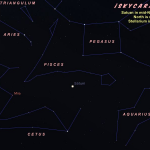
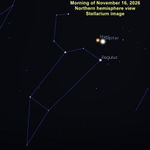



Mars passes 1.7° from Regulus on the celestial dome Wednesday. See them and Jupiter nearby. The best view is from midnight to dawn.
8
Uranus is at opposition 18.4 astronomical units (earth-sun distances) from us. The full moon appears near the planet now.

19
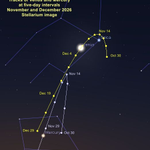
This week: Mars is passing Regulus in the first part of a triple conjunction. Jupiter is nearby. See them rising a little before midnight and higher in the sky until at their highest at dawn.

9
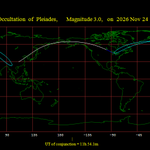
Northern regions of the earth get an occultation of the Pleaides Tuesday Universal Time. The moon passes in front of the star cluster.

10
Mira is approaching its maximum. Find out about the famous variable star on its way to its brightest. This week's SkyCaramba podcast is available on many platforms, including Podchaser.
podchaser.com/podcasts/skyca…
9
Spica and Venus will be lined up on the same celestial longitude line Sunday morning. See them close in the morning sky.
13
SkyCaramba retweeted
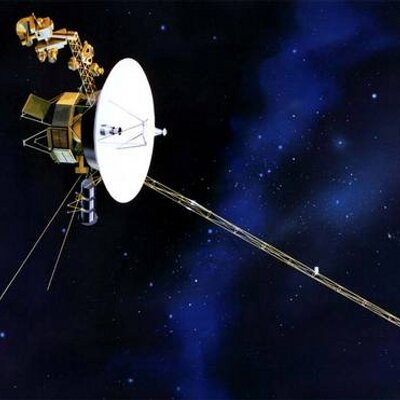
So now what? What's next? Get out your (long-term) calendars, because I have some dates for you.
On February 4, 2027, Voyager 1 will be one light-day from the Sun,
On November 1, 2035, Voyager 2 will be one light-day from the Earth,
On June 24, 2051, Voyager 1 will be 36 light-hours from the Sun,
On December 13, 2075, Voyager 1 will be TWO light-days from the Sun,
On February 16, 2097, Voyager 1 will be 80 billion km from Voyager 2, and
On October 1, 2099, Voyager 1 will be 40 billion miles from the Earth.
Mercury is easiest to see this week. Its greatest elongation from the sun will be Friday, 19.6° west. Look in the morning sky and see Venus too.

SkyCaramba retweeted
For those of you watching and waiting, the time is NOW. Sister ship Voyager 1 reached one light-day distance from Earth at 10:16:07 UTC today, in 2026. V1 will be one light-day _from the Sun_ on February 4, 2027. Why the difference? Because Earth is currently orbiting on the near side of the Sun, and so is closer (for now).
Because Voyager 2 lost speed during the Neptune encounter, it will take longer to reach these milestones: one light-day from the Earth on November 1, 2035, and one light-day from the Sun on November 27, 2035.
SkyCaramba retweeted
Sister ship Voyager 1 is currently ~24h 00m 00s of light travel time from Earth, or 25,902,000,000 km / 16,095,000,000 mi / 173.145 AU (2026:322:120000:1L) ONE LIGHT-DAY from Earth! …
Voyager I, launched in 1977, has traveled so far, it now takes a full 24 hours for a signal from Earth to reach it and just as far for a signal to get back.
4

