

"Personalized Duolingo" for your career. Get that job. Get promoted. Get ahead through curated dialogues with an AI sparring partner
Joined August 2024
- Tweets249
- Following1
- Followers39
- Likes21




The split by job ad:
Non-senior titles −4.54%, senior −0.39% (not significant)
0 to 5 years’ experience −4.87%, 6+ years +1.49% (not significant)
No mention of AI tools −5.23%, expects AI-tool use −0.17% (not significant)
Advertised wages didn't fall.
1
2
Early in your career? The drop hit ads asking for under six years' experience. Ads expecting AI-tool use showed no significant decline.
Caveats: correlational, public firms only, postings not hires. Preprint.
Borri, Cheremukhin, Liu & Tsyvinski: arxiv.org/abs/2611.27210

2
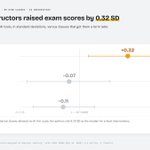
Most big studies of AI in the classroom found students learned less. A new randomized trial at 19 universities found they learned more: 0.32 standard deviations on proctored, in-person exams.
The difference: the instructors built the AI themselves.

1
12
What students valued most, in 1,414 open answers: practice and exam prep (49.2%), help understanding and solving problems (33.0%), content tailored to the course (23.2%).
One liked that the tool "doesn't give answers to my hw questions right away."
1
1
The skill AI should train is the one you are tested on alone. Make it give hints, not answers, and practice on your own material.
Caveats: applied STEM classes only; wide interval (0.06 to 0.59 SD); preprint.
Li, Bray, Martin et al., Nov 14, 2026: arxiv.org/abs/2611.19099

6
[1/6]
On Upwork, AI-related projects carry 52% bigger fixed-price budgets than similar non-AI work. The posted hourly rate is only 1.5% higher.
Clients are not paying more for an hour of AI work. They are buying more of it: 41% more hours in a hired contract's first 90 days.

1
14
[5/6]
The authors' read: value "may increasingly lie in defining the problem, connecting tools and activities, applying domain judgment, and delivering a finished outcome."
That is a skill list: scoping, integrating, judging, shipping. Not one task done faster.
1
6
[6/6]
Caveats: descriptive, not causal; one platform; authors at OpenAI and Upwork. Budgets are posted, not paid; hours cover hired hourly contracts, to April 2026.
Chin et al., "The Rebundling of Freelance Work in the AI Age" (Nov 2026): arxiv.org/abs/2611.14708
21
In the most AI-exposed US jobs, total employment hasn't fallen. Who holds the jobs has changed.
Per standard deviation of AI-exposure growth, 2023 to mid-2026:
under-30s without a degree −9.8%.
College grads aged 30–49: +4.5%.
All workers: −1.9%, not significant.

1
15
It isn't coding. Office and admin support accounts for 42% of the under-30 decline while employing 13% of young workers; customer service reps alone, about a quarter.
Computer and math jobs, where AI exposure rose most (+53 points), account for 2%.

1
6
Caveats: working paper, not peer reviewed. US CPS, occupation-level estimates per 1 SD (~12 points) of exposure growth. Holding remote work fixed shrinks the young-worker decline by about two-fifths. An earlier version found overall job losses; the authors now attribute those to the pandemic recovery.
Dominski, Boes & Lee (Nov 2026): arxiv.org/abs/2507.08244

1