

News from the Sternberg lab at Columbia Univ., HHMI. Posts are from lab members and not Samuel Sternberg unless signed SHS. Posts represent personal views only.
New York, NY
Joined October 2017
- Tweets155
- Following28
- Followers1.6K
- Likes15


7/7 As a lab we believe in sharing both our science and our research knowledge with others, and hope we’ve inspired a few minds! Looking forward to the next visit!


4/7 Students also had the opportunity to check out hands-on work in the lab with stations on robotics, microbiology, cryoEM, phages, gel electrophoresis, HT sequencing, and human tissue culture.

3/7 The East Meadow students are asking big questions: How does TikTok shape teen identity? Can AI be trusted for health info? How do climate shortages affect NYC restaurants? We had the chance to discuss these topics (and more) and give feedback on the research process.

2/7 We shared our personal research backgrounds with the students, and they had the opportunity to present elevator pitches on their current research projects.

1/7 Last week the Sternberg Lab welcomed ~40 junior & senior high school AP Research students from the East Meadow school district (and their incredible teachers) into our lab at Columbia University.

5/5 Huge congratulations to all the authors for their incredible work bringing this story together! It was a fantastic collaborative effort spanning time zones and continents.
4/5 DRT10 biochemistry and structure (with @IsraelF96135088): xitter.cf/SternbergLab/status/20…

1/11 New preprint from the Sternberg lab in collaboration with the Fernández lab! We are excited to share our structure-function study of DRT10, a bacterial defense-associated reverse transcriptase that synthesizes long tandem-repeat DNA.🧵
More here: biorxiv.org/content/10.64898…

3/5 For a deeper dive into the science, check out our original preprint threads below:
DRT10 biology and evolution (with @pentamorfico and @rafapinilla92): xitter.cf/stephentang23/status/1…

Genome maintenance by telomerase is a fundamental process in nearly all eukaryotes. But where does it come from?
Today, we report the discovery of telomerase homologs in a family of antiviral RTs, revealing an unexpected evolutionary origin in bacteria.
doi.org/10.1101/2025.10.16.6…

2/5 This work combines two complementary stories: one uncovering DRT10 biology and its link to telomerase, and the other exploring its structure and biochemical mechanism. We're excited to bring these findings together into a comprehensive picture of DRT10 function and evolution!
1/5 Telomerase has long been linked to chromosome maintenance in eukaryotes. Now, we show that telomerase-like activity is also present in bacteria, shedding new light on its ancient origins.
Excited to share that our work on DRT10 is now out in @Nature!
nature.com/articles/s41586-0…
2/2 We used sequencing and fluorescence reporter assays to uncover Arc’s role as a transcriptional repressor. It binds the transposon promoter and regulates gene expression, suggesting a new mechanism for transposon control!
1/2 Here we report the activity of Arc, a 50-aa DNA-binding protein encoded within IS605-family transposons. biorxiv.org/content/10.64898…
13/13 — A joint effort between the Sternberg and Chang labs: Renjian Xiao, Americo Casas-Ciniglio, Henry Le, Tanner Wiegand, and Dan Xie, supervised by Leifu Chang and Sam Sternberg.
12/13 — TldR is a naturally evolved parallel to engineered CRISPRi. Repression of an OppA variant shifts the relative contribution of remaining paralogs, which could influence which peptides a cell imports. What induces TldR natively remains unknown.
biorxiv.org/content/10.64898…

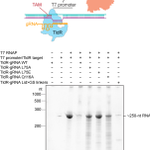
11/13 — Indeed, mutating Q116 or L75 strongly impairs TldR-mediated transcription blocking in vitro, with a charge-introducing L75E largely abolishing it. Replacing the disordered Lid motif with GS linkers has no such effect.

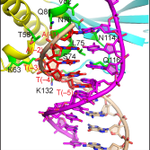
10/13 — The 5′-TTTAA-3′ TAM is read out in a groove formed by the REC and WED domains, anchored by Q116 inserting into the major groove, with additional contributions from L75 and S74. Compared with ISDra2 TnpB, the recognition interface is reduced and reorganized.

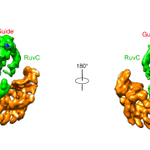
9/13 — To see how TldR engages DNA, we determined a cryo-EM structure of the Efa₁TldR-gRNA-DNA ternary complex at 3.1 Å (99.7% identical to the V583 homolog). TldR is bilobed like TnpB, but its RuvC is degenerate and the Lid motif is disordered.

