

This account is no longer active.
Larrakia Country
Joined November 2008
- Tweets880
- Following562
- Followers2.1K
- Likes3K







I have decided to leave Twitter/X. For other ways to connect with me please visit: linktr.ee/stevenbird

Language Technology and the Metacrisis, my recent talk at Australasian Language Technology Workshop @altanlp youtube.com/watch?v=YcU_tZIe…
As published in TheArticle, “the only publication committed to covering every angle”, ho ho ho 🙄 Has anyone published a scholarly response to Wifedom?

"Eileen may be invisible to the deliberately blind Funder, but everyone else can see her quite clearly."
Jeffrey Meyers reads 'Wifedom' by Anna Funder.
thearticle.com/in-defence-of…

Last week I spoke at #CLARIN2024 on language technologies and the metacrisis, suggesting alternatives to the popular ‘hallucinating plagiarism machines’. These scalable methods and design patterns centre human agency, capacity, and diversity. Watch here:
youtube.com/watch?v=tX8yYpE7…
Steven Bird 🍉 retweeted

On the final day of #CLARIN2024, @StevenBird gave a highly interesting and thought-provoking keynote speech on the "metacrisis": the crises of language, environment and meaning, and how our community should respond to this 💡

Steven Bird 🍉 retweeted

In his Keynote at #CLARIN2024, Steven Bird @StevenBird explores ramifications for our work in the space of language resources & technologies, and suggests some ways forward that avoid extractive processes & centre speech communities, to 'Making it Meaningful'.

I proposed the ACL Anthology at the ACL exec meeting at ACL'01 in Toulouse in response for a call for proposals for a 40th anniversary initiative for ACL'02. I offered to build it with the support of @LDCupenn plus donations, on condition that it would be freely available.

One challenge was that the late 1970s editions of our journal _Computational Linguistics_ were only published on microfiche. The NSF sponsorship to the ACL was conditional on this arrangement, to bring forward the day when every scholar would have a personal microfiche reader 😆
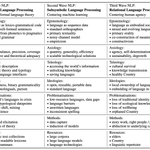
Thus, there are various ways of thinking about what language *is*. These are reflected in how we approach language technologies. The first wave and second waves of symbolic and subsymbolic NLP are familiar. I believe a third wave is emerging: Relational Language Processing.

For more of this story, please watch the 10 minute intro video, or dive into my ACL'24 paper "Must NLP be Extractive?"
bit.ly/bird-must-nlp-be-extr…
aclanthology.org/2024.acl-lo…
When we do this, something interesting comes up: relationality. Language is intrinsically social. Language is inseparable from culture, society, or nature. Language both reflects and creates context. This exceeds notions of language as lexicogrammatical code, or sequence data.
To ask this question is to return to a fork in the road at the genesis of AI, between Artificial Intelligence (McCarthy) and Augmentative Intelligence (Engelbart). Is our agenda to replicate human intelligence inside a machine or expand human intelligence using machines as tools?
Artificial Intelligence extracts behavioural data and takes over human agency. Augmentative Intelligence carefully enhances human agency. What would it be like to take this other fork, and seek a path towards a non-extractive NLP committed to augmentative solutions?
Big Tech promises a future with universal translation, where "people will be able to make more authentic connections in their native languages". This is the picture: human communication hostage to the machine; biases and hallucinations so hard to detect cross-culturally. 🧵1/8


Voices of Australian First Nations leaders concerning climate communication, and some learnings for technologies for indigenous languages. Our #ClimateNLP paper plus 10 minute intro video.
aclanthology.org/2024.climat… bit.ly/bird-climatenlp24-env… @acl_sigel @c3_nlp #SIGUL #SIGEL #LT4All
