

Algo trader. Started with options June 22 2020 🤦 Switched to CFDs in 2021. No DMs I'm afraid. Tweets != financial advice
UK
Joined August 2020
- Tweets18.2K
- Following388
- Followers2.4K
- Likes50.2K





David Hawkins retweeted

The strongest predictor of extraordinary work is whether the person had ever obsessed over something pointless; we saw this pattern across 5,000 startup meetings, and near-identical signals showed up across everyone from scientists to athletes.
We’ve met people who spent years optimising their fantasy football algorithms, or memorised every player in the NBA at 11, or collected thousands of train tickets, or built a Lego replica of their school; none of these activities really had much point.
What they were demonstrating was the hardest skill in any field; the mental capacity to stay focused on a seemingly boring task for much longer than it deserves. The path to genius is mostly insane levels of repetition, and people who achieve it have a broken off-switch. It is tough to fake having spent years obsessed with boring things that didn't matter.
With time-based no-take-profit exits I want to be having mostly small winning / small losing weeks, with the occasional big winning weeks when the markets really move + I'm on the right side + I didn’t cap my winners.
It goes without saying that I *always* cap my losers, which is why in practice I think the logic can work over time, once every model has proven efficacy OOS.
The many weeks of chop and unflattering portfolio performance is foundational to the big weeks when they come. I just need to ensure I'm not bleeding out when the markets aren't moving. Patience is needed to idle willingly.
Most trades exit on time, far away from -+1R. The markets didn't move that week. Only 12% of trades reach my stop, and those losses are swallowed in the chop weeks because my portfolio is executing enough trades; ∼15 per week.
Big weeks don't need to happen often. But when they do, we capitalise. Algorithms take the pressure off me needing to correctly forecast the right weeks, so it doesn't matter if I'm busy that week, or simply off my game. That pressure never sat well with me as a discretionary trader. The "weekly forecast" and all that.
I'm just a monkey now, watching the machine work. My only job is to not push a button out of boredom.
2
2
164
Let winners run —
Needed to not only survive normal losing streaks, but secure a profit in spite of them.
None of my 12 models have a TP set for this reason, and the backtest data justifies the decision: +$187 per average win vs −$91 per average loss; >2R.
This doesn’t include SL outcomes which are around 12% of trades, but OOS/IS on the report was still profitable including these stops so it's accounted for.
Letting winners run is psychologically hard as a discretionary trader (I could never master it), but practically very simple as an algo trader.
This is why I was able to secure an asymmetric return on a recent day the markets made a big jump; +5.5% on Nov 5 2026.
And it’s how I guarantee over time that my single winners outsize my single losers which are capped to around -1R. That alone is good for psychology I've found, particularly when going through losing streaks.
2
198
David Hawkins retweeted

STOP USING 1 SYSTEM.
It’s the most common beginner mistake, and it’s why so many people quit.
One strategy has good months and bad months. When the bad stretch comes (and it always does), you have nothing else to fall back on. So you panic, change the rules, and start over.
The fix isn’t a better system. It’s more than one.
Different systems on different markets don’t lose at the same time:
→ one is flat while another is climbing
→ the bad month of one is covered by the good month of another
→ the ride gets smoother, so you can actually stick to it
Think of it like a team, not a star player. One player can have a bad game.
A good team still wins.
The math behind it is real: spread the same risk across 5 systems that don’t move together, and your overall swings drop by more than half.
No magic. Just not putting everything on one bet.

What I believe to be crucial components of my latest portfolio design (if it is to succeed) —
1. Pre-registered hypotheses that survive OOS (edge)
2. Let winners run (this has always been a challenge for me. Easier said than done; easier with algo trading)
3. Average losers reduced through timed exits (heuristic: winners move fast, losers grind)
4. High enough trade frequency (learned the importance of this in Van K. Tharp's Super Trader)
1
106


Truth

Men.. I promise you.. Be boring & find someone that loves being boring with you.
That is the key to happiness.
I’m not even kidding.
As you get older, the people with “personality” are really annoying, always full of drama & a waste of time to be around.
If you tie yourselves to one of these clowns you’ll never sleep a restful night.
Find your boring match & revel privately in your accomplishments together as you build a fulfilling & drama free life together.
1
183
David Hawkins retweeted

What can really help you during an extended period of drawdown is a few things:
- Knowing your average expectancy per trade, per week, per month
- Knowing your average losing streaks
- Knowing your average recovery period, your average drawdown depth, and drawdown duration
These sort of things will really help you put things into perspective.
I stopped adding models at the point where I reached a 3-trade-per-day average alongside my Max3 rule. Max3 means I can only ever have 3 concurrent trades running.
At 1.5% risk per trade on challenges with -5% max daily loss, that's a -4.5% threshold. There's also a hard rule to flatten the book immediately, if -4.5% is ever locked in, in a single day.
That should be very rare.
Only 12% of my trades ever reach a SL; the majority have a timed exit and a small percentage will reach their TPs.
I also plan to risk 1% per trade on challenges that limit me only to max 3% loss per day; I feel that's where the CFD industry is heading. Account flattening at locking in -2.5%, in that case.
Continuing to add more models at this point is only going to exacerbate the problem of execution blocking, and if every model is having executions blocked, then no single model can express itself fully anyway, no matter how good it is.
I run into the problem of a hypothetical A* single model becoming a C model inside the book.
There is likely no single model to be added at this point, that's going to markedly improve performance. My only concern is a high enough trade frequency, adequate decorrelation in the book, and robust historical IS/OOS performance at the book-level.
I'm more interested in the book performing at an A* than any single model performing at an A*. And that's dictated largely by decorrelation, assuming every model has a baseline of strong performance to start with.
At the 3-trade-per-day average alongside my Max3 rule, I leave the portfolio to be its own thing and just let it run without me micro-managing or changing stuff out of boredom.
I monitor for activity that never presented itself during the 9 years of testing. Extraordinary losing streaks for example. Although it's inevitable at some point I will have a worse losing streak given enough time. But the intensity beyond historical proof is one of those discretionary things to judge as and when.
I will need to figure out when a model has officially lost its edge, without overreacting. That arena is still an unknown for me currently, and I guess the portfolio distribution of no-edge models alongside stronger models will make that trickier to figure out.
I have a daily prompt I use with AI which monitors every model in the book. I am told about the weakest models in the book in terms of WR, and what the historical WR was. I will need a lot of trades before I leave the realm of short-term noise.
I.e. Historical 50% WR with a live 20% WR over 300 trades. That would be useful information to work with.
1
1
218
On X, I feel like I can immediately tell who relies on trading to pay bills after reading a few of their posts. It's glaring and even a bit offensive.
Imo, trading should never be about paying bills; it's about augmenting other more stable income streams while you're learning, with a view to ultimately having a large enough self-compounding nest egg in trading profits to take the pressure off those stable income streams.
Eventually, trading pays for retirement (and extended fishing trips away from a boss breathing down your neck). But that's a long road and far away from paying bills with payouts.
Though I respect that in some countries it might be harder to find reliable income streams outside of trading. Unfortunately, that lack of choice will increase the incentive to cheat your way to payouts.
Perhaps that's why we see certain Asian countries as hives for reverse trading farms?
2
7
503
I swear that there are hundreds of toxic trader traits you can simply avoid by having income streams other than trading that you can depend on.
No pressure to inflate performance, or prematurely position oneself as a "trading mentor."
"Hustle" is a popular term these days for people getting stuck in, narrowing their focus, making shit happen, and having a great work ethic.
But it can also show a lack of foresight and desperation that could have easily been avoided.
New traders pay for it, and the deeply impersonal nature of the internet means a lot of these hustle-culture traders don't think twice about taking someone's money without having the competence to deliver on what they advertise.
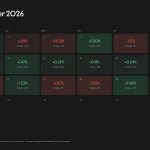
October performance was horrible, and so it becomes another performance snapshot case-study each new version of the book goes through; the 10-model book, the 11-model book, the 12-model book.
This isn't so much to invalidate a portfolio change; at the point I see the book's backtest performance in October alone, all my other checks have indicated whether a model is ready to be taken seriously. A single month's performance is not likely to tip the scales.
But it is absolutely helpful in calibrating expectations. I want to see what could have been a failed challenge during October, and accept that some months, that's to be expected.
I want to know that a portfolio which has great months can also have bad months, and that is perfectly normal. I do NOT want every hindsight month to be profitable; overfitted. I like seeing some losing months amongst mostly winning months. That for me is more trustworthy and robust.
The point here also isn't about getting completely accurate data. Live results would likely be slightly different from backtest results. The point is that in October, there's a decent chance a challenge (1.5% risk per trade, 15 trades on average per week, 3 per day) failed, and it doesn't mean my system doesn't have edge.


1
2
279
I have so much respect for swing traders who will spend multiple months on a single challenge phase. It's a whole other level of discipline and deserves praise.
But as I've said before, time has a value. This can be justified on personal accounts which we own. But with props, we can spend nearly 6 months on a single phase, only to receive an email telling us that we can't continue due to some policy change outside of our control.
That's what happened here by the looks of it. Nearly 6 months to pass P1 of a $200k FTMO swing account, and a few days later he has to settle for a refund before getting P2.
Now the good news is that it's not entirely wasted time. It's practice and useful lessons we can take into a personal account, maybe even other prop accounts. When we're trading in the tightened conditions of prop challenges, we're always putting in reps providing we're learning and adapting.
I'd eternally grateful for challenges as far as making me a better trader, but that development has always viewed personal as the long-term goal. I'll capitalise on props while they're here, but I will never put myself in a position where I'm dependent on them.
My point here isn't that this trader wasted time; it's that there's more of a time premium when trading with props.
I'd even make the argument that it makes sense to day trade props while swing trading personal. Props do not value our time.
Best of luck to this trader 🤝

Just completed the phase 1 of one of my $200k FTMO accounts with a discipline score of 87%
Now waiting on @FTMO_com to verify and send me to phase 2.


2
235
David Hawkins retweeted

Linda Raschke on why she never varies her bet size:
"I want an even bet size, because I don't know where the winners are going to be. I don't know where the losers are going to be. The minute I start monkeying around with that, it's going to be Murphy's law."
How she sizes, in her words: at the start of each quarter she takes each market's average daily range in dollars. If corn moves $500 a day and the S&P moves $5,000, she can trade ten corn contracts for every one S&P.
She does not know which trade will be the winner, so every trade gets the same size.
Full episode 👇

David Hawkins retweeted

This might sound crazy, but one of the skills you NEED to learn is how to deal with an increasingly illiterate society full of emotionally dysregulated people.
If you keep getting frustrated every day over how “dumb” everything and everyone seems, the stress of it is going to wreck your mind.
You can’t control the collective intelligence or emotional maturity of the world around you.
I wonder what the effect of FTMO *not* having purchased Oanda would have on the volume of payout denials we see.
169
My biggest winning month is OOS, and my biggest losing months are IS. I'm grateful for that.
❌ Biggest winning months IS (against OOS) can signal overfitting due to models being built using that data.
❌ Biggest losing months OOS (against IS) can signal overfitting due to models having not seen that data while being built. The signal is "edge failed to transfer."
1
2
208