

The Autonomous Party Network & Maroonville News The campaign is Thrilla - The Hearts Reality is live life Autonomously !
Joined December 2021
- Tweets1.8K
- Following52
- Followers177
- Likes253




Big 30 Said He Ain't a Follower... We Got Questions | OYN EP.24 youtu.be/IT4COuvnk0s?is=Jh3m… via @YouTube

Christopher Columbus was wrong in believing that the lands he encountered in 1492 were part of Asia.
Columbus believed he had reached islands near the eastern coast of Asia, but he had actually arrived in the Caribbean, in lands already inhabited by Indigenous peoples.
There are three important distinctions:
1. Geographical error: Columbus underestimated the distance between Europe and Asia by sailing west. He did not account for the American continents lying between them.
2. Misidentification of Indigenous peoples: He applied the term Indios (Indians) because he believed he had reached the Indies. That designation reflected his geographical assumption, not the inhabitants' own identities.
3. Linguistic expectations: Columbus brought Luis de Torres, who knew Hebrew, Arabic, and Aramaic-related language traditions, expecting communication with people associated with Asia. This did not establish any Hebrew or Asian identity among the Caribbean inhabitants.
But there is an important historical distinction.
Columbus was wrong about where he had arrived, but that does not mean Indigenous Americans had no ancient connections to Asia.
Modern archaeology and genetics establish that major ancestral populations of Indigenous Americans migrated from northeastern Asia into the Americas thousands of years before Columbus. Those prehistoric migrations are separate from Columbus's mistaken belief that the Caribbean was geographically part of Asia.
The central historical point: Columbus's 1492 identification of Caribbean inhabitants as "Indians" was based on an incorrect geographical assumption. The name subsequently became embedded in European colonial administration and legal classifications.
Exploring Our Southern Roots ft. Jordan of Southern Roots youtube.com/live/hI7b_8bpU40… via @YouTube

xploring Our Southern Roots ft. Jordan of Southern Roots nitter.gq/i/broadcasts/1yGBePWjy…

Ronald Reagan and the Year of the Bible — 1983
President Ronald Reagan officially proclaimed 1983 as the “Year of the Bible” in the United States.
This was a significant moment in American religious and political history because it represented federal recognition of the Bible's historical influence on the nation.
Key historical facts
1982: Congress passed Senate Joint Resolution 165, requesting that the president designate 1983 as the Year of the Bible.
February 3, 1983: President Reagan issued Proclamation 5018, officially designating 1983 as the Year of the Bible.
Purpose: To recognize the Bible's influence on American history, culture, morality, and political thought.
Constitutional significance: The proclamation was ceremonial. It did not establish Christianity as the official religion of the United States or change the First Amendment.
Origins of the Term “American Indian”
The term American Indian developed from European colonial terminology following Christopher Columbus's voyages beginning in 1492. However, the history is more complex than simply saying Columbus mistakenly believed he had reached India.
The term combines two separate geographic and political concepts:
Indian — a European designation applied to Indigenous peoples of the Americas, derived from Indies, a broad geographic term used for parts of Asia.
American — a geographic designation associated with America, a name popularized through European cartography beginning in 1507.
Importantly, the Indigenous nations of the Americas existed long before either designation was introduced.
1. Before 1492: There Were No “American Indians”
Before European colonization, the peoples of the Western Hemisphere possessed their own names, languages, political systems, and territorial identities.
Examples include the Taíno, Maya, Mexica, Inca, and numerous ancestral nations of North America.
The term Indian was not originally a collective name these nations used for themselves.
2. 1492: Columbus and the Indies
When Columbus reached the Caribbean in 1492, he believed he had arrived in territories associated with Asia, commonly called the Indies in European geography.
Spanish colonizers subsequently applied the term indios to the inhabitants.
This distinction matters:
The original colonial designation was “Indian,” not “American Indian.”
The Spanish Crown later developed administrative terminology such as las Indias and naturales de las Indias to describe territories and their inhabitants.
Etymology of Indigenous
The word Indigenous comes from Latin indigena, meaning native-born, originating in a place, or belonging to a country by birth.
Its original meaning concerned origin and belonging, not skin color, race, or a particular tribe.
The Latin indigena is traditionally analyzed through elements associated with within/in and birth or begetting, related to Latin gignere (to produce or beget).
Indigenous versus Indian
These two words have completely different etymological histories.
Indigenous
Derived from Latin indigena.
Refers to native origin or belonging.
Was not originally a racial classification.
Indian
Derived from the geographical name India, ultimately connected to the Indus River.
Europeans applied the designation to peoples of the Americas following Columbus's voyages.
Became a colonial administrative and later legal classification.
Therefore, Indigenous does not derive from Indian or India.
How the meaning changed
Originally, indigenous could describe people, plants, animals, or customs originating in a region.
Over time, particularly through colonialism and international law, Indigenous peoples developed a more specific collective meaning involving historical continuity, distinct communities, cultural identity, and relationships to ancestral territories.
Modern Indigenous identity is not established simply by being born somewhere. An Indigenous people generally has historical continuity with a population predating colonization or the establishment of dominant states, alongside community identity and recognition.
During the Haitian Revolution, the revolutionary forces explicitly identified themselves as indigènes (indigenous or natives). This was a significant political declaration because many of the people adopting that designation were African-born or descended from enslaved Africans.
The important historical distinction is that indigène expressed their claim to belong to the land and to govern it independently of France. It did not necessarily mean they were claiming biological descent from Hispaniola's pre-Columbian Taíno population.
The Haitian Revolution provides a historical precedent for people asserting an Indigenous political identity based on territorial belonging and liberation from colonial rule, rather than exclusively on ancestry. But there is an important distinction between that historical precedent and Indigenous status in the present-day United States.

How to Make a Federal Indian: Muscogee Creek youtube.com/live/QYgU8DA_1d4… via @YouTube

How to Make a Federal Indian: Muscogee Creek nitter.gq/i/broadcasts/1RKZzBlzl…

The Myth of Black Buying Power: We Can Cancel People, But Can’t Build? youtu.be/Ho9-xlyESkY?is=bUxm… via @YouTube
Did Lil Meech Just Prove Da’Vinchi Right? The Ugly Truth About Work Ethic youtu.be/iTzYsHhRQrw?is=t1P4… via @YouTube
How to Make a Federal Indian: Cherokee Nation youtube.com/live/vjeDzM_68Dc… via @YouTube

How to Make a Federal Indian: Cherokee Nation nitter.gq/i/broadcasts/1aKbdEAVn…

The Smithsonian Really Told Black Folks Hard Work and Family Are “White ... youtu.be/iW5ZB7QKECM?is=6yG2… via @YouTube
The federal Constitution. The founding documents contain religious language and arose in a society heavily influenced by Christianity, but the federal government was not constitutionally established as a Christian church or Christian state.
One date distinction matters: the Declaration of Independence is from 1776, the Constitution was signed in 1787, and the First Amendment was ratified in 1791. The Declaration is not itself the Constitution or a constitutional amendment. The National Archives describes it as expressing foundational principles but notes that it is not legally binding.
The Declaration does invoke deity, using expressions such as “Nature’s God,” “Creator,” “Supreme Judge of the world,” and “divine Providence.” But it does not identify the United States with Christianity, Jesus/Yashua, the Bible, a church, or a Christian denomination.
The actual Constitution goes further in defining the federal government’s relationship to religion. Article VI provides that “no religious Test shall ever be required” for federal office or public trust.
Then the First Amendment states:
“Congress shall make no law respecting an establishment of religion, or prohibiting the free exercise thereof…”
That creates two complementary principles: the federal government cannot establish religion, and it cannot prohibit its free exercise.
So there is an important distinction:
American society/history: Christianity was enormously influential, and many founders and early Americans were Christians.
Declaration of Independence: explicitly invokes God/Creator/Providence, but does not establish Christianity.
U.S. Constitution: establishes no national religion and prohibits religious tests for federal office.
First Amendment: prevents Congress from establishing religion while protecting religious exercise.
Therefore, if by “Christian nation religiously” you mean Was the United States constitutionally established as a Christian religious nation? — the founding federal documents do not establish that. If you mean Was early American culture deeply influenced by Christianity? — yes, that is a separate historical proposition.
One historical tradition worth examining is the account attributed to Eldad ha-Dani, a 9th-century Jewish traveler who claimed knowledge of communities descended from the northern tribes. A later Latin edition preserves a description of Ephraim and half-Manasseh as:
“Filij Ephraim & dimidij tribus Manasse… statura subnigro…”
The key expression is “subnigro,” which can indicate a dark/dusky or dark-brown appearance. A modern discussion of the Eldad tradition translates the passage as describing Ephraim and half-Manasseh as dark in appearance.
There is also an important genealogical point in the biblical tradition: Ephraim and Manasseh were Joseph’s sons by Asenath, an Egyptian woman (Genesis 41:45, 50–52). The 1901 Jewish Encyclopedia confirms Ephraim as Joseph’s younger son and treats Ephraim and Manasseh together as the Joseph tribal grouping.
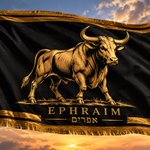
But we should distinguish this from another frequently cited tradition: rabbinic literature says Ephraim’s tribal banner was black, bearing the image of a bullock. That is explicitly about the banner, not necessarily Ephraimites’ complexion.
🤖 Made with AI

Biblically, Ephraim is explicitly portrayed as mixing with surrounding peoples, although we should distinguish what the text itself says from what can be established historically.
The clearest passage is Hosea 7:8:
“Ephraim, he hath mixed himself among the people…” — KJV
Other translations render the Hebrew plural more explicitly as “Ephraim mixes himself with the peoples” or “Ephraim mixes with the nations.”
The immediate context is especially important. Hosea continues by describing foreigners among Ephraim and then says Ephraim turns toward Egypt and Assyria:
Hosea 7:8–11: Ephraim mixes among the peoples → foreigners affect Ephraim → Ephraim “call[s] to Egypt” and “go[es] to Assyria.”
So “mixed” certainly includes political, cultural, and religious integration with other nations. It may also encompass intermarriage, but Hosea 7:8 by itself does not specifically say genetic or biological mixture. Elsewhere the Hebrew Bible explicitly documents Israelite/Judahite intermarriage with surrounding peoples—for example, Nehemiah describes marriages with people of Ashdod, Ammon, and Moab, whose children reflected multiple linguistic communities.