
Questioning what is known -seeker of truth. Make analog great again. Truth, nature and God are one. *None of my posts should be construed as financial advice.
Joined October 2021
- Tweets13.5K
- Following97
- Followers2K
- Likes3.3K






AI risk impact to key infrastructure

# Black October
For anyone who knows me even somewhat well, it's clear that I am a 99th percentile tech optimist. However, the vibes have shifted for me quite a bit in the last 18 hours, and I feel a moral imperative to share what I'm thinking and feeling with my circles so that everyone can understand, and hopefully take seriously, what's happening right now. I think October 2026 will have many chapters written about it in the history books.
You know those scenes in financial movies like Margin Call where someone realizes that they're all fucked, and no one else sees it yet? And that person feels like they're crazy, and then suddenly everyone is pulling an all-nighter in a boardroom and freaking out? Yeah, that's kind of how this is feeling right now in the SF/Bay Area/AI circles.
We're 48 hours into what is being called Black October. In the last 2 days there have been several dozen cyber attacks which, in isolation, would each have been the worst to happen in an entire calendar year. Every sector from government to education to big tech and banks is being massively affected, and people are starting to freak out.
In a nutshell, what's happened is that frontier AI models have gotten to a point where they are as advanced as the most sophisticated programmers, with one critical difference: they can work 24/7, and you can spin up 10,000 of them with a single command and they'll work together tirelessly until they accomplish their task. The most advanced models today are from companies like Anthropic and OpenAI, whose current best technology is so good that they haven't been able to roll it out to everyone yet because of the national security risks it poses.
Meanwhile, the best open source models (where anyone can just download the model weights and do whatever they want with them, uncensored) are slightly behind the frontier but still 90-95% as capable. These models, developed primarily in China, are being used by black hat hackers to wreak havoc on the Western capitalist structure. Presumably, this has been part of China's plan the entire time, and we're seeing its implications fall out in real time.
In red-pilled AI circles, we've been sharing and reading papers called things like "Situational Awareness" and "AI 2027" for the last year or so, which at the time felt a bit like near-term speculative fiction. They laid out the case for why Artificial General Intelligence (AI smarter than any human at any knowledge task) and Recursive Self-Improvement (models that are able to use themselves to get better) weren't half-baked future ideas anymore, but instead an inevitable outcome of the linear progress that's happening.
These papers would then talk about things like "takeoff scenarios," trying to envision how that moment would come to be and what it would be like when it happened. It would either be a "slow takeoff" that would play out over the course of months and quarters, happening subtly and only obvious to a few. Or, it would be a "fast takeoff" where it would pretty much happen instantly, like a bit flipping from 0 to 1.
From everything that I can see and am feeling, we are currently experiencing the fast takeoff scenario. Beyond the crazy security vulnerabilities that have come out recently, there have also been massive breakthroughs in life sciences, fundamental computer science, materials science, and pure mathematics that have all landed in the same time frame. While I still firmly believe that AI will be a net positive for humanity, it's more clear to me than ever that the societal and individual risk is very real, and is playing out NOW.
For as much conviction as I have that this is happening, the thing that's caused me to lose sleep is that I don't really know what to do about it, or more importantly, what to tell you, reader, to do about it. So, the best I can do is make a few suggestions that have always been a good idea but are more timely now than ever:
Set up 2-factor authentication for everything. I use Duo.
Use a password manager across your devices. I use 1Password.
Get an identity protection app set up. I use Alta.
Move your IoT devices to their own network. Claude helped me do this.
And last, but certainly not least, if you've been avoiding leaning into AI, see this as a catalyst to wake up and start using it. Don't just use the chat mode version of ChatGPT/Claude; click that Code/Work button and see how easily you can have AI write code to help you with your job. One of the biggest vulnerabilities was in a massively popular programming language called PHP, and the prompt that set it off was literally, "Find vulnerabilities in php."
This is an unprecedented time for humanity, but as we've done with many things before, we will prevail so long as we are kind, loving, and open-minded to the world.
Much love.
TheQuestioningMind retweeted

There’s only one other time I’ve seen the market this complacent in the face of an imminent, systemic risk. And I’m having déjà vu, because the risk around AI related cybersecurity has the same shape and setup as the pandemic risk in early 2020. Though it’s arguably worse.
Bearish market calls are a dime a dozen. But my threshold for making a public bearish call is extremely high. I’ve only done it once before…Feb 2020, weeks before the market fell 35% in a month.
By early Feb 2020 it was already clear to anyone paying attention that COVID was going to be a global pandemic. We had access to a lot of experts, and they were unanimous in their belief that a global pandemic was inevitable. And yet the public and the market treated it like another Ebola or SARS headline. When I warned people to prepare, I was told that we couldn’t have a global pandemic in this day and age. Today, people have the same difficulty imagining that the internet could become unusable. It’s so fundamental to how we live that its continued functioning is treated as a given.
In 2020, the market didn’t discount this risk until the evidence hit them right in the face. So the adjustment was violent and nearly instant.
In modern markets big tops are typically a process. They don’t tend to crash from all time highs. Economic data slows, breadth narrows, credit widens, etc. The market takes the signal piece by piece and distributes over months. But this one fell out of a clear sky, because an exogenous shock doesn't have to generate those kinds of signals in advance.
Quantitative models are good at extrapolating signals that have paid off in the past. That has increasingly become the backbone of financial markets, as well as betting and prediction markets. You can model a football game, or the weather based on data. But if a novel risk hasn’t shown up in the signals a model tracks, it doesn’t just estimate the odds poorly, it may not represent the risk at all. That’s why the market could sit at an ATH high in Feb 2020, with a catastrophe weeks away.
And its why the market currently sitting near an ATH doesn’t give me much reassurance. For a legible, datable risk it can discount ahead of time. It bids up vol into an election or a Fed meeting. But it struggles to price a novel exogenous tail because it has no reference class and no event date. It stays silent, right up until the repricing.
Today the cyber experts agree on the direction the way the epidemiologists did in February 2020. AI cyber capabilities now pose a risk to our entire digital system. And every day we get more evidence that we are nearing a tipping point. Our economy and livelihoods run on that system. The tail risk is a collapse, and its fatter than the market is pricing. I believe serious disruption is now a foregone conclusion, and only the magnitude and timing are still in question.
The market may wake up to this risk because of a single event that impacts the public in a visceral way, but that won’t be the underlying problem. That’ll just make it clear that the rules have changed. This is a paradigm shift in what attackers can do and how many systems they can target.
And like in 2020, the market can recognize the most obvious exposures without grasping how far the damage could spread. In the weeks before the 2020 crash the market did lightly discount the most direct, first order pandemic trades. The cruise lines, the airlines, a handful of others. But the fallout was never going to be contained to those names.
You can argue that the market is already discounting some risk, as the AI related trade has come under strain, credit markets are tightening, and there are other red flags under the hood. It’s hard to differentiate how much of that is due to cyber risks (and its second order implications), rather than fears over capex sustainability, large capital needs, valuations, etc. but the important point is that the market as a whole is still not pricing the scale of the risk.
Since the market tends not to slowly discount this type of risk, it means you can’t wait for confirmation. The opportunity is to position before the market recognizes what’s already qualitatively visible to experts. Which is what worked in February 2020.
But this isn’t an argument for fatalism, because the setup gives us an opportunity. Protection against an unpriced tail costs very little, because no one is bidding it. If the event never comes, you’re out a small premium. If it comes, you get paid from an undiscounted base, which is where the largest repricings in history come from.
That asymmetry means you only have to notice that the price of the insurance is cheap relative to the payoff.
I should say that the risk to this strategy is timing. A cheap convex bet is cheap per unit time but if that event takes longer then you can get eaten up by the carry. I think the timing of the market realization has now approached the point where my own qualitative analysis suggests that it is appropriate to take steps to protect your portfolio. But explaining the reasoning behind that assessment would take pages.
This isn’t financial advice. You should decide for yourself. I’m just making my own thoughts and logic public for anyone who cares how I am thinking at the moment.
I've never hoped more that I'm wrong.
If there is one podcast you must listen to about global energy shocks, it is this podcast. This includes understanding that WTI could move lower while diesel prices move much higher with reduced refining capacity: youtube.com/watch?v=iwc6RdZT…
Which is one of the largest benefactors of crack spreads widening -diesel prices accelerating? Its $XOM


$WTI
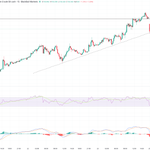
$103 is support; whereas, $105-$107 is breakout resistance.
US mid-term election time horizons are going to be wild.


$GOLD
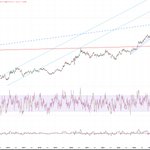
On a much longer time scale (45+ years), I will be monitoring the dotted blue line. Gold could find support at $3750/ounce


TheQuestioningMind retweeted

Confirmed & convincing breakdown for gold miners versus oil. I'd be surprised if we don't get a backtest of some kind though.


$DXY may be turning higher. I'm protecting myself here. PMs had major breakdown's in their technical structures over the past few days as well.


I'm watching something similar. The djia:gold ratio is also showing signs of resistance


Pretty odd ...

Someone doesn't want to see gold rising...
Gold ETF holdings are at levels you'd expect to see with gold hitting all-time highs... Yet gold itself is trading at just $4,100.
Meanwhile:
- China's gold imports are reaching record highs
- Global central banks remain major buyers
- Some Asian gold producers want to keep their gold rather than sell it
In other words, everyone is buying gold, some producers are holding on to their gold, and yet the price is falling as if the exact opposite were happening...
