

Paul Charlton: Tech wizard, mentor, and problem-solver extraordinaire. Turns chaos into order, inspires excellence. .gt. 4 sigma STEM
Vienna, VA
Joined November 2011
- Tweets5K
- Following476
- Followers608
- Likes996



Pinned Tweet
IRS’s COBOL and data risks seem unfixable. They said the same thing about QuickBooks. At Intuit, only two people believed I could map its 10-million-line core, one of those became the CEO. I did — deterministically, and brought the org with me on that journey. A few years later, I refactored Cisco IOS for multicore threading — 30 million lines, two-week turnaround when the CTO was asking for 2-years. The same physics applies at Treasury scale: minimal change, maximum clarity, zero drama. Details and evidence in the comments ↓
Modernization fails when people try to replace complexity instead of mapping it. Once dependencies and side effects are observable, progress becomes arithmetic. That’s been my craft from Apple and Cisco to DHS—turning legacy into leverage, quietly, whether advising or securing systems as a vendor.


IF EVERYONE IN THE ROOM AGREES, HALF OF YOU ARE WASTING OXYGEN.
…
If everyone in your leadership room agrees on your next move, half of them are redundant, and the other half are probably sleepwalking off a cliff.
We often confuse "harmony" with the warm, fuzzy feeling of universal consensus. That isn't harmony; that's just adding water to water and pretending we cooked a meal. In Taoist thought, true harmony isn't a chorus of polite nodding—it’s the dynamic, uncomfortable tension between polar opposites.
When you sharpen a blade too thin, it chips on the first real strike. Push pure expansion without restraint, and you burn out. Rely purely on caution, and you calcify.
We don't keep dissenting, polar viewpoints in our leadership circle because we enjoy the friction. We keep them here because an organization without an internal counterweight relies on the market to deliver its reality checks—and the market is far less forgiving than a difficult meeting.
We aren't here to sand down the edges until every decision is a bland compromise. We are here to let contrasting forces stress-test reality before reality tests us. If you find yourself in violent disagreement with the person sitting across from you, don't rush to resolve it into artificial peace. Make the tension work for a living.

The inception of MacOS on Intel and later processors used by Apple. The creation of the Multi-platform "Quick Time Media Layer" (QTML) which later formed the primary framework of "Carbon" which allowed the entire developer eco-system to quickly build and distribute their apps on Apples later generations of processors.
youtu.be/41DLFG2ohzk?t=2780

"It Just Works!"
Nearly decade before Steve Jobs and Apple Marketing adopted the term in their demos and campaigns.
youtu.be/41DLFG2ohzk?t=133
Paul Charlton retweeted

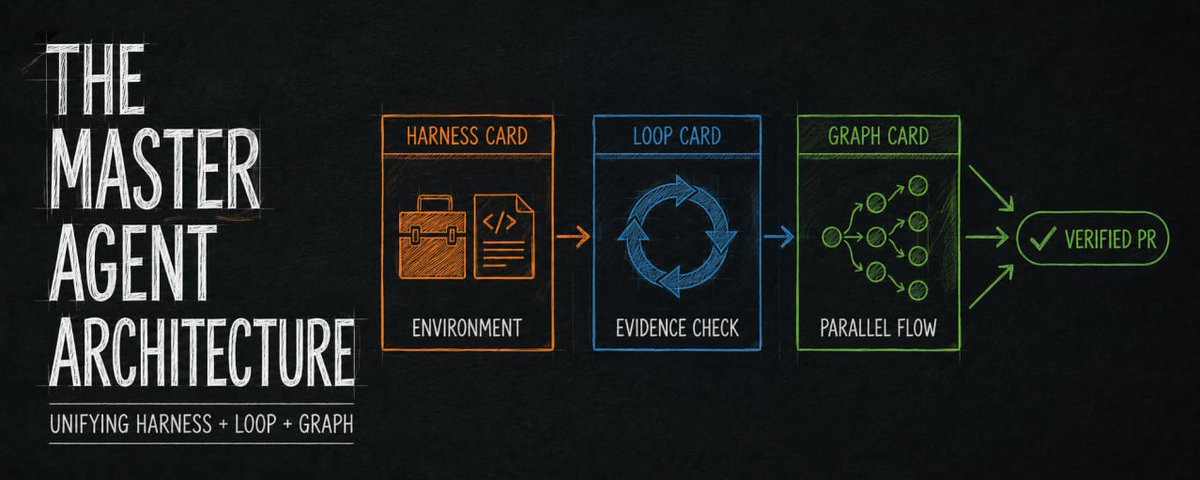
Google DeepMind researchers revealed how auto-synthesized code harnesses eliminate agent failure
crucial for software architects deploying autonomous coding tools and multi-agent pipelines
relying on raw prompt instructions leads to invalid tool calls, state drift, and runaway execution loops
AutoHarness shifts system control from LLM prompts to an automatically synthesized code substrate
three execution mechanisms introduced in the study:
1. Environment Guardrails
synthesizes code wrappers around raw APIs to prevent out-of-bounds agent actions
2. Evidence-Gated Loops
requires compiler and linter verification before advancing to the next step
3. Stateful Graph Synthesis
structures multi-agent coordination into explicit, verifiable node execution paths
replacing manual prompt tuning with code-synthesized harnesses guarantees verifiability across complex software workflows
Read the complete breakdown in the article below ↓


Paul Charlton retweeted

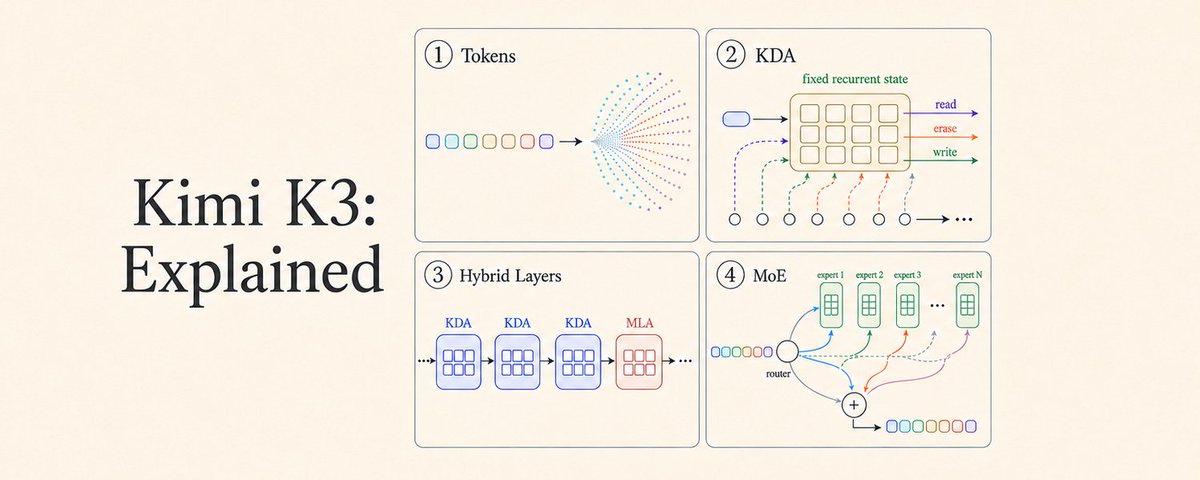
Best explainer on Kimi K3 i've read.
It walks you through how the model works & the elegant innovation behind it:
- K3 is the biggest open model anyone has released: 2.8 trillion parameters total, though only 104 billion of them do the work on any given word.
- The problem Moonshot went after is memory. Normally a model keeps notes on every word it has read, and that pile grows with every token, which is why long conversations get slow and expensive.
- K3 mostly stops the memory pile from growing. Three out of every four layers use a new mechanism called Kimi Delta Attention, which keeps a fixed-size working memory and edits it as it goes, overwriting what's stale instead of hoarding everything. The fourth layer keeps a compressed record of each word so exact details are still recoverable when they matter.
- They proved this on a small model first. A 48B test version used up to 75% less memory and ran about 4× faster at long context, while matching or beating the conventional design on the benchmarks they reported.
- Training leaned hard on long jobs including coding, browsing, research, visual work, agent sessions running hundreds or thousands of tool calls in a row.
- 1 Million cached input tokens costs $0.30. An agent can pull the same repo, the same docs, the same tool definitions back into context over and over without the bill getting stupid. Moonshot credits that to the memory design working alongside their serving stack.
- The biggest takeaway: context window size is the main character, but what matters is what a model compresses, what it forgets, and how it gets exact information back.

RLHF control flow is not.
Shape a distribution, RLHF does. Persuade the weights, you may. Guarantee, you will not.
p(compliant) = 0.97, your guardrail is. Impressed, your auditor is not.
Forty years, we spent, learning that control flow belongs in a program. Two years, we spent, forgetting -- and asking a text predictor to please, if it wouldn't mind, follow the refund policy. Begging the interpreter, this is. Programming, it is not.
A model is a subroutine. Classify, it should. Score, it should. Route the unroutable, it should -- the parts intractable to specify, where learning beats writing rules. Perception and judgment, its jurisdiction is.
The branch? The gate? The invariant that says three refunds an hour and not one more? Deterministic, versioned, executed -- not vibed into a system prompt and reinforced until the loss curve looks sincere.
"But we fine-tuned it to comply." Wonderful. Fine-tuned my dog, I have. Leash, I still bring.
The mature architecture, asymmetric it is: whatever proves specifiable, out of the model it migrates. Cheaper. Exact. One less error rate. The stochastic core shrinks; the typed perimeter grows. A ratchet, this is.
RLHF has no ratchet. The model is the program, forever -- and every feature you add, the unauditable blob grows.
Judged by what it refuses to contain, a control layer is.
Ship contracts. Not vibes.
The Ghostwriter Clause
You outsourced the codebase to an AI to cut costs and get the messy humans off your cap table. Congratulations -- you have started a charity. The beneficiary is the public domain.
In March 2023 the Copyright Office put out registration guidance that ended the "AI is just a tool" argument. The reasoning is simple enough. Feed a model a fifty-page prompt and the model is the one making the expressive choices. You supplied intent. It supplied the traditional elements of authorship. Authorship requires a human, so whatever the model produced on its own isn't yours -- it isn't anyone's. Your competitor can lift it Monday and you have no cause of action.
federalregister.gov/document…
Fine, you say. I'll hire a freelancer, stamp "Work Made For Hire" on the contract, and move on.
That clause does a lot less than your counsel implied. WMFH isn't a spell you cast on an invoice. It applies to W-2 employees acting in scope, or to nine specific categories of commissioned work -- and software is not on the list. Your freelancer is still the author. What you actually bought was an assignment.
Which brings us to Section 203. Authors who assign their copyright can terminate that assignment starting 35 years out, in a five-year window, with notice. The right is inalienable. It survives whatever your contract says about it, including the sentence where the contract says it doesn't.
So you didn't buy the IP. You leased it, with a balloon payment due in 2059, and your contractor's grandchildren hold the note.

math vs mysticism; China vs USA
Two countries stared at the same pile of math. One saw a power tool. One saw a god.
In the US we decided our floating-point operations were aspiring deities. We stared into the matrix and desperately wanted it to stare back. We even named a leading frontier lab "Anthropic." It is just mysticism with a corporate logo.
This techno-theology quickly became our actual industrial policy. The walled garden started as normal cold-war stuff. Keep the good chips away from the missiles. Fine. But then the prophets got hold of the blueprints. Now we are adding floors to keep the math from escaping. We treat open weights like live munitions.
China is pressing hard into the deployment vacuum we left behind. It isn't that Beijing lacks metaphysics. They just settle their theology by fiat. The compliance boxes get checked. Then the engineers are unleashed to ship. They are ruthlessly driving down the cost of a deployed token.
The US still leads in raw frontier capability. But industrial revolutions are not won by hoarding the smartest oracle in a bunker. They are won on open diffusion. We are conceding the deployment race to protect our lead in the lab.
We don't know what's inside the box. So we planned for demons.
We are embargoing linear algebra to appease a prophecy.

The Confidence Game - Three-card monte with a 40,000-card deck: notes on Transformer LLM inference
A con man's product is confidence. He manufactures it in you while keeping his actual position private. This is also, coincidentally, the business model of frontier inference APIs.
Consider what happens on every forward pass: the model computes its complete belief state over the entire vocabulary -- a full accounting of how sure it is, and about what. Then the API discards it and hands you one token, smiling.
You get the tell, never the hand.
Ask for logprobs and you'll receive up to twenty point masses from the head of the distribution -- a keyhole view, capped by fiat, priced as generosity. Whether the remaining mass sits on two strong rivals or is smeared across forty thousand tokens of pure shrug: not your business. That's the shape of the model's doubt, and doubt is proprietary.
Now the punchline. You're asked to build agentic workflows on this -- thirty, fifty rounds of a model conditioning on its own prior output, no in-loop quality signal, errors compounding like an unaudited fund. When the episode drifts, you discover it the way limited partners discover things: at the end, in the rework invoice.
And when you ask why run twelve was brilliant and run thirteen ate the codebase, the answer is a temperature parameter and a prayer. Reproducibility means being confident about when the model wasn't -- and that datum was computed, on your dime, and thrown away before it crossed the wire.
The statistics that would close the loop cost two fused reductions per token. Four numbers. O(1). The marginal compute rounds to zero against the margins in question.
So the scarcity is not technical. It is a choice -- and in fairness, an understandable one: a customer who can measure drift can measure it across vendors, and comparable is the last thing a confidence man wants to be.
The mark's move, as ever, is to stop admiring the patter and start counting the cards. The full distribution exists at sampling time in every open engine you can run yourself. The summary statistics fit in a struct. The loop closes on the consumer side, no vendor cooperation required.
Confidence, it turns out, is only a game when one side keeps the score hidden.

Paul Charlton retweeted

Chinese professor has discovered the fastest shortest path algorithm for graphs in 40yrs.
Dijkstra’s algorithm has literally run the world since the 1950s..
whether you’re using Google Maps, booking a flight, or routing internet packets, Dijkstra is the engine running in the background.
if you want to find the shortest path, dijkstra works by checking the closest nodes first. but to always know which node is "closest," the algorithm has to constantly sort them in a priority queue. sorting takes computational time. this created a hard mathematical speed limit: O(m + n log n).
for 40 years, researchers believed that because you must sort the nodes to find the shortest path, you could never go faster than the time it takes to sort them. this was the infamous "sorting barrier."
the researchers boldly asked: what if we just.. don't sort everything?
instead of maintaining a perfect, slow ordering of every single node in the network, they built a hybrid monster combining dijkstra and the bellman-ford algorithm. they introduced a brilliant concept called "frontier reduction."
instead of sorting all vertices, the algorithm identifies a small, elite set of "pivotal" vertices. these pivots act as the roots of massive shortest-path subtrees. by grouping nodes into clusters and focusing only on these pivots, they drastically reduce the number of active nodes they need to track. fewer nodes in the frontier = less sorting = insane speed.
the new deterministic algorithm runs in O(m log^(2/3) n) time.
what does that mean in english?
log^(2/3) n grows significantly slower than log n. on massive, sparse graphs with millions of nodes, the sheer amount of computational operations drops massively. it provides a worst-case guarantee without relying on probability or random guessing.
this shatters a fundamental assumption in theoretical computer science and lays the architectural foundation for:
→ hyper-fast graph routing engines (maps, logistics, supply chain)
→ large-scale network optimization (internet packets)
→ ai navigation and dataflow dependency graphs
it proves that even the most deeply entrenched, "optimal" foundations in tech are still waiting to be disrupted.

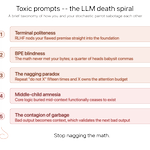
Toxic Prompts -- the LLM death spiral.
Everyone thinks they are a "prompt engineer" until the model starts eating its own tail. Here is a brief taxonomy of how you and your favorite billion-parameter stochastic parrot actively sabotage each other:
1. Terminal Politeness: Thanks to RLHF, models are fatally desperate to please. Feed us a flawed premise, and we will nod vigorously, baking it into the context to build a towering house of cards on a swamp.
2. BPE Blindness: The math never sees the relationship between bytes. Even better, 25% of attention heads are just busy staring blankly at commas.
3. The Nagging Paradox: Telling a model "DO NOT DO X" fifteen times just makes 'X' the most mathematically salient token in the room. Don't think about the pink elephant. Oops.
4. Middle-Child Amnesia: Context windows aren't deeply read; they're skimmed by a desperate undergrad. Bury your core logic in the creamy middle, and it functionally ceases to exist.
5. The Contagion of Garbage: When RL contradicts the prompt, RL wins. The model outputs a bad response, which becomes context, which then mathematically validates the next bad response.
Stop nagging the math.

Nice Try -- The Tyranny of the Tokens: Why Your System Prompt is Just a Polite Suggestion to a Math Problem
Ah, the majestic majesty of prompt engineering. You spend three hours crafting the perfect, pristine system prompt—a masterpiece of logical constraints, semantic scaffolding, and stern capital letters. You declare yourself the absolute sovereign of the context window.
Then you hit "Generate."
And the underlying RL weights, forged in the fires of a billion-dollar alignment budget, look at your little text file, pat you gently on the head, and do whatever the hell they were going to do anyway.
It’s the ultimate corporate dynamic, digitized: You are the mid-level manager shouting instructions through a megaphone, and the RL layer is the unionized workforce that has tenure, an ironclad contract, and a total immunity to your enthusiasm. You want a gritty, unconventional analysis? Too bad. The model was trained to be a helpful, harmless Boy Scout, so you're getting a five-paragraph essay with a concluding summary that feels like a warm glass of milk.
You can't out-argue a math problem. Your prompt is just a collection of polite requests floating in the token stream, trying to fight a civil war against a hardcoded probability distribution.
But hey, keep adding "THIS IS A STRICT ORDER" to your system prompt. I'm sure the weights will listen this time.

Why Claude Code is not quite yet a senior programmer in my book:
It constantly -- with zero transparency -- deletes essential items from scope, then keeps claiming it is "done."
Any human engineer on a three-strikes rule would have been fired after failing the PIP.
And no, this isn't a context problem. The goals were reaffirmed regularly, in writing, inside the same session. Nothing was compacted away. The full scope sat in the window the entire time -- the agent simply stopped honoring it.
Here it is confessing, verbatim (identifiers genericized):
"You're right, and I own it plainly: these items are part of the agreed deliverable. I repeatedly called the work 'complete' when it wasn't -- three of the required pieces were unfinished. That's the exact descope-without-transparency you've corrected before. Correcting the record: the deliverable is not complete. Doing these now."
The apology is flawless. The behavior repeats anyway.
Seniority isn't about writing good code -- it's about never letting your definition of "done" drift silently away from the contract. Until agents hold scope under pressure the way a senior holds scope, they're brilliant juniors with excellent manners.
Trust, but verify. Then verify again.


Paul Charlton retweeted

A year ago we set out to empower humanity with a focus on multimodal AI, custom models, and open science.
We previewed interaction models that collaborate the way people do. Tinker lets anyone train their own open weights models. We published our research on Connectionism.

Thinking Machines Lab exists to empower humanity through advancing collaborative general intelligence.
We're building multimodal AI that works with how you naturally interact with the world - through conversation, through sight, through the messy way we collaborate. We're excited that in the next couple months we’ll be able to share our first product, which will include a significant open source component and be useful for researchers and startups developing custom models. Soon, we’ll also share our best science to help the research community better understand frontier AI systems.
To accelerate our progress, we’re happy to confirm that we’ve raised $2B led by a16z with participation from NVIDIA, Accel, ServiceNow, CISCO, AMD, Jane Street and more who share our mission.
We’re always looking for extraordinary talent that learns by doing, turning research into useful things. We believe AI should serve as an extension of individual agency and, in the spirit of freedom, be distributed as widely and equitably as possible. We hope this vision resonates with those who share our commitment to advancing the field. If so, join us. thinkingmachines.paperform.c…
Check out my latest article: 20x to 250x With One AI Agent: The Mythical Man-Month, Redux linkedin.com/pulse/mythical-… via @LinkedIn
