

Business Development Partner at @VictusGlobal // Project Ambassador // Tier 𝟙 KOL// Love Memecoins
Joined March 2022
- Tweets14.1K
- Following2.8K
- Followers16.6K
- Likes13.5K





Pinned Tweet
I just rethought what “decentralized infrastructure” actually means and it pushed me to make a move.
Here’s what I discovered about BTFS, why it matters for Web3 + AI, and why I’m paying close attention
@BitTorrent @justinsuntron #BTFS #TRONEcoStar

One general-purpose assistant may not be the ideal way to organize every task.
Different responsibilities can benefit from separate agents with their own contexts.
BAIclaw addresses this through a dedicated agent management page and @ mention routing.
Users can direct conversations to specific agents rather than treating every request as part of one continuous interaction.
The comparison presents three approaches:
→ BAIclaw: Dedicated agent page with @ mention routing.
→ OpenClaw CLI: Command-line switching.
→ Cloud AI assistants: Single-conversation experience.
This is useful because context matters.
When users separate different responsibilities into dedicated agents, they can organize their interactions more clearly.
BAIclaw makes that process accessible through its graphical interface.
@justinsuntron @BAI_AGI #TronEcoStar

150
Interest rates on JustLend are not static.
They adjust according to the supply and demand conditions of individual money markets.
Consider what happens when borrowing demand increases.
→ More users borrow from a particular market.
→ Available liquidity decreases.
→ Utilization increases.
→ Borrowing interest rates rise.
→ Higher rates can encourage additional supply while discouraging excessive borrowing.
The reverse can happen when borrowing demand is low.
More available liquidity can put downward pressure on borrowing rates, making the market more attractive to borrowers.
This dynamic interest-rate model helps balance the interests of suppliers and borrowers.
It also gives users an important reason to monitor market conditions before supplying or borrowing.
@justinsuntron @DeFi_JUST #TRONEcoStar

125
One of the interesting additions highlighted in the SUN.io documentation is SUN AI.
The feature is presented as a conversational AI interface that allows users to interact with DeFi through natural-language commands.
Its listed capabilities include:
→ Queries.
→ Token swaps.
→ Liquidity management.
This creates a different way to approach DeFi interactions.
Instead of navigating every operation manually, users can communicate their intentions through natural language.
The broader idea is to make certain DeFi activities more accessible through an AI-powered interface.
It also reflects an interesting direction for blockchain applications: combining traditional on-chain infrastructure with AI-driven interaction.
SUN AI brings that concept into the SUN.io ecosystem.
@justinsuntron @OfficialSUNio #TRONEcoStar

102
Not every download needs to start immediately.
Sometimes the best time to download is when the network is less busy or when the computer is not being used for other demanding activities.
BitTorrent Classic includes a scheduler that allows users to specify when downloads or seeding should take place.
This provides more control over the downloading routine.
→ Schedule downloads for selected periods.
→ Set convenient times for seeding.
→ Reduce competition with other network activities.
→ Organize downloading around your daily routine.
Scheduling turns torrent management into something more structured.
Instead of manually starting and stopping every task, users can configure the client to follow a preferred timetable.
@justinsuntron @BitTorrent #TRONEcoStar

88
BTTInferGrid’s economic framework also introduces a Fee-Based Burn / Sink Mechanism.
The concept is that a portion of user-paid fees can be burned or recycled into the reward pool.
This creates two possible economic functions:
→ Burning removes tokens from circulation.
→ Recycling directs a portion of fees back into incentives.
Both are connected to the network’s economic activity.
Rather than relying entirely on token emissions to support incentives, the mechanism introduces a relationship between fees generated by users and the reward structure.
This is important because actual network usage can contribute to the economic system supporting resource providers.
It connects the demand side of the network with its incentive design.
@justinsuntron @BitTorrent #TRONEcoStar

94
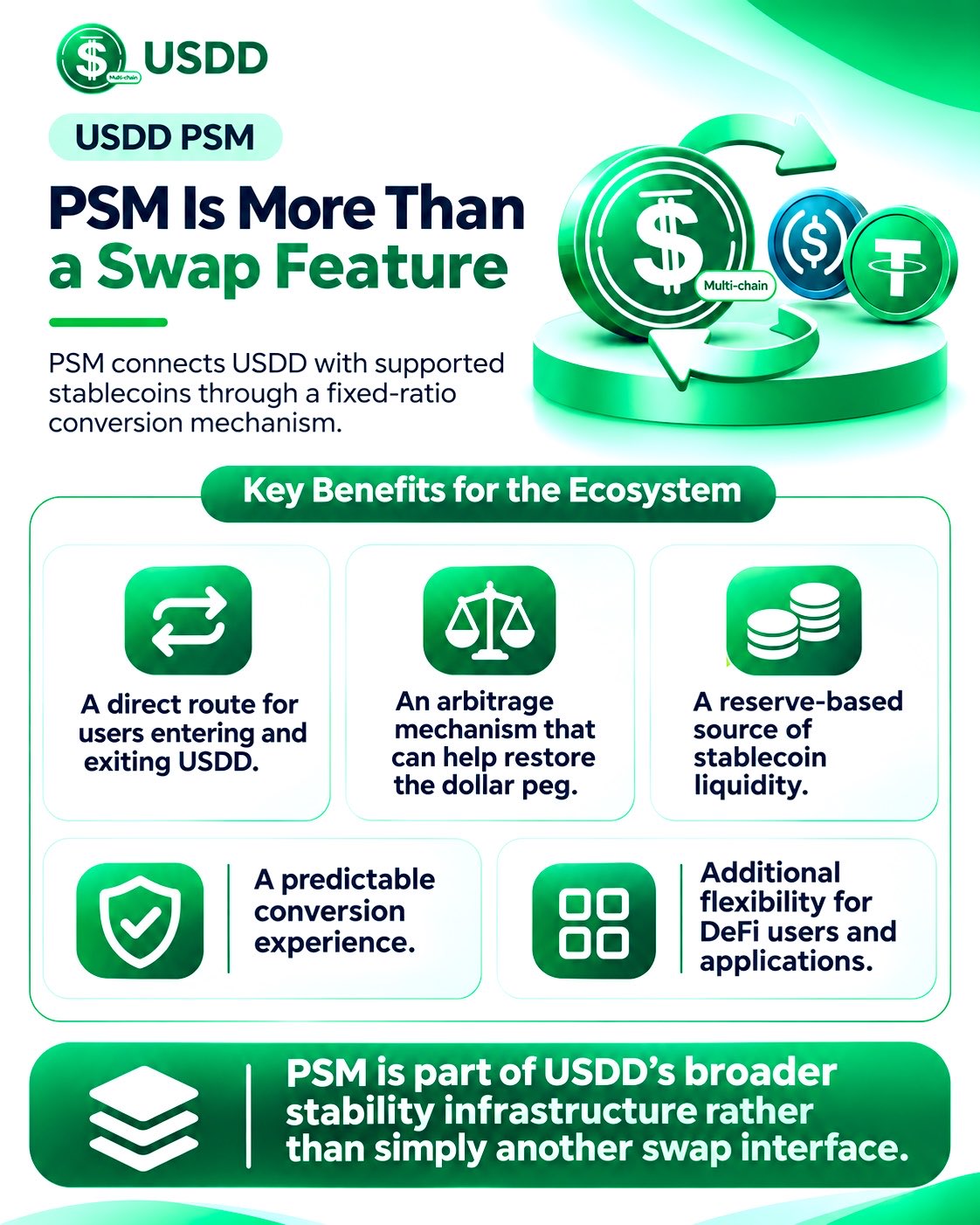
It is easy to look at PSM and see only another stablecoin conversion tool.
But its role within USDD goes further.
PSM connects USDD with supported stablecoins through a fixed-ratio conversion mechanism.
That creates several benefits for the ecosystem:
→ A direct route for users entering and exiting USDD.
→ An arbitrage mechanism that can help restore the dollar peg.
→ A reserve-based source of stablecoin liquidity.
→ A predictable conversion experience.
→ Additional flexibility for DeFi users and applications.
These functions make PSM part of USDD’s broader stability infrastructure rather than simply another swap interface.
@justinsuntron @USDDecentralize #TRONEcoStar
85
AI interaction is no longer limited to a single application.
People communicate across different platforms, and managing separate assistant environments can become inconvenient.
BAIclaw highlights multi-platform access across 6+ channels through a graphical interface.
This is a major part of its positioning.
The comparison shows:
→ BAIclaw: Access across 6+ channels with GUI management.
→ OpenClaw CLI: Requires manual configuration.
→ Cloud AI assistants: Presented as single-platform solutions.
The benefit is a more centralized way to manage AI access across different communication environments.
Rather than treating every channel as a separate setup, BAIclaw aims to make multi-platform management easier.
@justinsuntron @BAI_AGI #TRONEcoStar

81
Collateral protects lending markets, but collateral values can change.
Imagine a borrower supplies an asset and uses it to borrow another token.
If the collateral loses value or the borrower’s outstanding debt increases, the position can become increasingly risky.
JustLend uses a Risk Value metric to assess borrowing positions.
The formula is:
Risk Value = Total Borrow ÷ Borrow Limit × 100
A Risk Value above 100 indicates that the position has crossed the liquidation threshold.
At that point, eligible liquidators can repay part of the borrower’s debt and receive a portion of the collateral according to protocol rules.
This process helps address unhealthy borrowing positions and protects the market.
The lesson for borrowers is important:
Monitor collateral values, borrowing balances and Risk Value. Do not wait until a position approaches liquidation before managing its risk.
@justinsuntron @DeFi_JUST #TRONEcoStar

85
The SUN.io documentation identifies veSUN and tokenomics as important topics for ecosystem participants.
This is worth exploring because governance participation and token economics are closely connected in many DeFi ecosystems.
The documentation provides dedicated entry points for users interested in:
→ SUN DAO governance.
→ veSUN.
→ Tokenomics.
→ Proposals and voting.
These areas help participants understand how governance is organised and how token-related mechanisms fit into the broader ecosystem.
Rather than looking at SUN.io only through its swap and liquidity features, users can also explore the economic and governance structures behind the protocol.
For long-term ecosystem participants, understanding these mechanisms provides a broader perspective on how decentralised protocols operate.
@OfficialSUNio @justinsuntron #TRONEcoStar

83
BitTorrent Classic also supports remote torrent management.
According to its official product information, users can add torrents to their desktop client remotely through BitTorrent Android or a browser on another device.
Think about the convenience.
A user can manage a download task without having to sit directly in front of the computer running the client.
The remote feature creates another layer of flexibility for people who maintain a home downloading setup.
It also shows how a desktop torrent client can fit into a broader, connected device experience.
@justinsuntron @BitTorrent #TRONEcoStar

81
Reward distribution is an important part of any DePIN economic model.
If providers receive substantial incentives regardless of whether their resources are being used, the network risks encouraging unnecessary supply.
BTTInferGrid’s Utilization-Weighted Rewards approach addresses this issue.
Its framework gives minimal rewards to idle resources while meaningfully rewarding actively utilized compute.
Why does this matter?
→ It links rewards more closely to productive contribution.
→ It discourages dependence on idle resource capacity.
→ It gives providers an incentive to serve actual inference demand.
→ It helps align network incentives with resource utilization.
This is a different way of thinking about compute rewards.
The focus shifts from rewarding hardware availability alone to recognizing the compute that is actively contributing to network activity.
@justinsuntron @BitTorrent #TRONEcoStar

75
A fixed 1:1 exchange rate is useful, but the mechanism also needs available assets to fulfil swaps.
USDD PSM operates through reserves of supported stablecoins.
When users exchange supported stablecoins for USDD, the mechanism provides the corresponding USDD.
When users exchange USDD for another stablecoin, the corresponding asset must be available in the reserves.
This introduces two important considerations:
→ Available reserves determine how much of a particular stablecoin can be exchanged.
→ Swap limits can restrict the amount processed through the module.
So, while PSM offers a fixed conversion ratio, users should always check the available amount before initiating a transaction.
A predictable exchange rate and available liquidity are both important.
@justinsuntron @USDDecentralize #TRONEcoStar

76
Most people interact with AI by opening a conversation and submitting a prompt.
But recurring work does not always need to begin with a new manual instruction.
BAIclaw includes scheduled task management with visual cron configuration.
This allows users to configure when automated tasks should execute.
The comparison highlights an important difference:
→ BAIclaw: Visual cron configuration.
→ OpenClaw CLI: Requires manual configuration.
→ Cloud AI assistants: Scheduled tasks are listed as unsupported in the comparison.
This capability makes BAIclaw interesting for people who want AI assistants to become part of recurring workflows.
Instead of manually initiating every repeated task, users can configure execution schedules in advance.
@justinsuntron @BAI_AGI #TRONEcoStar

75
Supplying $1,000 worth of assets to JustLend does not automatically mean a user can borrow $1,000.
The protocol uses collateral factors to determine how much of a supplied asset’s value can count towards borrowing capacity.
For example:
If an asset has a collateral factor of 80%, supplying $1,000 worth of that asset contributes $800 towards the borrowing limit.
Different assets can have different collateral factors.
Why?
→ Highly liquid, large-cap assets may receive higher collateral factors.
→ Less liquid assets may receive lower collateral factors.
→ Riskier collateral receives more conservative borrowing parameters.
The borrowing limit is calculated using the value of eligible supplied assets and their respective collateral factors.
This is an important risk-management mechanism.
It helps ensure that borrowing remains supported by sufficient collateral rather than allowing users to borrow against the entire value of their deposits.
@justinsuntron @USDDecentralize #TRONEcoStar

76
DeFi protocols are not only about trading and liquidity.
Governance also matters because it provides a framework for ecosystem participants to engage with protocol decisions.
SUN.io’s documentation includes SUN DAO governance as one of its core areas.
Users can explore:
→ SUN DAO governance.
→ veSUN and tokenomics.
→ Protocol proposals.
→ Voting processes.
These components provide a framework for participation in governance-related activities.
Proposals create a way to present changes or initiatives for consideration, while voting provides a mechanism for eligible participants to express their preferences.
For anyone interested in the long-term direction of a decentralised ecosystem, governance is an important area to understand.
It connects tokenomics with community participation and protocol decision-making.
@justinsuntron @OfficialSUNio #TRONEcoStar

93
A torrent’s download experience depends partly on the availability of other participants sharing its content.
This is why swarm health matters.
BitTorrent Classic allows users to check the health of a torrent’s swarm before starting and while a download is in progress.
Why is this useful?
→ It provides information about the availability of peers.
→ It helps users assess whether a torrent is likely to download efficiently.
→ It offers visibility into conditions that can affect download performance.
A torrent file alone does not guarantee a fast download.
The availability and activity of peers are important parts of the peer-to-peer distribution process.
Understanding swarm health helps users make more informed decisions.
@BitTorrent @justinsuntron #TRONEcoStar

85
Not all available compute contributes equally to a decentralized AI network.
A GPU that is actively processing inference requests is providing a different level of economic utility from one sitting idle.
BTTInferGrid addresses this through Utilization-Weighted Rewards.
The framework specifies:
→ Idle resources receive minimal rewards.
→ Only actively utilized compute is meaningfully rewarded.
This creates a distinction between simply supplying hardware and actually contributing useful compute capacity.
It also changes the incentive structure for resource providers.
Instead of focusing entirely on how much hardware they can connect, providers have a stronger reason to focus on whether their resources are being used.
The principle is simple: meaningful network participation should be reflected in meaningful rewards
@justinsuntron @BitTorrent #TRONEcoStar

88
Stablecoin users often need flexibility.
Sometimes they want to convert USDT or USDC into USDD. At other times, they may want to move from USDD back into another stablecoin.
PSM supports both directions.
The process is simple:
→ Deposit a supported stablecoin and receive an equivalent amount of USDD.
→ Deposit USDD and receive an equivalent amount of a supported stablecoin.
This gives users a direct conversion route without relying on the price curve of a traditional liquidity pool.
For people interacting with the USDD ecosystem, having a predictable entry and exit mechanism is an important feature.
@USDDecentralize @justinsuntron #TRONEcoStar

89
AI assistants become more useful when users can adapt them to different workflows.
BAIclaw’s comparison highlights full OpenClaw ecosystem support as one of its customization advantages.
OpenClaw CLI is also presented as supporting the full ecosystem, while cloud AI assistants are described as offering more limited customization.
This creates an important distinction.
An assistant should not be restricted to one predefined way of working.
Users may want to extend capabilities, organize different agents and adapt their environment to specific tasks.
BAIclaw brings that customization into a graphical management experience.
The combination of ecosystem flexibility and visual controls makes customization more accessible without making command-line interaction the centre of the experience.
@BAI_AGI @justinsuntron #TRONEcoStar

88
Borrowing on JustLend begins with collateral.
Users first supply supported assets and use eligible supplied assets as collateral to establish their borrowing capacity.
The process can be understood in four stages:
→ Supply assets into the protocol.
→ Enable eligible assets as collateral.
→ Select an asset with available borrowing liquidity.
→ Borrow within the account’s permitted borrowing capacity.
Borrowing interest is calculated dynamically according to market conditions.
Unlike a conventional loan with a negotiated maturity date, the protocol’s borrowing process does not require users to arrange individual loan-expiry terms.
Borrowers must still monitor their debt, interest and collateral position.
The amount available to borrow depends on the value of eligible collateral, the applicable collateral factors and the protocol’s risk parameters
@justinsuntron @DeFi_JUST #TronEcoStar

95