

Staying on top of things by understanding what the market is pricing. Stocks, macro and the stuff in between.
Joined September 2026
- Tweets75
- Following55
- Followers24
- Likes34


Pinned Tweet
In my opinion, calling $HOOD a brokerage is starting to miss what the company is turning into.
For transparency, I am long $HOOD . I think a thesis is easier to judge when you know whether the person writing it actually has skin in the game.
The core business is still growing. Particularly, Q2 revenue hit a record $1.31B. Platform assets reached $384B in August and equity trading volume was up 68% YoY.
Robinhood processed 4.7B prediction-market contracts in August. That is 15x last year! It now has more than 1M funded customers internationally. Stock tokens are already available across more than 120 countries and Robinhood is building its own blockchain infrastructure around them.
The company's direction is clear. They does not want you opening the app only when the stock market is open. Stocks. Options. Crypto. Prediction markets. Tokenized assets. They can all be traded for longer hours and across more countries.
I believe the next leg of the story is less about adding another few million brokerage accounts. It is more about getting existing customers to use more products and more often in a day.
Of course, there are risks as well. A lot of these newer businesses are still tied to trading activity and regulation. Prediction markets are facing legal challenges and tokenized equities are still tiny compared with the traditional stock market.
There is still plenty to prove but I think the next few years are more about watching Robinhood’s revenue mix than just watching funded-account growth.
The stock is also running into overhead supply around 120-125 near the September high. A clean push through that area would make the setup stronger. Rejection there would make me more cautious about adding.

SoftBank is borrowing more than $11B to fund its OpenAI investment. Some of the bonds are being marketed around 9% to 10%.
My opinion is that AI is starting to get a real cost of capital. Funding these bets from cash is one thing. Borrowing at close to 10% changes the math pretty quickly.
OpenAI does not just need to grow now. The returns eventually have to justify some very expensive money. I think investors may start paying a lot more attention to cash generation from here.

bitcoin:native Bitcoin is back above $85K and $HOOD is up nearly 5% premarket.
Last quarter, crypto was only 8% of Robinhood’s revenue. Prediction markets already made more. My view is that Bitcoin matters more to Robinhood as an activity trigger now.
People come back for crypto and Robinhood has a lot more ways to make money from them once they are there.
Options. Prediction markets. Gold. Margin.
If the rebound sticks, I will be watching the rest of the platform rather than just crypto revenue.

In my opinion, calling $HOOD a brokerage is starting to miss what the company is turning into.
For transparency, I am long $HOOD . I think a thesis is easier to judge when you know whether the person writing it actually has skin in the game.
The core business is still growing. Particularly, Q2 revenue hit a record $1.31B. Platform assets reached $384B in August and equity trading volume was up 68% YoY.
Robinhood processed 4.7B prediction-market contracts in August. That is 15x last year! It now has more than 1M funded customers internationally. Stock tokens are already available across more than 120 countries and Robinhood is building its own blockchain infrastructure around them.
The company's direction is clear. They does not want you opening the app only when the stock market is open. Stocks. Options. Crypto. Prediction markets. Tokenized assets. They can all be traded for longer hours and across more countries.
I believe the next leg of the story is less about adding another few million brokerage accounts. It is more about getting existing customers to use more products and more often in a day.
Of course, there are risks as well. A lot of these newer businesses are still tied to trading activity and regulation. Prediction markets are facing legal challenges and tokenized equities are still tiny compared with the traditional stock market.
There is still plenty to prove but I think the next few years are more about watching Robinhood’s revenue mix than just watching funded-account growth.
The stock is also running into overhead supply around 120-125 near the September high. A clean push through that area would make the setup stronger. Rejection there would make me more cautious about adding.
Pretty ugly weekend for geopolitics. Ukraine escalated attacks on Russia and the Houthis hit Saudi targets again.
Futures still opened green and oil is lower.
My view is that markets may be starting to price peak escalation rather than another leg worse from here.
A lot of the obvious damage has already happened. Oil has been above $100. Shipping has been disrupted. Saudi infrastructure has been attacked.
However, it can still deteriorate. Need to see whether the next headlines actually move oil, shipping or yields.
$QQQ $SPY
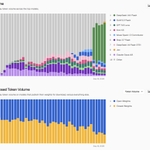
DeepSeek V4.1 Flash is 64.8% of token volume on Vercel. It is only 4.5% of spend.
My take is that token volume is starting to tell us less about where the money goes. Cheap open models can soak up a huge amount of inference without creating much revenue.
That probably pushes OpenAI and Anthropic further toward work companies are willing to pay more for. OpenAI is already leaning harder into Codex and agents. Anthropic is doing the same with Claude Code.
If the cheapest "good enough" model keeps changing, developers have less reason to stay loyal to one API. I can see model pricing falling while spend on agents keeps rising. AI usage could grow much faster than model revenue from here.
Token volume may become a poor measure of who is winning economically.

CXMT says its new DRAM process can produce 50% more dies per wafer.
My take is that China does not need to catch $MU Micron in HBM to matter here. Fifty percent more dies is a lot of extra conventional DRAM supply. Micron leans harder into HBM because of it.
The uncomfortable part comes later. If HBM pricing cools, Micron could be coming back to a DRAM market that is already more crowded.

Relative strength is one of the things I pay the most attention to when day trading. By this, I don’t mean simply checking whether a stock is up 5% while QQQ is up 1%.
A sector ETF (State Street) and their equal weighted versions (Invesco) can tell you whether the move has breadth. They shed light on whether the index is being carried by a handful of names or most stocks are participating
I believe actual intraday relative strength is more granular and compare candles almost bar by bar.
If QQQ pulls back, does the stock move?
If QQQ makes a lower low, does the stock hold?
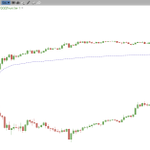
$HOOD and $SNDK are just some examples below.
QQQ spent a large part of the session recovering from weakness. HOOD and SNDK had already made a strong move, stayed above VWAP and kept holding near the highs instead of giving much back.
Every time the market gave it a reason to sell, buyers kept absorbing it. Breadth tells me whether the environment is supportive. But relative strength tells me which stock I actually want to trade.


The Fed raised rates 25bps. For $CRCL , that is both good news and a warning sign.
Circle actually has quite an unusual business model. USDC itself does not pay you interest. Circle backs those dollars with highly liquid reserves including cash, short term Treasuries and overnight Treasury repos. Circle gets to earn the yield on those assets.
This income is still the majority of the business. Just for Q2 alone, Circle earned $667.7M of reserve income out of $701.3M (~95.2%) in total revenue and reserve income. So higher treasury yields translate to more income on the assets backing USDC.
But do note that Circle does not get to keep all of it. Its model estimates about $360M of additional distribution and transaction costs for every 100bps. Coinbase is a big part of that and Circle incurred about $324.6M of distribution costs related to its Coinbase agreements.
Higher rates also make USDC less attractive if all you want to do is park cash. USDC itself earns 0%. So if short term Treasuries and money market funds can give you close to 4%, holding a 0 yield digital dollar becomes way more expensive in opportunity cost terms.
USDC still has another use though. People use it to trade, settle and move money around the clock. This demand may be much less sensitive to whether Treasury yields are 3% or 4%.
In other words, I would expect the net effects:
1) Make USDC more profitable for Circle
2) Make zero yield USDC less attractive as idle cash
3) Make $COIN distribution relationship valuable
4) Bigger incentive for Open USD and other competitors more economics to fight over
The real question is how much of reserve income Circle gets to keep over time.
I have no position in Circle.
Nasdaq is heading toward 23/5 trading and tokenized stocks are pushing selected names toward 24/7 trading.
I believe most people are looking at this as a convenience story. Being able to trade US stocks from Asia timezone and react to news immediately. No need to wait for Monday.
In my opinion, I think the bigger change could be what it does to the way price moves.
Take the opening range breakout (ORB) system for example. Today, 9:30am matters because a huge amount of buyers and sellers arrive at the same time. Overnight news gets processed quickly, volume jumps, and the market establishes a fresh range. But I can see the 9:30am open gradually becoming less about price discovery and more about liquidity confirmation.
If s stock has already been trading for 15 hours before New York wakes up, a lot of the overnight move may already be established. The question at 9:30am becomes whether the much larger pool of regular session buyers / sellers agrees with it.
Same thing for catalyst traders. An earnings surprise or major announcement today can create a huge gap and an episodic pivot the next morning. In a more continuous market, some of that gap could get traded away before the regular session even begins.
The catalyst does not disappear but the move just starts earlier. Episodic pivots could become multi-session moves instead of one giant gap. ORBs could become confirmation trades.
My guess is the technical setups will not vanish. The important or key levels may just stop being defined entirely by the opening bell. I could imagine traders eventually paying more attention to things like the Asia/Europe session highs and lows.
The headlines focused on the 25bps Fed rate hike but I believe the projections were the bigger story.
Normally, higher rates are used to cool an economy that is running too hot. Borrowing gets more expensive and companies have to pay more to refinance debt. Consumers tend to spend a little less as well.
But the Fed is doing this while it still expects the economy to hold up reasonably well. Latest projections have 2026 GDP growth around 2.3%, unemployment around 4.1% and inflation still well above the 2% target.
In my opinion, this is an important distinction. Higher rates are much easier for the stock market to handle when companies are still growing and consumers are still spending. The bigger problem would be rates staying high while growth starts weakening.
I am also monitoring the 10Y Treasury yield, which recently moved above 5%. In simple terms, this rate influences how expensive longer term borrowing is across the economy. When it stays high, mortgages and business loans stay expensive too. Investors are less willing to pay very high prices for companies whose profits are expected far into the future.
So my rough view is:
1) Rates up + strong economy = manageable
2) Rates up + borrowing costs keep rising + slowing growth = much more headwind for stocks
Having said that, there are companies that may actually benefit from this environment too.
$IBKR Brokers hold a lot of customer cash and lend money to clients who trade on margin. When interest rates rise, they can generally earn more interest on those balances. Interactive Brokers already earns a meaningful amount of revenue this way.
$CME Runs markets where institutions trade things like interest rate futures. The more uncertainty there is around where rates go next, the more companies and investors tend to hedge or trade that risk.
$JPM The big banks benefit too because they can charge more on loans. Some of them already raised their prime lending rates after the Fed hike. The catch is that higher rates can also mean fewer people borrowing and more borrowers struggling to repay. So I would not treat it as simple as "Rates up = banks up”.
My guess is the next phase of this market becomes less about whether the Fed moves another 25bps and more about who can actually live with higher borrowing costs for longer.
The market reaction tells us something too. Stocks initially sold off after the hike but recovered quickly. The 25bps itself was really not the surprise and investors all saw it was coming. The key focus is whether the Fed can get inflation under control without doing too much damage to growth.
For now, the market seems willing to believe the economy can handle higher rates.
New to X! Been following and trading the stock market for a while now, figured it is finally time to start sharing some of what I am looking at. Mostly interested in figuring out what is already priced in and what everyone else seems to be missing. If you are the type who overthinks markets for fun, we will get along!