

Founder & Head Sport Prep Coach @theuofstrength. Proud husband & dada, strength enthusiast and creator of Agility 5.0, Gameplay 7.0 & Inside The U.
Bedford, NH
Joined December 2015
- Tweets4.8K
- Following289
- Followers11.5K
- Likes2.2K




Pinned Tweet
Small Sided Games For Athletic Development Course
Most training relies on controlled drills & predictable patterns. But sport is dynamic, unpredictable, & constantly changing.
This course shows you how to design training environments that behave like sport, activities that look, feel, & act like the game itself.
Through practical video demonstrations & coaching guidance, you’ll learn how to use SSGs to develop movement skill, decision-making, gamespeed, & adaptability.
If you’re a coach, athlete, or parent, this course will give you the tools to build better training environments & unlock true skill transfer to sport.
theuofstrength.thinkific.com…
Forget the same 8–10 movements on repeat.
At #uofstrength, we embrace movement diversification & exploration.
Enter: Landing Prep
Same jumping task. DIFFERENT self-passing strategies:
🔹 Around the body
🔹 Between the legs
Different constraints. Different ground contacts. NEW movement solutions.
The goal? Challenge how athletes organize, adapt & solve movement problems.
The warmup isn’t just the beginning. It’s an opportunity for learning & skill adaptation.
Who says athletes need to master movement before they can explore it?
Clean reps. Perfect technique. One RIGHT way.
We flip the script…
Movement development thrives on:
🔹 Variability over repetition
🔹 Exploration over perfection
🔹 Problem-solving over prescriptions
🔹 Adaptability over rigidity
MESSY reps aren’t BAD reps. They’re LEARNING opportunities.
Change the environment. Change the problems. Expand the movement solution toolbox.
Want to experience a DIFFERENT approach to athletic development? Come check out our NEW home in Bedford, NH — Opening December 2026!
theuofstrength.com

At #uofstrength, we manipulate surfaces & environment constraints to challenge the athlete’s relationship with the ground.
Uneven surfaces👇
▪️Introduce variability
▪️Challenge 🦶 shape & contact strategies
▪️Develop adaptable jumping solutions
▪️Build resilience for chaotic sport environments
The ground is constantly providing information. The athlete’s job is to organize, adapt, & solve movement problems in real time.
Jumping is more than developing power. It’s an opportunity to build athletes who can organize force smoothly under changing conditions.
Right vs. Wrong or Movement Opportunities?
Too often, movement is labeled RIGHT or WRONG. But what if the “imperfect” rep is actually an opportunity to LEARN?
At #uofstrength, we prioritize:
🔹 Opportunities over rehearsals
🔹 Constraints over constant cueing
🔹 Principles over positions
🔹 Exploration over perfection
🔹 Adaptability over rigid repetition
The BIG question?
Not “Was the movement correct?”
But “Did the movement solve the problem?”
Movement ATTRACTORS are guides, not rigid templates. FLUCTUATORS reflect individual constraints & solutions.
The goal? Not perfect movement, but functional movement that solves the problems of sport.
Come experience our non-traditional approach to athletic development at our NEW home in Bedford, NH — Opening December 2026!
theuofstrength.com

Complex & contrast methods are key to our force development approach.
The goal? Train across the force-velocity continuum within the SAME SET.
Here’s a look at two of our pairings:
1️⃣ Unilateral Press ➡️ Throw
2️⃣ Unilateral Deadlift ➡️ Jump
Strength to speed.
It’s not just about how much force you can produce. It’s about how FAST you can generate it.
MORE force. MORE speed. MORE power.
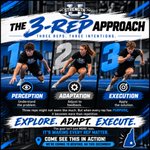
The 3-Rep Approach
Three reps. Three intentions.
1️⃣ PERCEPTION – Understand the problem.
2️⃣ ADAPTATION – Adjust to feedback.
3️⃣ EXECUTION – Apply the solution.
Three reps might not seem like much. But when every rep has PURPOSE, it becomes more than repetition.
Explore. Adapt. Execute.
The goal isn’t just MORE reps. It’s making every rep MATTER.
Come see this in action! We’re coming to Bedford, NH this December!

Who’s REALLY driving development?
🔹 COACH-CENTERED
The coach DIRECTS. The athlete FOLLOWS.
▪️ Prescribed movements
▪️ Predetermined solutions
▪️ Coach-controlled decisions
▪️ Repetition & compliance
🔹 ATHLETE-CENTERED
The coach GUIDES. The athlete EXPLORES.
▪️ Individualized environments
▪️ Constraints shape behavior
▪️ Training autonomy
▪️ Discovery & adaptability
The BIG Difference?
Coach-centered: Move how I want.
Athlete-centered: Discover what works & what doesn’t.
At #uofstrength, we don’t want athletes who simply follow instructions. We want PROBLEM-SOLVERS.
Less dictating. More facilitating.
The U of Strength is coming to Bedford, NH — December 2026!

Want to UPGRADE Your Warmup?
Add contact prep to your pre-training toolbox.
We finish our pre-training process with roughhousing activities that challenge force, coordination & problem-solving.
Inside the Activity: 1v1 Chaotic Kneeling Tag
🔹 Both youthletes remain in a tall kneeling position.
🔹 TAGGER: Tag your opponent within 5 seconds.
🔹 RESISTER: Use resistance to prevent the tag & exceed the time limit.
The Goal?
Prepare youthletes to manage force under physical interference.
Introducing Inside The U 2.0!
Go beyond traditional drills. Discover the WHY behind the WHAT.
🔹 Creative activity designs
🔹 Non-traditional training methods
🔹 Real-world applications
🔹 NEW content added DAILY
More than a video library. A constantly evolving resource to CHALLENGE conventional thinking, FUEL exploration & EXPAND your coaching toolbox.
theuofstrength.thinkific.com…

Being FAST means nothing if you can’t READ the game.
Speed in team sports isn’t just about movement. It’s about how quickly athletes can perceive, decide & act under uncertainty.
That’s why we use SSGs to challenge:
🔹 Visual scanning
🔹 Spatial awareness
🔹 Anticipation
🔹 Decision-making
🔹 Adaptable movement solutions
Inside the Activity: Perception Meets Acceleration
The task? Enter one side, exit the other as FAST as possible, while avoiding dynamic lateral obstacles (other participants).
Every rep presents a NEW problem. Opponents move. Space changes. Information changes. Solutions adapt.
The goal? Develop perceptual monsters who don’t just move fast, but perceive, decide & act fast.
Train the information that guides movement.
The 3 Bs of Human Movement
1️⃣ BRAIN – Perception
2️⃣ BIOMECHANICS – Actions
3️⃣ BEHAVIORS – Offensive & Defensive Intentions
Too many training programs focus on ONE: Biomechanics (Output).
But movement is more than mechanics.
We perceive to act. We act to perceive. It’s a continuous, interconnected process.
Perception guides action. Intentions shape behavior.
The goal? Stop training movement in isolation. Start designing activities that connect all 3 Bs.
Train the system, not just the movement.
The U of Strength is excited to welcome athletes to our NEW home in Bedford, NH — opening December 2026!

Developing power doesn’t always require traditional exercises or perfectly scripted movements.
At #uofstrength, we challenge youthletes to explore different bilateral force production strategies.
Here’s an inside look at our unorthodox approach to force development with our Foundation Level.
The Activity: Seated Jump & Unilateral Grab
🔹 The Pairing: Performed between sets of our primary resistance training movement (trap bar deadlift).
🔹 The Objective: Explore bilateral force production, explosive intent & coordinated total body power.
The Twist? Our ONE OPPORTUNITY Approach.
The youthlete gets ONE repetition per set. No practice attempts. No second chances.
Why? To encourage intentional movement, maximize effort & create an environment where every opportunity matters.
The goal isn’t just to produce MORE force. It’s to develop different strategies for EXPRESSING it.
MORE reps. MORE sets. MORE volume.
But does MORE always mean better?
At #uofstrength, we prioritize quality over quantity.
Our ONE OPPORTUNITY approach challenges athletes to maximize intent while minimizing unnecessary workload.
🔹 Quality over quantity
🔹 Intent over repetition
🔹 Adaptability over perfection
🔹 Effectiveness over exhaustion
The objective? Find the minimal effective dose, enough work to drive positive adaptations without unnecessary fatigue, compensation or excessive soreness.
Inside & outside the weight room, every opportunity has a purpose.
The goal isn’t to do MORE. It’s to get MORE out of LESS.

James Smith retweeted

Totally agree! One of mine main goals is actually helping senior *horses* rediscover / reclaim their gallop (first, without a rider). And it helps sneak gallop under the radar for the human, as we encourage mimicking the horse’s movements as a cue or reinforcer 😁
Galloping is one of those rudimentary movement skills that quietly disappears as athletes get older.
Often dismissed as “too simple” or difficult to measure, galloping plays an important role in developing rhythm, coordination, elasticity, & force application.
Galloping sits somewhere between skipping and sprinting, challenging athletes to organize asymmetrical movement while maintaining rhythm, shape, & intent.
Why Does It Matter?
🔹 Rhythm & Timing
🔹 Front-Side Mechanics
🔹 Asymmetrical Force Transmission
🔹 Coordination
Inside the Activity: Gallop to Box Jump
The task? Perform one gallop followed immediately by a box jump. Rep to rep, we manipulated the distance between the starting position & the box to influence different force vectors, timing demands, & takeoff strategies.
The Goal?
Don’t just develop athletes who can jump higher or further. Develop athletes who can organize, coordinate, & transfer force in different ways.
Simple doesn’t mean easy. And measurable doesn’t always mean meaningful.
The Agile Programming Model
The best programs don’t follow a “perfect” 8-, 10-, or 12-week progression, they adapt to the athlete in front of them.
Instead of asking, “What’s the next progression or regression?” Ask, “What is this athlete showing me today?”
An agile programming model is built around four key considerations:
1️⃣ Individual Structure – Every athlete organizes movement differently based on their physical makeup.
2️⃣ Action Capabilities – What can they produce, accept, coordinate, perceive & control today?
3️⃣ Rate Limiters – What’s limiting performance right now?
4️⃣ Rate Enhancers – What gives them an advantage?
The goal isn’t to remove structure, it’s to make structure adaptable.
We’re bringing a new approach to athletic development to Bedford, NH — opening soon!

Stop chasing perfect mechanics. Start creating more meaningful problems.
At #uofstrength , we don’t believe in micromanaging every step, angle, or position.
Instead, we manipulate the environment, task constraints, & intentions to allow movement solutions to emerge.
🔹 The environment becomes the teacher.
🔹 Constraints guide behavior.
🔹 Athletes learn to adapt, not imitate.
Speed isn’t just about HOW you move. It’s about WHY, WHEN, & WHERE you move.
Here’s an example from our 1/2 Kneeling Self-Toss Ball Chase Acceleration activity.
The design:
▪️ Start in a 1/2 kneeling position.
▪️ Self-toss the ball.
▪️ Accelerate & catch it before the second bounce.
▪️ Manipulate the initial direction to create different acceleration demands.
The goal isn’t to force perfect techniques. It’s to develop athletes who can organize their movements around the demands of the task.
Biomechanics matter. But adaptability matters more when the game gets messy.
Being FAST doesn’t always mean playing FAST.
🔹 SPEED — Developing physical capabilities:
▪️ Force potential & elasticity
▪️ Limb velocity & pretensioning
▪️ Muscle slack reduction
▪️ Rate of relaxation
▪️ Positional awareness
🔹 GAMESPEED — Expressing speed under uncertainty:
▪️ Perceptual attunement
▪️ Decision-making
▪️ Anticipation
▪️ Tactical awareness
▪️ Adapting acceleration, max velocity & curved speed to changing information
The Difference?
Both matter. But the fastest athlete isn’t always the fastest problem-solver.
The goal isn’t just to develop faster athletes. It’s to develop athletes who can USE their speed in the chaos of sport.
Want to take your GAMESPEED to the next level? Come experience The U of Strength at our NEW home in Bedford, NH — opening this December!


Med ball throwing isn’t separate from speed…
It’s an extension of it. Acceleration characteristics all show up, just slowed down enough for athletes to feel & refine solutions.
Here’s a look at a recent design and how we use the seated position to influence a lower center of gravity & mimic shapes comparable to the acceleration phase of sprinting.
This isn’t about looking “right”. They’re about discovering what works and what doesn’t.