

Cold, wet and sandy… as God intended. 🇺🇸 "The map is not the territory." A(n) - Forward Compute
Pennsylvania, USA
Joined January 2017
- Tweets4.2K
- Following2.1K
- Followers35.5K
- Likes155K








Pinned Tweet
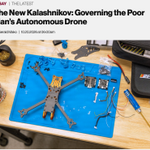
No, The New Kalashnikov Is Not a Weapon – A rebuttal to Gerald Mako's @smallwars opinion.
Cheap commercial drones fitted with readily available guidance software have collapsed the cost of precision strikes. Ukraine has demonstrated the method at scale: mass-produced frames, improvised warheads, and increasingly autonomous terminal guidance have given states and non-state actors capabilities once reserved for conventional military forces. The warfare equation has changed. That much is not disputed.
What does not logically follow is the policy package offered to reverse it.
Gerald Mako's argument for tighter controls on hardware that enables onboard autonomy, enforceable obligations on manufacturers whose platforms are routinely militarized, and a minilateral coalition of component producers treats the commercial dual-use ecosystem as if it were a controllable arsenal. It absolutely is not. The systems in question began as hobby, racing, photography, and agricultural products and became weapons only after conversion. The proposed remedies – manufacturer due diligence, conversion-resistant firmware, and supply denial of enabling components – do not survive contact with how these systems are actually built and fielded.
The AK-47 analogy fails as an analogy. The Kalashnikov was purpose-designed as a military weapon and then deliberately proliferated as a geopolitical instrument: cheap, rugged, and simple to operate by design. Small UAVs and FPV platforms followed the opposite path. They began as commercial products before being adapted, often in small shops and wartime factories, into delivery vehicles. The distinction is acknowledged in passing and then ignored. A weapon that begins as a weapon can be regulated as one. A commercial airframe that becomes a weapon only after a user straps on a warhead or swaps the flight controller presents a fundamentally different regulatory problem.
Imposing strict due-diligence duties, secure-boot mandates, and market-access conditions on commercial manufacturers because downstream actors convert their products is the gun-control argument applied to dual-use electronics. A manufacturer cannot reasonably be held responsible for every illicit modification any more than a tire company can be held liable for a drunk-driving manslaughter. The article concedes that no firm can be responsible for every conversion, then recommends treating refusal to adopt “reasonable” anti-militarization features as grounds for exclusion from Western markets. That substitutes upstream obligations for downstream enforcement. Such measures may deter some casual misuse and impose compliance costs. They will not stop a knowledgeable bad guy.
The practical failures are straightforward. Software is already open and mirrored. Jailbreaks, forks, and companion computers have been routine in the hobby community for years and are now industrialized. Physical conversion does not require defeating firmware. A warhead and basic fuze can be zip-tied or strapped to a commercial platform. Motors, props, batteries, and boards can be stripped from a “conversion-resistant” airframe and reused on an open stack. Middle markets and gray-market channels for commodity components persist as a structural feature of global trade, not a temporary loophole. These realities make conversion resistance a weak foundation for policy.
Local fabrication has already collapsed the premise that the original commercial stack is an indispensable chokepoint. Ukraine’s wartime industry is the existence proof. Firms there now machine motor housings, wind stators, fabricate or assemble flight controllers, ESCs, and initiation boards, and produce frames and props at meaningful volume. Localization of 70–90 percent or more is documented across multiple producers, with isolated examples of near-full domestic component sets for FPV systems. Residual dependencies remain – high-grade magnets, battery cells at volume, certain specialized sensors, higher-end edge chips – but they are narrower than a comprehensive supply-denial regime assumes. Once process knowledge and modest equipment exist, a determined actor does not need the original manufacturer for an effective short-to-medium-range system. Targeting commercial makers or the commodity layer cannot be the primary line of effort.
The coherent response is therefore actor-centric. If the concern is bad actors using drones, policy should target those actors and the systems they field. That means intelligence and interdiction against the specific groups, workshops, conversion networks, and deployment chains that assemble, arm, and employ them. It means layered detection and defeat once the systems are in the air. It means narrow restrictions only where they can be tied to identified diversion networks and the few high-end items that still materially improve particular programs. It does not mean spreading friction across legitimate commercial markets, component producers, and software repositories in the hope of raising costs for actors who have already demonstrated their ability to substitute and fabricate around those frictions.
Two clocks are running, but not the clocks described. One is the conversion cycle on commercial frames. The other is the localization and substitution cycle that has already outpaced upstream controls. Geneva processes and minilateral component coalitions will not stop what small shops and motivated actors can already build. The practical task is to target the people who turn available technology into weapons, not the manufacturers and markets that produce the technology.


TimOnPoint retweeted

Guatemala sends its elite Kaibiles, some very tough and capable special forces, to back @nayibbukele against the gangs in Haiti.
It is the ultimate snobbery to underestimate these guys.

Guatemala🇬🇹 sale en apoyo de #bukele🇳🇮 mando un batallón de militares especializados. Serían los boinas rojas kaibiles (fuerzas especiales),
Mientras los políticos dominicanos? Quien sabe talves se estan haciendo la paja junto a los empresarios haitianos creadores del caos en haiti, uno nunca sabe. 🇳🇮❤️🇬🇹❤️🇭🇹🖤🇩🇴💩
The afternoon edition is up. We'll get the link thing fixed by Monday, one way or another. Until then, all posts and working links are archived at the website.

AUTOWAR25 Afternoon Edition, Friday, Oct. 23. The top 25 autonomous-warfare stories, ranked. 🧵
DIU and the Navy open a prize challenge for drone boats armed with counter-air weapons, and AUKUS runs more than 40 crewed and uncrewed systems off California. DARPA tests an autonomous robot strike team for EUCOM, and a Ukrainian drone raid shuts all four Moscow airports.
Every story with its links: autowar25 dot com (tap the link in our bio).


Yes, it's a bit funny.
Yes, that's the level of technology that turned the defense world on its head.
xitter.cf/WildcatThicket/status/…

Warhound would be the ultimate nickname.

Warhound, a defense‑tech startup founded by Palmer Luckey and Ben Lamm, has raised $200 million in seed funding to genetically engineer war dogs for the U.S. military.
Lamm is responsible for the de-extinction of the dire wolf which died out ~10,000 years ago.
Warhound will find top dogs and then biobank their genetic material before cloning the proven dogs.
The company will take the cell lines for top breeds like Belgian Malinois and German Shepherd before editing the genes to make the dogs perform better and improve “things like speed and agility or enhance olfactory sensors for bomb sniffing and whatnot.”
Luckey’s Anduril will supply the dogs with advanced body armor, ear coverings, and other military technology like EagleEye, an artificial intelligence military helmet.
Anduril is also reportedly working with META on battlefield augmented reality eyewear.
Lamm says the genetically modified dogs with advanced equipment will not only make the dogs safer, but will also make the human handlers safer.
The first Warhound puppies will reportedly soon be cloned and incubated and will be born in early 2027 and then will begin training.


The AUTOWAR25 Open Opportunities list is out. Links are at website below.
AUTOWAR25 Open Opportunities, Friday, Oct. 23. Open defense-innovation calls for autonomy and defense tech. 🧵
64 open items today, 2 new, plus 2 updated. Newest: an Army training-range RFI on Group 1 drone compatibility with the TRACR II interface, and a DLA sources sought for the MTRS robot's gripper. Army RCCTO extended its CAML-Lite autonomous launcher solution briefs to Monday morning.
Today's full list: autowar25 dot com/opportunities

We're keeping the @AUTOWAR25 archive website very plain – text and links – with a hope of being more friendly to DoW, gov and other organizational network services. Web address is below.

In no particular order:
• Humans have been manipulating the genes of dogs for thousands of years, so whatever...
• Call me when @PalmerLuckey is able to deliver my battle elk, goat, pig though.


Warhound, the brain child of Ben Lamm and Palmer Luckey, emerges from stealth to genetically engineer dogs for military and law enforcement.
spr.ly/6011BHZNMF


Oh.

BREAKING: Katie Hobbs-Aligned Canvassers Caught Willing to Allow Non-Citizens and a Felon to Vote
Muckraker went undercover in Arizona to investigate the groups working to re-elect Gov. Katie Hobbs @katiehobbs and other Democrats.
Here’s what we found:
Stand Indivisible Arizona (endorsed Gov. Hobbs in their 2026 ballot guide) — Our journalist posed as a Canadian citizen and asked to register to vote. The canvasser not only agreed to help the alleged non-citizen register, but when asked whether other Canadians could register too, she said, “Tell them to do it online.”
Worker Power (working to re-elect Gov. Hobbs) — Our journalist told a canvasser they were not a U.S. citizen. Despite this, at our journalist’s request, the canvasser marked “yes” on the citizenship question of the voter registration form.
When We Count (the DNC’s own registration program) — Our journalist posed as a felon on probation and asked to register to vote. The canvassers looked up the law and saw that a felon on probation is ineligible. Even so, they encouraged our journalist to register: “You should just do it.”
AFL-CIO (phone bank mobilizing voters for Gov. Hobbs) — Our undercover journalist asked a phone bank trainer whether to ask the people being called if they're citizens. The trainer’s answer: “We don’t care.”
Our journalists stopped every exercise before any voter registration form was submitted.
We also asked Gov. Katie Hobbs about these findings.
Watch this report and share it with the world.
"Damage to the monument, which included the removal of one depicted soldier's head along with additional destruction, is estimated in the hundreds of thousands of dollars..."


Follow up — yeah, he’s an illegal.

NEW: Multiple federal sources confirm to @FoxNews that the suspect arrested for using a sledgehammer to behead a WW2 Iwo Jima monument in Quantico, VA on Tuesday is a Mexican illegal alien & former DACA recipient whose legal status expired this year.
Miguel Alonso Maldonado Soriano has now been charged with felony destruction of property and trespass with intent to damage property.
Per federal sources, Soriano illegally crossed into the U.S. in December 1999. He was granted DACA by the Obama administration in 2014 and had it extended for years, most recently by the Biden admin in 2024, but he lost his DACA status in August of this year when it wasn’t renewed by the Trump administration.


Good morning everyone. The entire post archive is available with links at AUTOWAR25.com. We endeavor to get X link stripping problem solved by Monday.
AUTOWAR25 Morning Edition, Friday, Oct. 23. The top 25 autonomous-warfare stories, ranked. 🧵
AUKUS partners are running more than 40 crewed, uncrewed and autonomous systems off California, and the Pentagon's counter-drone task force lays out its one-buyer model. Ukraine launches interceptor drones from helicopters, and a cargo ship sinks off Romania after a suspected drone strike.
Full archive: autowar25 dot com

As movies go, a year that’s impossible to beat. I struggle to rank them — probably Aliens, but I’m a nerd like that.

Top Gun, Platoon, Heartbreak Ridge and Aliens all debuted in 1986. Here's why six military and war-related movies still deserve attention. military.com/6-military-and-…

Warhound, the brain child of Ben Lamm and Palmer Luckey, emerges from stealth to genetically engineer dogs for military and law enforcement.
spr.ly/6011BHZNMF
