





Pinned Tweet
I sell data center capacity for a living. The conversation with customers has changed completely in the last eighteen months.
It used to start with price per kW. Now the first question out of everyone’s mouth is when can you actually give me power, and the honest answer in most major metros is later than you want to hear.
Everyone wants to argue about GPU supply. That is not where the wall is. The wall is a transformer you order today that arrives in three years, a permitting process that answers to a county board, and an interconnection queue with roughly 2,000 gigawatts stacked up in it. PJM ran the numbers on projects that came online last year and the average was over seven years from request to live power. Three years to get an agreement, four more years to actually energize after the agreement was signed.
And this is the easy part. We are nowhere near the peak of this demand curve. There is at least another order of magnitude coming, and the grid that is supposed to absorb it operates on utility capital planning cycles that were designed in a world where load growth was flat for twenty years.
Which is why the orbital compute argument stopped sounding exotic to me sometime around last fall. Up there you get uninterrupted sunlight, you dump heat straight into vacuum instead of running chillers, and there is no zoning hearing, no queue position, no substation to wait on.
Plenty of companies have interesting orbital compute concepts. Only one of them owns the rocket, has the scale, and deeply embedded partnership with Nvidia.
SpaceX filed with the FCC in January to launch and operate up to a million compute satellites, and there is exactly one launch provider on Earth with the cadence and the cost structure to make that number anything other than a press release. Starship is the reason this is an infrastructure plan and not a science project.
The constraint on the ground is the grid. The constraint in orbit is mass to LEO. SpaceX is the only company that has solved the second one.
$SPCX

Nvidia today announced that @spacexai will deploy Vera CPUs to accelerate its next generation of agentic AI applications.
"SpaceXAI plans to expand its AI infrastructure behind Grok on Nvidia Vera Rubin, while extending an optimized Vera Rubin NVL72 into space with its first-generation Starmind satellite.
SpaceXAI’s work with Nvidia is moving beyond AI factories on Earth. SpaceXAI is developing AI computing infrastructure for orbit, where power, thermal management, bandwidth, reliability and physical integration impose dramatically different constraints from conventional data centers.
SpaceXAI’s planned first-generation Starmind AI satellite will be based on the optimized Nvidia Vera Rubin NVL72 rack-scale system, extending the same accelerated computing architecture powering next-generation AI factories on Earth into space.
Nvidia and SpaceXAI are working to adapt that foundation to the requirements of orbital computing while preserving a common Nvidia architecture and software ecosystem.
This delivers one computing foundation across a wide range of environments: Vera CPUs accelerating increasingly sophisticated AI agents, Vera Rubin powering the AI infrastructure behind Grok and gigawatt-scale AI factories on Earth, and Nvidia accelerated computing extending into orbital AI infrastructure."


Putting this out there…
Here are my EOY 2027 $SPCX targets:
Base case: $3.5T ($258/share) +75%
Bull case: $6T ($442/share) +200%
If 13 GW is accomplished, the bull case is much more likely… base case (+75% from here) will likely be achieved mid-year as compute comes online and new compute leases are announced.
Ignore the noise… IMO, $SPCX is absurdly cheap @ $2T.

Ok. Listen. People are SEVERELY underestimating what SpaceXSI is building here…
If they execute (and they’ve proven they can) SpaceX is ABSURDLY undervalued.
13 GW of compute potentially online by EOY 2027.
Run the numbers yourself.
You’re looking at $500B+ in annualized revenue. More conservative $250-350B.
Imagine calling $SPCX expensive at ~$2T and then watching them scale towards these numbers over the next 12 months 😂🤣
So freakishly bullish. And then you get Starlink, Starlink Mobile, launch, moon and mars ambitions… I fucking love this company!!! ❤️ 🚀 🇺🇸

Grok 4.8. Calm before storm?
Haven’t heard anything in a while and by a while I mean 5 weeks, which in AI feels like a decade 😂
If you’ve used Grok Bot, clearly SpaceXSI is cooking but wonder where we’re at w/ 4.8. Soon?
The biggest takeaway should be that as token prices collapse, entirely new use cases become economically viable and consumption explodes…
and guess what? every one of those additional tokens still requires compute, power, and data center capacity.
We’re still incredibly early in this cycle. The demand elasticity is going to surprise a lot of people

I am shocked, absolutely shocked, that Anthropic ARR has likely gone vertical in October after they cut token prices.
Except the exact same thing happened for the entire AI market, which is why GPU rental prices have surged while token prices declined.
$100b plus in year-end ARR looks possible again.


Ordered Tesla’s Pirelli wheel and winter tires for the wife’s Cybertruck. Pretty good deal. Will see how they perform this winter. We went the last two winter’s w/out, but just safer and can feel more confident with winter tires. Last two seasons was the first time since I’ve owned a car that I didn’t put winter tires on our cars.

I find the comments coming from AT&T, Verizon, and T-Mobile about Starlink Mobile pretty amusing 😂
T-Mobile is questioning what gap in the market SpaceX plans to serve. Verizon is downplaying the competitive threat. AT&T is reminding everyone how expensive and difficult building a wireless network is.
I think they’re seriously underestimating what SpaceX is building.
SpaceX already operates the world’s largest satellite constellation, owns valuable wireless spectrum, and is potentially pursuing access to 80,000 cell sites across the U.S.
They’re building toward a hybrid satellite + terrestrial network capable of competing directly for wireless subscribers.
the opportunity is enormous. Even capturing a relatively small percentage of the U.S. wireless market could translate into billions in recurring annual revenue.
The incumbents keep explaining how difficult it is to build a traditional wireless network.
Meanwhile, their *potential* new competitor builds its own satellites, launches them on its own rockets, and is now looking to deploy terrestrial infrastructure at scale.
I wouldn’t underestimate the company that made reusable rockets and turned satellite broadband into a global business.
Particularly when that company is run by Elon Musk…
The Big 3 might want to spend a little less time explaining why this is difficult and a little more time considering what happens if SpaceX pulls it off 😂
My wife drives a Cybertruck, and with two kids, it’s been pretty epic.
The truck bed is awesome for hauling the stroller, wagon, Costco runs, and all the other stuff... (It's also extremely safe!)
Yesterday, I decided to bait her a little and asked if she wanted a Suburban instead.
Her immediate response: “No. I can’t get another car without FSD.”
😂 Exactly the answer I was hoping for. Just wanted to make sure.
FSD really is THAT good.
Once you get used to a Tesla driving you around nearly everywhere, it’s incredibly hard to imagine going back to a car without it.
It's also hard not to own $TSLA once you use this technology...
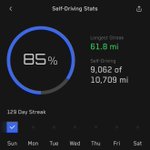
Wife’s stats. No we don’t worry about streaks.
85% of our last 10k miles 🤯


Tesla up 6% today. Couldn’t resist selling some covered calls 😂
Just sold 5 $TSLA $430 calls expiring Nov. 20, collecting $2,716 in premium.
We’ll see how these play out. I’d be happy to roll up and out if needed, but in typical $TSLA fashion, I expect it to pull back a bit.
Just looking for a quick, easy win.

out of my $IBIT covered calls.
Opened Sept. 16, had to manage and rolled Sept. 21 at a ~$6,500 loss, and just closed everything out for a net $775 profit.
I'll reassess when to sell more CCs over the coming days. Bitcoin feels a little like a beach ball under water…
and busy week ahead with earnings, inflation data, and the fed meeting.
Let's see where things go. 🚀 🐂
bitcoin:native
Everyone wants the returns of a long term investor.
Very few want to endure the volatility required to earn them.
They sell during corrections, wait for the perfect entry, and convince themselves they’ll get back in when things stabilize.
that’s an expensive habit.
It isn’t just Elon saying it… listen to what Amazon’s CEO is saying about data center demand.
Amazon is spending $220 BILLION this year, and they’re STILL leaving meaningful demand on the table.
2026: Sold out.
2027: Largely sold out.
2028: A significant portion already sold.
That’s an incredible statement when you consider the amount of capital being deployed across the industry.
I work in the data center industry, and I can tell you firsthand that the demand is very real. We’re seeing enterprises looking for multiple megawatts of capacity with very few options available.
And despite the enormous investments being announced, bringing new capacity online takes time. Power availability, infrastructure, equipment, and construction all constrain how quickly supply can respond.
I continue to believe we’re in the early stages of a massive infrastructure buildout.
If you’re an enterprise planning your future compute needs, you should be having conversations about capacity today.
The competition for power and data center capacity isn’t going away anytime soon.


The *entire* AI trade has been getting hammered over the last month…
CoreWeave down 38%. Vertiv down 22%. Micron down 18%. AMD down 16%. NVIDIA down 6%.
Meanwhile, $SPCX is essentially flat.
And this is while SpaceX has gone through multiple share unlocks, with everyone’s parade of unlock FUD around potential selling pressure.
I think that relative strength is pretty telling.
SpaceX is building an AI compute business with economics that is the best in the industry, alongside Starlink, direct-go-cell, and launch.
The market is increasingly focused on AI infrastructure economics, and I am of the belief that SpaceX is best positioned. Period.
One month obviously shouldn’t make an investment thesis, but the relative performance is certianly hard to ignore.
My conviction grown, particularly coming out of the Q3 earnings call... hard not to be bullish.
🤖 Made with AI

unavailable
The more I look at the economics of AI infrastructure, the more bullish I become on SpaceX.
David Sacks shared some fascinating numbers on All-In:
- SpaceX: ~$50B in monetization per GW, with roughly a 1-year payback.
- CoreWeave: ~$20B per GW, with roughly a 2.5-year payback.
These are estimates, but the difference is enormous.
A big reason is how the two companies structure their contracts.
CoreWeave relies heavily on long-term commitments to finance its infrastructure. SpaceX has the balance sheet and access to capital to operate with much shorter contracts, giving it exposure to today’s significantly higher compute pricing.
That flexibility is worth a LOT in a supply-constrained market.
And consider what happens when you’re recovering your capital in roughly a year. You can reinvest that money into additional compute, bring more capacity online, and potentially accelerate growth without relying as heavily on external financing.
Now consider SpaceX is targeting ~13 GW of operational compute capacity by the end of 2027.
The economics at scale could be extraordinary if they execute.
I’ve been extremely bullish on SpaceX for years, but the AI infrastructure opportunity has become a much bigger part of the investment thesis.
There’s never been a better time to be a long-term investor.
Innovation is accelerating, productivity is improving, and opportunities to own pieces of incredible assets have never been more accessible.
The next 20 years could create extraordinary wealth.
Make sure you’re participating.
I think we’re entering one of those periods where people will look back and wonder why they weren’t buying more.
The AI/autonomy/robotics trade has a LONG way to go.
Bitcoin looks ready for its next major move.
And I think the next 12-18 months could be incredible for investors.
My advice? Buy assets you believe in, keep buying, and think in decades.
If you can’t hold for 5 years, you probably shouldn’t be buying.
You don’t need to catch every move. You need to own the right assets long enough.
My big three…
$SPCX bitcoin:native $TSLA
Pretty interesting to see the S&P 500 trading at nearly the same forward P/E as the April 2025 selloff.
Earnings have grown significantly, yet valuations have continued to compress.
I’m still very bullish on where this market is headed, especially with AI investment and adoption accelerating.
If earnings keep delivering, there’s plenty of room for this bull market to run.
This is where we’re @ on the S&P 500:


And this is what makes the valuation compression even more interesting …
S&P 500 earnings estimates continue hitting record highs, with $370 projected for 2026 and $424 for 2027.
Earnings are accelerating while valuations are compressing.
Pretty bullish setup if you ask me. Especially with AI adoption still in its early stages.

