








Tom Lee retweeted

I still don’t understand why people save 100 articles a month and never open a single one again
you know that folder, bookmarks, pdfs, saved posts, a notes app full of half-read stuff
you saved it because future you would need it, and future you shows up and googles the same thing again because finding the note takes longer
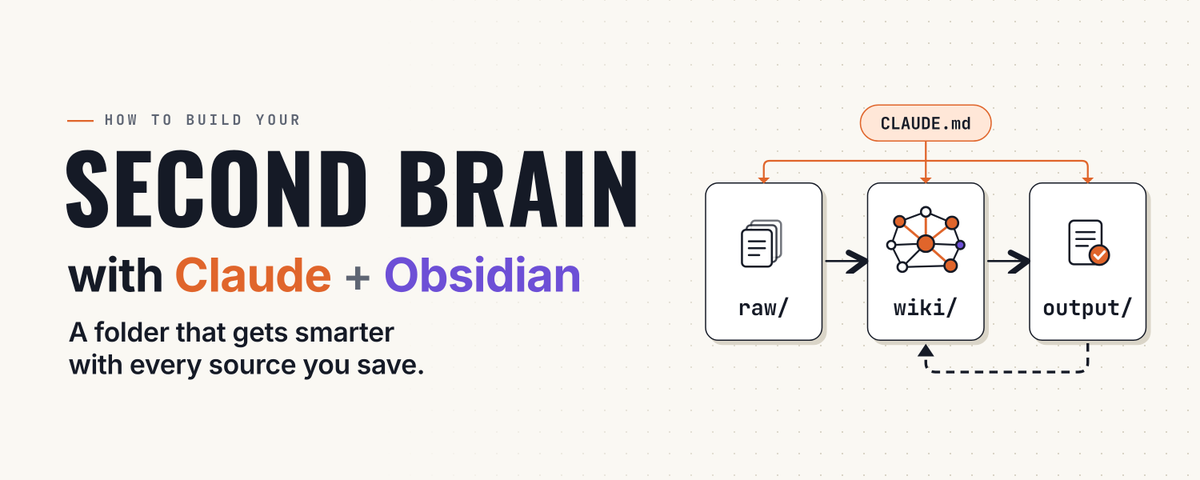
hand that whole mess to Claude Code and it becomes a wiki that knows where everything is
Claude reads, sorts, links and cleans up, you drop things in and ask questions
here is the setup:
make a folder with raw/ and wiki/, and a CLAUDE.md in the root
drop everything into raw/: articles, pdfs, transcripts, saved posts, nothing gets sorted by hand
open Claude Code and say “ingest raw/, write one wiki page per topic, link related pages and keep the source file name on every page”
ask your questions against wiki/ and never against your memory: “what do my notes say about X and where do they disagree”
once a week say “lint the wiki: find contradictions, orphan pages and stale notes”
CLAUDE.md is the part that makes it yours, it holds the rules:
one topic per page, lowercase file names
every claim links back to its source in raw/
when two sources disagree, keep both and mark the conflict
never delete a page, mark it stale instead
the more you drop in, the more every new note connects to what is already there
and before you write anything new, ask “what do I already know about this”, the answer comes from your own pages with the sources attached
your notes finally answer back


Tom Lee retweeted

This is f*cking insane. Former OpenAI CTO, Mira Murati:
"The models we work with today are turn-based. You talk, they talk, then they go off and think, and while they're thinking they're deaf and blind.
The next ones never stop listening. They take in audio, text and video all the time and answer in 20-millisecond chunks."
In just 2 minutes, she shows why the chatbot you type into is about to look like a fax machine.
Prompt Box → Chatbot → Agents → AI That Works Next To You In Real Time
A turn-based model waits for you to finish typing, then goes quiet while it thinks.
An interaction model sees and hears what you're doing, and can cut in the moment you start going the wrong way.
Anyone can type a prompt. Almost nobody is ready to work with an AI that never stops paying attention
Watch the full 2 minutes. This is worth your time.
Bookmark it, like it, save it, I don't care... this is the best thing you'll see on X today.
Tom Lee retweeted

This is f*cking gold, the CEO of Obsidian put his own second brain on GitHub for free and people still build theirs from zero
7 free repos from the Obsidian team:
-> kepano obsidian (by kepano)
github.com/kepano/kepano-obs…
the vault template of the Obsidian CEO himself, copy it and skip the blank page
-> jsoncanvas (by obsidianmd)
github.com/obsidianmd/jsonca…
the open canvas format, your maps stay plain files that are yours forever
-> obsidian releases (by obsidianmd)
github.com/obsidianmd/obsidi…
every community plugin and theme in one list
-> obsidian sample plugin (by obsidianmd)
github.com/obsidianmd/obsidi…
the official template, build the plugin you are missing
-> 40 questions (by kepano)
github.com/kepano/40-questio…
40 questions that turn your notes into a yearly review
-> obsidian minimal (by kepano)
github.com/kepano/obsidian-m…
a clean theme so your vault stops looking like a mess
-> flexoki (by kepano)
github.com/kepano/flexoki
the color scheme he made for writing and code
your second brain should never start from a blank page
copy his vault and make it yours


Tom Lee retweeted

Here’s why agent swarms are going to be a very big deal. We can finally make compute a critical variable in a large number of important tasks in the economy which wasn’t possible before.
There’s a large amount of work in the world that is essentially only constrained by the amount of time that we put into research, data processing, discovery work, running tests, and more. All of this work is bottlenecked by our ability to plan, execute, review, and coordinate everything happening in these workflows. Which means we basically do very little of them today relative to their economic value.
Agent swarms are the first real ability to parallelize this work in a way where - in theory - the only parameter that matters is how much compute you throw at the problem. Cyber security, life sciences or material science research, trading, QA testing, data processing, and many other fields are essentially compute constrained problems in the limit once models are good enough at these tasks.
The breakthrough is that in a world where agents can use tools, write code, process data, have strong domain depth, and can coordinate with each other, you can begin to solve arbitrarily complex problems by setting the right goals and applying enough tokens to the problem. This changes a lot of fields as well as even the competitive dynamics in these fields.
Tom Lee retweeted

Introducing Honen
Turn your company context into interactive courses that self-improve over time
We partnered with NVIDIA to bring AI literacy to 250,000 learners
We're ensuring no person or company gets left behind
Try free at honen.com/s/trynow
Tom Lee retweeted
Claude now works inside Google Docs, Sheets, and Slides, and those files also open inside Claude.
In Google Workspace, Claude sits in a sidebar next to your file, reads what you have open, and edits it in place. You can approve each edit before it lands.

Tom Lee retweeted

Obsidian Web Clipper has something like this for YouTube
nitter.gq/kepano/status/20426833…

Tom Lee retweeted

One of the most underrated (and free) tools: lens dot org
You can search any term and see the 📈 trend in academic papers + patents, but also filter:
- Who is filing (author, institution, etc)
- Related terms
- Geography
- Date range
- Citations
- Even things like legal agent


Tom Lee retweeted
Claude Opus 5.5 has been out for a few days. Some of our favorite things people have explored and discovered with it so far:
nitter.gq/RyanSael/status/210259…

I asked Opus 5.5 to explain camera focus by building an interactive lens lab
Here's what it came up with after 1 hour 26 minutes in one shot, $25.66 API cost
lens.lab.sael.net
Move the focus ring and you can see the glass elements shift the sharp plane through the scene
Tom Lee retweeted

Anthropic just published its official prompting guide for Opus 5.5.
If you're still writing prompts the way you did for Opus 5, you're paying more and getting less.
Here's what changed 👇
1. Default to medium effort
Medium on 5.5 already outperforms high on Opus 5, at a lower cost. Maxing it out by habit just burns tokens.
2. Drop "think step by step"
Reasoning is built in now. The model decides how much thinking a task needs, so asking it to think harder adds nothing.
3. A check-in isn't a finish line
On long runs, it sends progress updates along the way. If it stops to report, tell it to keep going.
4. Fence off anything you paste
Put emails, docs, and web text in clearly labeled sections or tags. That way it can tell your instructions apart from the material it's working on.
5. Retire your image workarounds
Those custom chart readers and OCR steps you built are probably dead weight. It reads screenshots, diagrams, and charts accurately on its own.
6. For design work, name what you don't want
"Make it unique" gets you generic. "No purple gradients, no centered hero, no emoji icons" gets you something different. It follows specific bans much better than vague direction.
♻️ Repost to save someone a few API bills.
Tom Lee retweeted
Projects now run from one conversation, starting in Claude Code. You describe what needs doing, and Claude directs parallel threads that keep working after you close your laptop.
In beta today for select Pro and Max users in cloud sessions; coming to all Claude users soon.
Tom Lee retweeted
Agents already make up the majority of inference. This will quickly trend toward nearly all inference over the next year or two.
The vast majority of tokens used in the world will be agents that are executing unbelievable amounts of tasks for us in the background 24/7.
Agents will be deployed to read all code changes to secure our software, process all of our data inside of workflows, handle a significant majority of the research that goes into recruiting and customer prospecting, review every event stream and log from every system in the world, go out and execute tasks for us in our personal lives, and hundreds of other use cases.
The rate of new agents coming online that will be consuming insane amounts of tokens is not slowing down. Just in the past week I’ve introduced multiple completely new workflows that would not have been possible technically even a month ago.
Incredible time to be doing anything in inference and of course building on top of all of this.

AGENTIC TRAFFIC NOW MAKES UP MORE THAN 70% OF ALL INFERENCE TRAFFIC 🚀
Agentic workloads are characterized by four elements:
🟠 Multi-turn: a session includes tens or hundreds of turns, leading to high potential KV-cache reuse.
🟠 Long context: system prompts, tool definitions, and the large number of turns make context accumulate quickly.
🟠 High prefix reuse: since the conversation progresses linearly, where output from turn n-1 is concatenated to turn n (typically), most context can be served from KV cache rather than recomputed (this depends on the amount of storage available to store KV tensors). As n grows, the ratio of cached input relative to uncached input typically tends towards 1.
🟠 Sub-agent bursts: a session launches multiple short-lived sub-agents with fresh context, which create bursty KV-cache patterns.

Tom Lee retweeted

Andrew Ng just released a 1-hour course on full AI engineering: LLM → prompts → agent teams → graphs, from 0% to 100%:
0% → 0:17 - LLM understanding from scratch
30% → 20:02 - how to actually write prompts
55% → 29:03 - build your first team of agents
100% → 47:19 - the final stage of agents: graphs
thirty years of AI engineering compressed into one hour, by the person who lived it
Prompts → Agents → Loops → Graphs
most people will stop at the second timestamp and call it learning
he spends the last eighteen minutes on the only part that is still true next year
same model, same tokens, completely different week
watch it today
the full guide on building graphs is below, save it while it is still early ↓


Tom Lee retweeted

50 legendary internet rabbit holes you can spend hours exploring👇
1. zoom.earth — Watch the world via live satellite imagery
2. flightradar24.com — See every plane currently in the sky
3. marinetraffic.com — Track all ships at sea in real time
4. windy.com — Live map of winds and storms
5. lightningmaps.org — Watch lightning strikes hitting Earth in real time
6. earthquake.usgs.gov — Live list of recent earthquakes
7. submarinecablemap.com — Ocean cables carrying the internet
8. globalforestwatch.org — Watch forests disappear from space
9. worldometers.info — The world's statistics, second by second
10. internetlivestats.com — Current number of tweets and searches being posted
11. thetruesize.com — Compare the true sizes of countries
12. oldmapsonline.org — Maps from centuries ago
13. davidrumsey.com — Archive of 150,000 historical maps
14. openstreetmap.org — World map drawn by volunteers
15. window-swap.com — Look out the window of a random person around the world
16. virtualvacation.us — Virtual walks through cities
17. mapcrunch.com — Teleport to a random spot on Earth
18. atlasobscura.com — Catalog of the world's strangest places
19. neal.fun — Interactive knowledge experiences
20. htwins.net/scale2 — Scale journey from atom to universe (Updated HTML5 link)
21. eyes.nasa.gov — Explore the solar system in 3D
22. stellarium-web.org — Real sky map in your browser
23. apod.nasa.gov — NASA's astronomy picture of the day
24. images.nasa.gov — NASA's entire visual archive, free
25. pudding.cool — Visual articles told through data
26. ourworldindata.org — The state of the world with real data
27. gapminder.org — What we mistakenly think we know about the world
28. informationisbeautiful.net — Visualizing complex data
29. data.worldbank.org — World Bank's open data
30. data.tuik.gov.tr — Turkey's official statistics database
31. archive.org — Archive of millions of books, films, and software
32. gutenberg.org — 70,000 free books whose copyrights have expired
33. openlibrary.org — Record of every book in the world
34. loc.gov — U.S. Library of Congress digital archive
35. europeana.eu — Europe's cultural heritage archive
36. dp.la — America's digital library collection
37. artsandculture.google.com — Tour museums from home
38. rijksmuseum.nl — Download artworks in high resolution
39. wikiart.org — Archive of 250,000 artworks
40. publicdomainreview.org — Forgotten visual treasures of history
41. openculture.com — Free archive of culture and education
42. metmuseum.org — Met Museum's open collection
43. musicmap.info — Family tree of music genres
44. radiooooo.com — Pick a country and decade to listen to that era
45. listen.hatnote.com — Turn Wikipedia edits into audio
46. wikipedia.org — Random knowledge well
47. timeanddate.com — Time, sunrises, and sky events
48. sciencedaily.com — Live stream of science news
49. arxiv.org — Free preprints of scientific papers
50. observablehq.com — Visualize data with live code
Save this. You’ll definitely need some of these later. 🔖
Follow @zakiraicoder for more useful websites, AI tools & tech resources.
Tom Lee retweeted

Elon Musk just said something you can't afford to ignore:
You have at most 5 years left to make money selling your work, after that AI will handle most tasks and paying a person for their time stops making sense.
The 200 year old model where you traded your time for money is ending.
This is the greatest wealth transfer in modern history.
Every single day there are more tools built to replace human work.
The only way to stay ahead is to adapt to this shift, not fear it but win from it.
That's why i wrote a guide below on the AI features 99% of users have no idea exist, useful for both beginners and pros.

