

AI is eating the world, and we are investing in the next generation AI & infrastructure transforming the world. Disruptors, news and insights on all things #AI
New York, NY
Joined June 2018
- Tweets2.3K
- Following1.3K
- Followers287
- Likes6.9K



Trajectory AI retweeted

Our Founder and CEO Nick Harris discusses the company's optical networking innovations at AI Infra Summit 2026 and looks ahead to @OpenComputePrj's global summit next month.
@theanalognick @ConvergeDigest @NextGenInfra_io
@AvidThink @WireRoy
Trajectory AI retweeted

📢 Datavault AI (NASDAQ: DVLT) announced an initial $100 million purchase order for $QEST tokenization services.
🔗 Read the press full release: bit.ly/4712XIu
#DatavaultAI #DVLT #AI #DataMonetization #Tokenization #DigitalAssets #Blockchain #Technology #NIL #NILv #ProjectQestrel #QEST #Quantum $DVLT $QEST

Trajectory AI retweeted

Great to spend time with the @GlobalFoundries team at their event and connect with leaders across the semiconductor and photonics ecosystem.
As we continue working with GF as a partner for our photonic chips, we’re excited about what’s ahead and the opportunity to advance photonics at scale.
Thanks to the team for hosting us and for bringing together so many leaders shaping the future of semiconductor technology.


Trajectory AI retweeted

Fantastic @PrimaryVC Tech Summit talk w/ @UbertiGavin, CEO of @Etched. Deep dive into the next generation of chips & compute AI infrastructure. The problem they set out to solve 4 years ago, and next phase as @Etched begins shipping. “The future is about owning the full stack”.

Trajectory AI retweeted

Satya Nadella talks about how in Quincy, Washington, a 400/500 MW data center has contributed to a rural town over many years.
the tax revenues have gone up 12X, continued economic growth, new infrastructure, and public infra such as a school, hospital, town center, and aquatic center.
----
From "All-In Podcast" YouTube channel, (full video link in comment)
Trajectory AI retweeted

Every $DVLT shareholder should listen to the presentation @NateX112756 gave yesterday.
200M guidance for 2026 reiterated, half of which they got yesterday, to be recognized THIS quarter.
"If you don't believe me, just wait for the Q's & K's." -Nate 🔥
ir.datavaultsite.com/news-ev…

Trajectory AI retweeted

Anthropic's Fable 5.1 and OpenAI's GPT-6 Astra both push the frontier, but benchmarking on 198 analyst-level queries shows the biggest gains come from the harness around the model, not the model itself.
Swap in plain vector search and a simple MCP tool and you get stale, non-primary sources. Swap in AlphaSense's decision-grade harness and cost drops 1.9x with better answers grounded in fresh, high-quality sources.
Daniel Campos breaks down what this head-to-head benchmarking reveals about GPT-6 Astra and Fable 5.1, why newer isn't automatically better, and why frontier models need frontier context.
Read the full article: alpha-sense.com/resources/pr…

Trajectory AI retweeted
Great to meet you at today’s @PrimaryVC computer event @PatrickTBowen, and what a fantastic @thecompute100 discussion. Light is the future of AI infrastructure 🙌
Trajectory AI retweeted

@PatrickTBowen sees an opening the rest of the industry has missed: prefill, not decode, as the place optical compute wins first. That's the bet behind @neurophos . New episode of The Compute 100.

Today's episode is with @PatrickTBowen, CEO of @neurophos. We're thrilled to have him join us for a discussion about his journey from metamaterials to optical computing. Give it a listen!
Trajectory AI retweeted
Big shout out thanks to the @PrimaryVC @BSchech @thecompute100 team for hosting a fantastic, and insightful event this morning on AI compute. Great talks on where infrastructure is heading, and financing the future of AI infrastructure 👏👏👏 Great NYC community gathering.

Trajectory AI retweeted
Frontier MoE models need massive scale-up clusters, but copper maxes out around 144 GPUs. Expanding to 512+ GPU pods usually requires 130K+ optical fibers, a challenge for costs, supply chains, and reliability.
Bidirectional (BiDi) optics change the game by combining transmit and receive on a single fiber using two wavelengths:
⚡ 50% fewer cables & connectors
⚡ ~15% lower network spend
⚡ 50% fewer passive optical failure points
⚡ Zero compromise on bandwidth or reach
As AI demands larger scale-up domains, BiDi is the path forward and Lightmatter has built it directly into its interconnect portfolio. Read our full analysis: lightmatter.co/resource/one-…
#BiDi #Photonics

Trajectory AI retweeted

JPMorgan upgrades $IREN to Overweight with a $65 price target calling it an emerging “top tier neocloud provider” as AI demand and customer momentum accelerate.
That momentum is showing up in the deals with pricing moving toward $15 to $20 plus per watt as customer prepayments help fund IREN’s push toward $4B of ARR.
The bigger opportunity comes in 2027 where JPMorgan believes IREN’s planned 0.5 GW expansion could command materially higher pricing and drive a ton of upside to current estimates.


Trajectory AI retweeted

A few people asked over the weekend what the calls to slow the pace of frontier AI mean for the buildout. Some thoughts:
Even if models never improved from here, just rolling out what they can already do would take more compute than the world can build for years. The debate about how fast AI should be allowed to improve is a fair one to have. It's about future generations of models.
Existing demand is the part I think people are misreading. Anthropic CEO Dario Amodei said in May they'd planned for 10x growth and were running at an 80x pace in the first quarter, and that's why they've had trouble supplying compute. OpenAI president Greg Brockman said in July they'll be in a compute shortage no matter what, and are choosing which products to scale. Google says it's processing 7x the tokens it did a year ago. Hundreds of millions of people use these models today, and most of them use a small part of what the models can already do. And every time more compute comes online, usage steps up again: limits come off for people already using it, customers who were turned away get on, and new use cases show up that weren't in anyone's plan.
Now supply. The constraint is HBM, the memory that sits inside every major AI chip. Three companies make it and all three are sold out this year. A new memory plant takes years to build. TrendForce has HBM shipments growing 50-60% next year. NVIDIA, the biggest buyer of it, expects its revenue to grow about 70% next year and calls that outlook 'supply-constrained', noting its customers' forecasts point closer to 100%. On our own bottom-up work, the memory constraint lands in about the same place as NVIDIA's growth number.
Then the chips need a building with power connected, which takes longer again. Goldmans reckons only about half the US capacity scheduled over the next two years will actually be built on time.
The risk to demand continues to seem heavily weighted to the upside. The risk to supply continues to seem weighted toward less capacity getting built, not more.
Trajectory AI retweeted
Interview with an industry expert on why hyperscalers remain the right choice for sensitive workloads ( $AMZN, $MSFT, $GOOGL, $CRWV ):
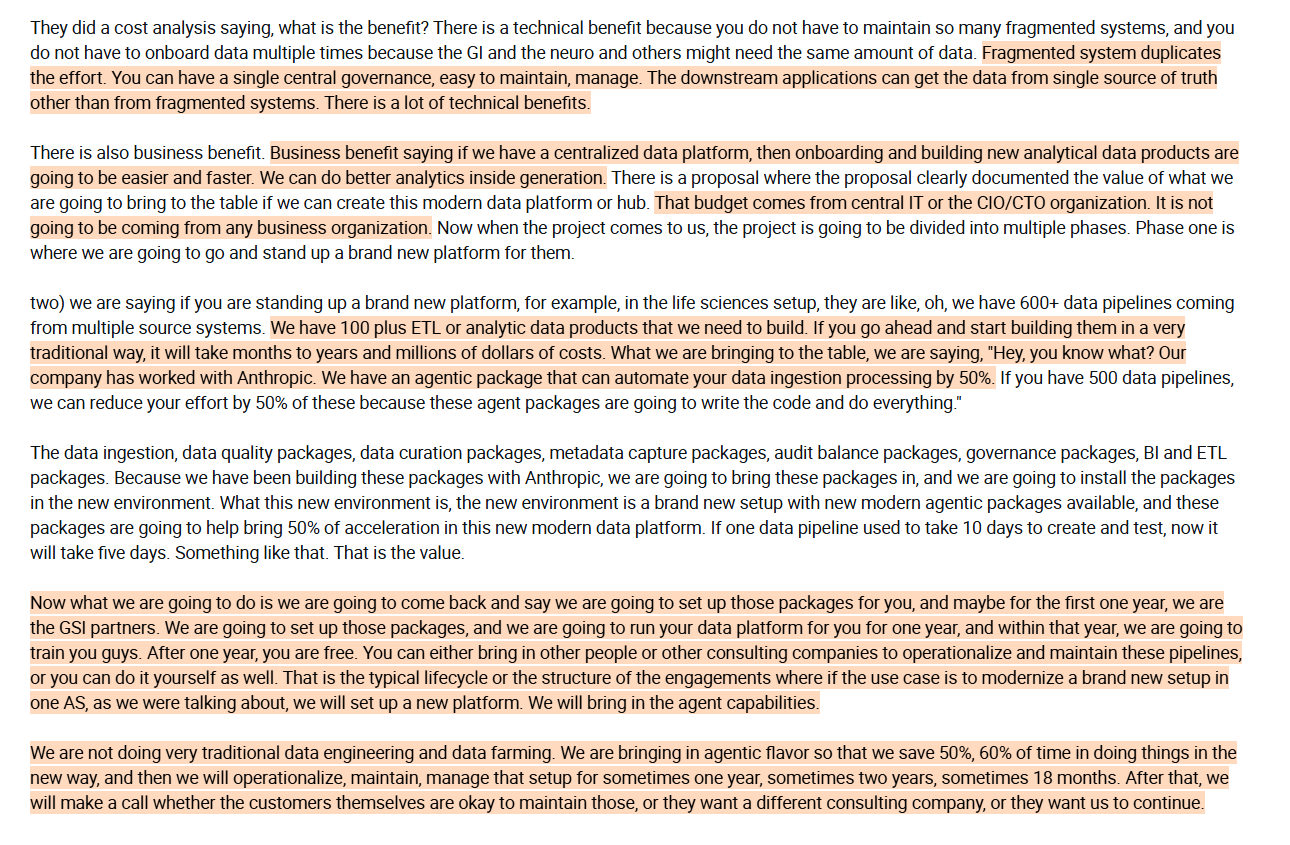
- The expert highlights a new approach to data platform modernization that replaces traditional data engineering with agentic packages built with AI labs, to avoid spending months and millions of dollars building out hundreds of ETL and analytic data products the conventional way. The engagement typically runs one to two years, covering platform setup, installation of agentic packages, and training the client's team, after which the client decides whether to take operations in-house, bring in another partner, or continue the relationship.
- The expert notes that the expected shift toward open source models never materialized. Until now, frontier models with strong reasoning capabilities have consistently outperformed open source alternatives when layered with agents, and the market moved toward agentic adoption rather than fine-tuning.
- On cost, the expert explains that open source models require procuring GPUs, training, deploying, and managing clusters that run 24/7, making the economics only favorable at very high API call volumes that most enterprise use cases have not yet reached, leaving pay-as-you-go frontier models as the more practical choice at current scale.
- Security and compliance present another barrier, with most large organizations having legal and security teams that have not approved open source or Chinese models for use on actual customer data. Frontier models from Anthropic and OpenAI have a clear advantage here as they are natively integrated within major cloud providers like AWS and Azure, making them far easier to clear through enterprise security policies.
- The expert emphasizes that enterprise AI adoption is still in very early stages, with most Fortune 500 companies having done a handful of POCs but very few having actually deployed full-scale agentic solutions in production. Confidence is low, adoption is low, and the expert sees an enormous amount of runway still ahead, both for large enterprises and the broader mid-market.
- The expert believes hyperscalers remain the right choice for sensitive workloads given their established security and data privacy frameworks, while newer neoclouds are being engaged for different, less sensitive types of workflows. The distinction matters because the kind of work being put through neoclouds is significantly different from what runs through hyperscalers, reflecting a practical split based on security requirements rather than performance preferences.


Trajectory AI retweeted

The biggest AI companies may be using safety to lock everyone else out of the future (Save this).
@DavidSacks believes that warnings about catastrophic AI risks will build public support for a powerful federal regulator.
That regulator may never explicitly ban open source AI.
Instead, it could require every advanced model to remain continuously monitored, centrally controlled and capable of being withdrawn.
Closed models such as Claude could satisfy those requirements because they operate on company controlled servers.
Open weight models would struggle to comply because anyone can download, copy and modify their underlying weights.
Once those weights are publicly released, the developer cannot recall every copy, monitor every user or guarantee that its original safeguards remain intact.
Anthropic identifies this irreversibility as a legitimate security concern.
Applying identical rules to open and closed models could therefore produce very unequal consequences.
Anthropic and OpenAI could afford expensive testing, licensing and monitoring requirements, while startups and independent developers might be unable to comply.
The eventual result could be a government protected oligopoly dominated by a few closed model companies.
There is evidence supporting part of Sacks’ concern.
Anthropic advocates mandatory pre-release testing for every sufficiently powerful model, whether it is open or closed, with evaluations focused on cyber, biological and alignment risks.
However, Anthropic explicitly denies supporting a blanket ban on open weight models.
The company describes open models without dangerous capabilities as a public good and argues that regulation should depend on demonstrated capabilities rather than whether a model is open or closed.
Sacks’ strongest argument is therefore about regulatory consequences because safety organizations could receive stronger protections, politicians could acquire greater authority and dominant AI companies could gain an expensive compliance moat.
And open source competitors could gradually be eliminated without the government ever formally announcing a ban.
Trajectory AI retweeted

We all know $NBIS and $IREN by now.
$WYFI is one of those interesting smaller AI infrastructure names with a lot of potential.
If you like to better understand $WYFI and what their management is trying to build long-term, this is definitely worth a read👇

WhiteFiber Management Call: The Focus on Strategy and Execution
This week, as promised, we are releasing our full @WhiteFiber_ management call analysis for everyone to read. We had a very constructive conversation with Michael Francisco, Vice President of Cloud Services, and Cameron Schnier, Senior Vice President of Capital Markets and Corporate Strategy.
I know the WhiteFiber retail community has been highly anticipating this one. $WYFI
We went into the call wanting to understand how the different parts of WhiteFiber fit together and what kind of company management is actually trying to build over the long term. We also wanted to discuss the broader market and what is currently happening across the data center space. This gives us an even deeper understanding of companies we have already followed for a long time, including Nebius and IREN.
We discussed everything from the strategy behind NC1, NC2 and NC3 to colocation, financing, WhiteFiber’s efforts in cloud and managed services, the Token Factory it is building, and the partnerships management wants to use to scale faster.
This call gave us much more than an update on individual projects. It gave us a clearer view of the model management is building.
In short: own selected strategic sites, create stable colocation income, selectively deploy cloud capacity, and scale beyond the company’s own balance sheet through managed services and partner locations.
This was a good conversation to pick management’s brain about WhiteFiber’s strategy, while also testing our own view of where neoclouds and the broader AI infrastructure market are heading against Whitefibers model.
A very good conversation and, in my opinion, a highly complete write-up for anyone who wants to understand what WhiteFiber is trying to build looked trough my strategic lens. 17 pages of company insights!
Enjoy!
Link in comments 👇
$WYFI $NBIS $IREN $CRWV

Trajectory AI retweeted

Anthropic just released a 37-minute guide on how to build AI agents that can automate an entire business.
It’s free, and it comes straight from the engineers who built Claude.
Agents that actually work, delegate tasks, and get things done on their own.
Save this post 🔖
Readers added context they thought people might want to know
The video is a May 2026 hands-on workshop demo of building one specific incident-investigator agent with Claude Managed Agents, not a newly released comprehensive guide for automating an entire business; the content has been public since at least May.
youtube.com/watch?v=19HDQ9…
claude.com/blog/claude-ma…
github.com/anthropics/cwc…
Trajectory AI retweeted

OpenAI's @cdngdev predicts robotics will have its own version of the 3D printing craze, with people buying cheap, open-source robot arms and connecting them to agents.
"I can see a world quite soon where, similar to when everyone went and bought 3D printers and ran software, everyone's going to buy plastic, cheaper robot arms that you can clip onto a table, put stuff in front of, and plug them into agents."
"The price of classic robotics equipment is thousands of dollars at the moment. This arm I'm using here is a Hugging Face SO-100 robot, which is open source, fully 3D printable, and around $200."
"People can just pull up Codex and start controlling robots with it right now."

Trajectory AI retweeted

get a robot arm and start messing around!

OpenAI's @cdngdev predicts robotics will have its own version of the 3D printing craze, with people buying cheap, open-source robot arms and connecting them to agents.
"I can see a world quite soon where, similar to when everyone went and bought 3D printers and ran software, everyone's going to buy plastic, cheaper robot arms that you can clip onto a table, put stuff in front of, and plug them into agents."
"The price of classic robotics equipment is thousands of dollars at the moment. This arm I'm using here is a Hugging Face SO-100 robot, which is open source, fully 3D printable, and around $200."
"People can just pull up Codex and start controlling robots with it right now."