


Pinned Tweet
Our team has been developing the key technologies for this approach for years, including capture mechanisms to constrain and move small asteroids and orbital debris. Accessing materials already in space could eventually enable a new generation of industries beyond Earth.
If you're interested in the future of space resources, the articles are worth a read.
arstechnica.com/space/2026/0…
spacenews.com/transastra-aim…


The secret plan is out! Two great articles today about our plan to capture a small asteroid and bring it into Earth orbit. The concept is part of our New Moon mission, which explores relocating a small near-Earth asteroid into a controlled orbit as the first step toward building industrial infrastructure in space.
Our team has been developing the key technologies for this approach for years, including capture mechanisms to constrain and move small asteroids and orbital debris. Accessing materials already in space could eventually enable a new generation of industries beyond Earth.
If you're interested in the future of space resources, these articles are worth a read.
hashtag#space hashtag#asteroidmining hashtag#spacetechnology hashtag#spacex hashtag#venture

Hey @DJSnM thanks for the shoutout! We would be happy to give you a closer look at how our observatories make these kinds of discoveries possible!
Scott got it right, our TKO network’s patented tech is catching faint, fast-moving near-Earth objects that usually slip past conventional surveys, including large ones no one had spotted before.
Our global network keeps advancing Space Domain Awareness, and we’re only getting better.
🛰️ The Road to Asteroid Capture: Day 1, Mantis Goes Up
From the lab to the gantry: our 10-meter Mantis Capture System is fully assembled, lifted, and ready for operations.
Did Day 2 give us the results we wanted? Find out next week. 🚀
#space #aerospace #spacetech
youtube.com/shorts/D1NEY8waU…

Excited to have our CEO taking the stage at the 4th NASA-USGS Offworld Resources Workshop today to discuss how we are bridging the gap between terrestrial mapping data and autonomous asteroid harvesting to power the future of in-space manufacturing.
Space is the next industrial frontier. There is a manufacturing need & Asteroids will provide the resources.
Unlocking this frontier requires specialized infrastructure. We’re deploying space domain awareness to locate viable near-Earth objects, our Mantis Capture Bag to safely enclose them, and SolarForge technology to process raw asteroid material.
We're excited to continue striving towards this future.


TransAstra retweeted

The CEOs (all friends) of @TransAstra_Corp @AstroForge and Karman+ (Joel, Matt and Teun) with Dominic Gallello, the Chair of Investment Committee at DARPA on a social break at the 4th NASA-USGS Offworld Resources Workshop at NASA Ames.
Great conversation. We will be doing a panel discussion later today. Historic times! @MattGialich
Very much appreciated the kind words from Dominic last night at the plenary.

TransAstra retweeted
Quick update on another new asteroid discovery from TransAstra's Sutter TKO telescope network. The Object is called TKO0004.
Technical people will appreciate how unique and powerful our system is based on the parameters below. Here are the specs on the detection from when we first saw this target two days ago:
• Rate: 97.40 deg/day–99.88 deg/day
• Detections: 10 Tracklet Length: 149 min
• Magnitude: 16.3–16.6 mag
• Survey Pattern: Standard for Cislunar Targets
Weather has been bad at most of our sites since, but weather cleared and we just saw it again from our observatory in AU. Within the last few hours we have multiple detections including 1 one at 20.38 visual magnitude and then a few others in the 19s. Not sure who else can see a target at that speed and that faint. Rate has dropped to like 10º per day but still, pretty cool (some other observatories did see it when it was still bright by recovering and tracking on it as a moving target, but we see everything up to like 800 or so degrees per day in all velocity vectors within in our FOV).
It passed within about 2 lunar distances of the Earth and is probably about a 30 m object, like the size of a house.
Also, keep in mind that this is all preliminary stuff I am posting to X, not Nature, so there may be errors or things may change, but I though the community would get a kick out of this (I sure did!).
Here is a plot showing where we detected the object in its orbit from spain (111026-MR43-12) and OZ (121026-ME54-4)
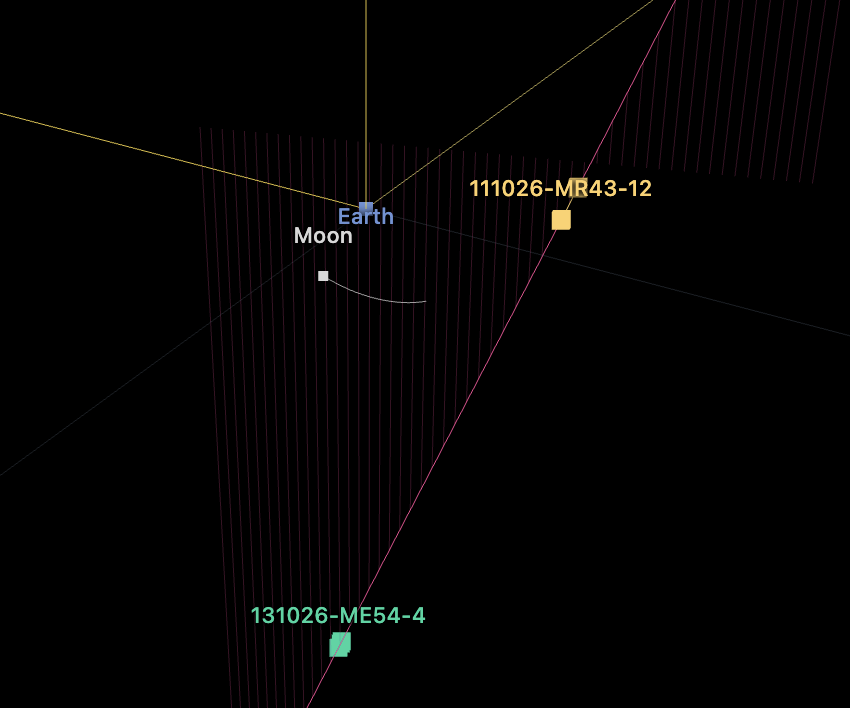
I think this is kind of cool. A few weeks ago TransAstra started to submit asteroids we have newly discovered to the Minor Planet Center just as a no cost contribution to the community. 🔭 .
Here is a screenshot from the UI our telescope operators (and AIs) use to run the network.
So far we have reported about ten but the numbers will grow over time. This is in addition to the thousands of known asteroids we report improved tracks on and many other things we keep for ourselves or report to our customers. We get paid for finding things in Cislunar space, but report these asteroids to give back to the community.
Highlights from a recent latest batch:
• 2026 OC4 (Apollo) — ~60–140 m, spotted in Space Force survey data and secured with automated follow-up
• 2026 RB4 (Aten) — ~15–35 m, close approach ~4.9 lunar distances in September
• 2026 RO39 — tiny (~4–8 m) but flew inside the Moon’s distance on 14 Sept
• 2026 TD & 2026 PQ — recent TransAstra finds (Apollo & Amor)
These are just a few of the thousands of objects our Theia software and globally distributed telescopes have pulled from the sky. Every detection improves planetary-defense awareness and builds the catalog of accessible targets for future in-space resource utilization (ISRU).
You can’t mine what you can’t find. 🚀
#Asteroids #NEA #PlanetaryDefense #SpaceResources #TransAstra

We just hit a major milestone in TransAstra’s history.
Here’s a first look at our 10-meter, 1,300-pound Mantis Capture system, fully inflated during recent testing. (That’s one of our engineers standing next to it for scale.)
In October 2025, we validated our 1-meter version aboard the ISS. Less than a year later, we’ve built and tested a system 10 times larger.
Why scale our technology? Because the challenges ahead are only getting bigger. We’re creating solutions to a multitude of issues facing the future of space logistics, and every step forward in our R&D brings us closer to a sustained human presence in space.
Stay tuned. Over the coming weeks, we’ll be sharing videos that break down what we tested, what we learned, and what Mantis can really do. We promise it's worth a look!

🛰️ The Road to Asteroid Capture: Everything We've Built, Ready to Prove
Quiet channel, loud accomplishment: our 10-meter Mantis Capture System has shipped — every piece, and we know it all works.
Now it's time to validate the integration. 🚀
youtube.com/shorts/uUXUcQD0j…
#space #nasa #aerospace #spacetechnology #InnovationFromFromFrom

🛰️ The Road to Asteroid Capture: Putting Mantis to the Test
Proof load tests: done. Assembly holds 1.5 tons and can function with dynamic movement.
Next up: the rollers that guide the drawstrings. Pass or setback...find out next week. 🚀
#space #aerospace #SpaceTech
youtube.com/shorts/PYVNKm8Mk…

Excited to share this one 🚀
Huge win for the team and the Sutter TKO network.🔭
It's fun to wake up in the morning and check the TransAstra internal comms and see a newly discovered asteroid. Today I got a report that we are credited with discovery of Aten asteroid 2026 OC4.
This one came out of our Sutter TKO observatory in New South Wales Australia. The team was reprocessing routine Space Force survey imagery and Theia pulled a target that didn’t match anything we already knew.
Two nights later we saw it again with an automated follow-up, built a second tracklet, and sent the arc to the Minor Planet Center. The MPC designated it 2026 OC4. It's about 100 meters across (±50%), on a tilted orbit that takes it from inside Venus’s orbit out past Mars about every 16 months.
We first saw 2026 OC4 after closest approach, at about 4.5 million km. It was faint enough that it did not pop in a single frame; Theia had to stack short exposures to pull it out.
Why we built the network: you can’t mine what you can’t find, and you can’t find these fast movers if you only look once.
Our Sutter Turn Key Observatories have hundreds of small but important innovations that make it possible to find, track and automatically followup on asteroids and other fast moving deep space targets. These include innovations in how the cameras are mounted to the telescopes, how we automatically focus and tune the scopes throughout the night, how we automatically adjust gain (a new software feature), how we simplify the process of taking darks and flats, and many other things.
We also have the coolest network control software in the industry.
This Thursday: AeroSpace on Tap 🚀
This edition's got a Star Trek 60th Anniversary twist. Show out Space-tech community!
Relaxed vibe, good people, first drink on us.
Costumes optional but encouraged 🖖
📍 Rock & Brews El Segundo — 143 Main St, El Segundo, CA 90245
📅 September 10th
🕐 5:30–7:00 PM
Let us know you're coming 👇

🛰️ The Road to Asteroid Capture: Building the Box That Holds It All
Housing Mantis is one thing. Making it operational is another.
This week the team finished the Jewel Box — the structure that houses and containerizes our 10 meter capture bag, built so every face can cinch and inflate on demand.
But a box that just holds things isn't enough. So we also built the interface: the electronics and gas handling system that let us actually send commands to Mantis and control every function it needs to run. Without them, the capture bag doesn't do anything.
By week's end, the jewel box was ready for operations and the electronics were tested and validated.
Next week, it ships.
#space #nasa #aerospace #SpaceTechnology #Innovation
youtube.com/shorts/6Egdm4q56…

🖖 Reminder!!! AeroSpace on Tap is coming up!
After the long weekend coming up, come raise a glass to the Star Trek 60th Anniversary and the space-tech community that keeps making sci-fi into reality. Founders, engineers, builders, dreamers. All welcome!
Same relaxed happy hour vibe. Good conversations, no agenda, first drink's on TransAstra 🍻
Bonus: still time to pull together that costume! Uniforms, pins, whatever gets you in the spirit. 🚀
📍 Rock & Brews El Segundo — 143 Main St, El Segundo, CA 90245
📅 September 10th
🕐 5:30–7:00 PM
Let us know if you will be attending! 🖖

🛰️ Fair winds, Nancy Grace Roman Space Telescope!
As Roman continues its journey to L2, we had the privilege of tracking it along the way!
Our observatory in California was first to spot it, and our system got to work immediately, automatically generating a tracklet in real time. That tracklet was then handed off across the globe to our site in Spain, which picked up the trail and confirmed the detection autonomously, no manual handoff required.
The result: a 16-hour observational window on a single object, spanning two continents, with minimal input required.
Smooth sailing, Roman. We'll be watching. 🔭
🖖 We're proud to announce AeroSpace on Tap is back in the South Bay and this time it's extra special, landing right alongside the Star Trek 60th Anniversary!
There's no better group to celebrate with than the builders, engineers, founders, and dreamers who grew up inspired by that vision of the future. Trek imagined so much of what we're actually building today. It feels only right to raise a glass to it together.
Same relaxed happy hour vibe as always. Space-tech community, good conversations, no agenda. First drink's on TransAstra 🍻
Bonus: feel free to dress up! Uniforms, costumes, pins , whatever gets you in the spirit. We'll be celebrating in style. 🚀
📍 Rock & Brews El Segundo — 143 Main St, El Segundo, CA 90245 🗓 September 10th ⏰ 5:30–7:00 PM
Let us know in the comments if you're beaming down! 🖖

The Road to Asteroid Capture: Racing the Clock on Mantis
Deadlines don't care that you're building hardware that's never existed before. This week on TransAstra's road to asteroid capture, the pressure is on Mantis.
This week the team is buttoning up the cinching mechanism — the part that has to close the loop, literally.
Meanwhile, a 10 meter bag doesn't just get thrown in a box. Foam gets cut, crates get lined, and every soft good and circuit gets tucked in like it's precious cargo...because it is. One bad shipping decision undoes months of work before the bag ever sees an asteroid.
And then there's the flat set, pressure systems and electronics laid bare. Before anything gets integrated, it has to prove it works on its own first.
No guarantees this week goes the way the team wants. That's the honest part. Check back next week and find out if it did. #space #nasa #aerospace #spacetechnology #innovation
youtube.com/shorts/asZZx8SUU…

Follow TransAstra on the road to asteroid capture. We’ll take you behind the scenes each week as our team tackles engineering challenges, hits unexpected obstacles, celebrates breakthroughs, and works toward the milestones that will ultimately get us to an asteroid.
We’ll share what’s working, what isn’t, what we’re learning—and what has to happen next.
First: September 25th...A successful 10m bag functional test will validate the system architecture and open the door to flight qualification.
