

I research stocks that can 10x in value over 10 years. Start for free with the Asymmetric Investing newsletter or find me on YouTube.
Join Asymmetric Investing ⬇️
Joined February 2010
- Tweets16.7K
- Following775
- Followers11.9K
- Likes3.6K



Pinned Tweet
2025 is in the books, and it was both outstanding and unsatisfying.
If you had told me at the beginning of the year, the Asymmetric Portfolio would more than double the market's performance, I would have taken it.
But after being up 53% early in October, the final results feel unsatisfying.
The good news is, this is a long game. I'm happy to buy some of my favorite stocks 30-50% off their highs, and long-term, these compounding businesses will become compounding stocks.
Thank you to everyone who subscribes, and if you want to see the portfolio's performance, the linked article is free to view.
Bring on 2026!
asymmetric-investing.beehiiv…

Travis Hoium retweeted
Your best investments won't feel smart, they'll feel dumb in the moment.
Only in hindsight will "obvious" investments seem smart.
Travis Hoium retweeted
Filter out bad companies (no matter the price) from consideration, and you'll increase your odds of success.
$FIX is down because the margin expansion story is over.
HVAC only has so much pricing power and if/when supply and demand go back to normal we could see operating margins cut to historical norms of ~5%.

Filter out bad companies (no matter the price) from consideration, and you'll increase your odds of success.
Travis Hoium retweeted
Writing ~3,000 words supporting (and trying to break) the investment thesis for every stock I own has been the most important change I made in 2023.
Ben Thompson interviewed Craig Moffett today and he articulated something I've been saying and wring about for a while in a great way.
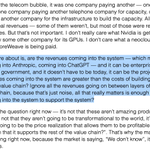
Neocloud revenue, chip revenue, equipment revenue is all meaningless when it comes to the bubble discussion. The only thing that matters is money coming into the system. If the money coming into the system (Anthropic, OpenAI, etc) doesn't justify the Capex, none of the details matter.

Read this. Twice!

What if everyone is right about AI but wrong about the investment?
This will probably get under the skin of quite a few people, particularly those heavily invested in AI infrastructure businesses. But I would encourage everyone to put their biases aside for a moment, forget about the stocks they own, and examine these businesses from a bird’s eye view. Are they truly extraordinary businesses with wonderful economics, sustainable competitive advantages, pricing power, and high returns on capital? Or are we confusing extraordinary demand for something with the existence of an extraordinary business?
I think this is something too many investors overlook. History is filled with industries that transformed the world and experienced tremendous growth, yet many of the businesses operating within them struggled to generate attractive returns for shareholders. Airlines revolutionized transportation, telecommunications connected the world, and railroads transformed economies, but that didn’t automatically make the companies wonderful investments. Just because the world desperately needs something doesn’t mean providing it is an extraordinary business.
When I examine AI infrastructure businesses, I see extraordinary demand and revenue growth, but also staggering capital requirements, huge financing needs, and expensive equipment that becomes outdated surprisingly quickly. Unlike businesses that can grow enormously without requiring much additional capital, these companies need to spend billions simply to expand their capacity. And eventually, actually rather quickly, much of that equipment will need to be replaced. So how much of this impressive growth will actually translate into cash that belongs to shareholders?
Consider depreciation, which I think is one of the most underappreciated aspects of these businesses. Imagine a company purchases $10 billion of computing equipment and assumes it will remain economically useful for 5 years, resulting in $2 billion of annual depreciation. But if the equipment’s actual economic life turns out to be 4 years, that annual economic cost increases to $2.5 billion. That’s a $500 million difference simply because one assumption about the useful life of the equipment changed.
And here’s something even more fascinating. The same technological advancements making AI increasingly powerful may simultaneously make existing computing equipment less competitive. If tomorrow’s equipment delivers twice the computing power for the same price, what happens to the economics of yesterday’s infrastructure? Technological progress can create extraordinary value for society while simultaneously destroying some of the economic value of the assets purchased to support it.
Then there’s pricing power, which deserves considerably more scrutiny. When demand exceeds supply, providers can enjoy attractive prices, but that doesn’t establish a durable competitive advantage. What happens when competitors expand capacity, supply catches up to demand, and customers gain more alternatives? Will these businesses retain attractive pricing, or will competition eventually transfer much of the economic benefit to customers in the form of lower prices?
I’m also fascinated by the enormous emphasis on EBITDA and revenue growth. Imagine a company invests $10 billion in infrastructure and generates $3 billion in annual EBITDA, which sounds extraordinary until you subtract $2 billion in economic depreciation and $600 million in financing expenses. Suddenly, you’re left with just $400 million in pretax earnings. The business hasn’t changed, but your understanding of its economics certainly has.
1/👇
Travis Hoium retweeted
"My biggest wins have been unexpected. This is intentional, but not predictable."
- me, Jan 13, 2024
This video with @TMFJaguar was pretty timely earlier this week. $META has a lot of questions about how it's going to monetize all of this spending, even if the core business gets better.
youtu.be/zw7ZnDpUOlY

Travis Hoium retweeted
Your best investments won't feel smart, they'll feel dumb in the moment.
Only in hindsight will "obvious" investments seem smart.
The paradox of Fintwit is that the tickers that get the most clicks are often the stocks that perform the worst going forward.
It's been the same in financial media for decades.
The tickers you want to buy are the ones no one is talking about.
History rhymes.
"My biggest wins have been unexpected. This is intentional, but not predictable."
- me, Jan 13, 2024
I'm building a market-beating portfolio IN PUBLIC with new buys EVERY MONTH. Find out what I own here:
asymmetric-investing.beehiiv…

It's all fun and games when everything is going up in the AI trade.
This is when you're going to be tested.
What's your conviction in a stock?
Do you believe in the business model?
Do you buy more?
Do you panic sell?
Do you move on?
I got a lot of hate for the post below, but since then neoclouds have continued their downward spiral. And it'll continue because it's a bad business mode.
I've made my bet, which is NOT to invest in this space. That's cost me performance early in 2026, but it also means I am buying stocks I DO have long-term conviction in while the market is looking elsewhere.
Everyone has to decide their own moves and I've shared my publicly...right AND wrong!
It's easy to be loud when number go up. What happens when number go down?
xitter.cf/TravisHoium/status/211…


Neoclouds are a BAD business model!
They're predicated on constantly raising capital by issuing debt and equity.
The PROBLEM is you're selling a commodity. So, it's profitable and accretive until...it isn't.
And when the market loses faith in you the game ends quickly!
$NBIS is getting hit today and it'll get worse because they have convertible debt. The stock is nearing the 2031 and 2033 convert prices. Sure, that's years out, but if the stock falls below $180.31 suddenly they don't have dilution, they have to come up with $4.3 BILLION in cash to pay off debt!
They could refinance with new debt...AT A HIGER RATE!!
This is a downward spiral. $CRWV is in it. $IREN is in it. $NBIS is in it.
This won't end well! See SunEdison!

If your business is predicated on access to the capital markets and the capital markets close to you…it’s over.
Your best investments won't feel smart, they'll feel dumb in the moment.
Only in hindsight will "obvious" investments seem smart.
Travis Hoium retweeted
📈 My dream investing world:
1️⃣ Inconsistent dividends are OK!💰
2️⃣ Financial statements should read right to left!
3️⃣ Earnings calls on a lie detector. Let's make em really sweat!🔍
"Volatility is the price of admission. The prize inside is superior long-term returns." - @morganhousel
I'm building a market-beating portfolio IN PUBLIC with new buys EVERY MONTH. Find out what I own here:
asymmetric-investing.beehiiv…