

Scientific project focused on constructing a renewed democratic society by providing political actors and civil society with empirical evidence on gender needs.
Joined September 2023
- Tweets354
- Following100
- Followers65
- Likes19




📅 Reminder: the #UNTWIST (WP7) survey raw database (microdata) will be open on Zenodo from 31 March (end of embargo).
🔗 Data: 10.5281/zenodo.15083114
📚 All outputs: zenodo.org/search?q=UNTWIST&…
📊 Explore #UNTWIST interactive infographics & observables (incl. interactive web dashboards):
upo.es/investiga/UNTWIST/our…
#UNTWIST

🎥 Missed our #UNTWIST event in Brussels (European Parliament)? Watch the full video here: youtube.com/watch?v=PkNdLCHc…
#UNTWIST
💡 Want to stay updated on #UNTWIST?
Subscribe to our newsletter to get the latest insights on the project, work in progress and upcoming activities directly in your inbox. 📨
👉 Subscribe here: upo.es/investiga/UNTWIST/new…
📌 In WP10, we organise recommendations by actor level:
🇪🇺 EU/Parliament: push to reform platform design and governance.
🏛️ Institutions: internal training and continuity of initiatives, including researcher safety.
🗣️ Parties/media/NGOs: evidence-based messaging, without mirroring far-right frames.

📌 In WP10, the literature review was organised around 3 pillars:
1⃣ Disprove (debunk/prebunk misinformation)
2⃣ Co-opt (appropriate or instrumentalise far-right frames; with caution not to legitimise them)
3⃣ Create (build proactive, inclusive narratives).
🔍 What did we do in WP10 of #UNTWIST? We explored how online media tools can help communicate gender-based needs more effectively and empower democratic actors to counter violent and reactionary messages. We combined a literature review with an expert workshop.
✅ Another WP9 takeaway: many widely supported solutions fall within government remit—regulation, public investment and structural reforms—enabling proactive agenda-setting. To strengthen credibility: clear communication + support and funding to scale participatory formats.
#UNTWIST
⚠️ Key lesson from WP9: in the participatory workshops, the material concerns identified in the focus groups (healthcare, cost of living, jobs...) also emerged as top priorities across different voter profiles and national contexts.
#UNTWIST
✅ What kinds of solutions were proposed? 80% were “political actions”, mostly regulation (44%), followed by higher public spending (25%) and other state interventions (10.7%).
#UNTWIST
📌 What came up most? Workshops focused mainly on material issues: healthcare & welfare, cost of living, labour conditions, and social-media polarisation.
#UNTWIST
🧩 How did we do it? With a shared structure (intro → problems → solutions → wrap-up), adapted to each country. Goal: link everyday challenges to concrete proposals.
#UNTWIST
✅ Key policy implications for mainstream parties and policymakers:
🔹 Acknowledge these gender-related grievances matter (ignoring them opens space for anti-gender narratives).
🔹 Re-engage those who feel "abandoned" without abandoning equality and EU values: dialogue and inclusion.
✅ More implications:
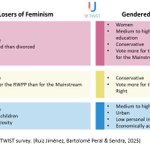
🔹 Tailored responses: material measures to address GPD + communicative strategies aimed at ‘losers of feminism’.
🔹 Strengthen representation and democratic trust so #RWPP do not monopolise social discontent.
