
The Systems for Future Intelligence lab at @uwcse.
Seattle, Washington
Joined February 2026
- Tweets94
- Following16
- Followers148
- Likes51






Check out our new benchmark where we give agents up to 36 hours and a live GPU sandbox to build inference systems from scratch!

UW SyFi retweeted

Would you bet that an agent could write an inference engine from scratch in 12 hrs and beat vLLM? We find that it can 😎
Introducing Humanity Last System, a benchmark that tests how well agents can build hyperspecialized serving engines for text, agentic, and multimodal workloads
UW SyFi retweeted

🎯 Much of today's analysis of LLM inference still rests on GQA models. Today's open models, however, have moved beyond GQA. They combine latent caches, sliding windows, sparse attention, compressed caches and linear attention. These designs differ drastically in memory usage and computational efficiency.
📊 With ServingStudio, we compared eleven recent open models with Qwen3-Coder-480B-A35B, a GQA model of similar size. At a 128K-token context, the new designs bring:
- Memory: up to 139× less per request.
- Decode: up to 250× fewer bytes read and 44× faster attention.
- Prefill: up to 183× fewer attention FLOPs and 46× faster attention.
🧵 More in the thread below (1/9)

UW SyFi retweeted

Ruby Lee (@rubywtlee) is a fantastic researcher. As an undergrad researcher in @UWSyFi, she led Murmur and other ML systems projects.
Murmur transcribes long audio 2.5× faster than single-pass decoding and beats WhisperX on accuracy. Ruby is applying to PhD programs this cycle. If you’re recruiting, talk to her!

Pipeline parallelism, custom prefix caches, and thoughtful schedulers really do boost peformance of LLM serving for coding agents! With ServingStudio to predict how a design performs, we were able to build a bespoke prefill engine for GLM 5.3-Flash that kills the competition!
Work led by our own @KanZhu854772!

🔥 Serving coding agents well needs a high-performance prefill engine, but existing systems fall short.
🚀 Introducing SSEngine-GLM5.3-Flash: an open-source prefill engine for GLM-5.3-Flash on four B200 GPUs. It combines pipeline parallelism, a tiered prefix cache across GPU memory, DRAM and SSD, and a shortest-remaining-prefill-first scheduler.
📈 On real hardware, it sustains 3.1× (AgentX) and 3.2× (TraceLab) the request rate of any vLLM or SGLang setup we tested.
🧵 More in the thread below (1/8)

UW SyFi retweeted
🔥 Serving coding agents well needs a high-performance prefill engine, but existing systems fall short.
🚀 Introducing SSEngine-GLM5.3-Flash: an open-source prefill engine for GLM-5.3-Flash on four B200 GPUs. It combines pipeline parallelism, a tiered prefix cache across GPU memory, DRAM and SSD, and a shortest-remaining-prefill-first scheduler.
📈 On real hardware, it sustains 3.1× (AgentX) and 3.2× (TraceLab) the request rate of any vLLM or SGLang setup we tested.
🧵 More in the thread below (1/8)
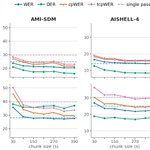
Murmur is compatible with vLLM. Results on an H100, end to end with diarization (2 models x 4 meeting datasets):
- 2.5x faster than single pass on average (2.0-2.9x)
- tcpWER 2.0 pts lower than single pass on average
- Lower tcpWER than WhisperX in all 8 settings (7-17 pts English, 10-51 pts Mandarin)
1
2
76
Check out more:
💻 Blog post: syfi.cs.washington.edu/blog/…
🤖 Code: github.com/uw-syfi/Murmur
📝 Paper: arxiv.org/abs/2606.01483v2
Work done by @rubywtlee @KeisukeKamahori and @bariskasikci
2
118
UW SyFi retweeted
SyFI is hiring a postdoc or research engineer (~$100K/year) to lead our work on the NSF AI Efficiency Challenge. Build AI infrastructure with us!
Reach out to me or @thepadawang. Please repost or tag a colleague!
UW SyFi retweeted

🚀 Qwen, Kimi, GLM are all betting on linear attention. But it's still slow: the recurrent state is read & rewritten every token.
Meet LeapQuant: the first training-free method to make 8-bit or 4-bit recurrent states work.
📈 Across Qwen, Kimi, and GLM models:
• Matches FP32 accuracy
• 4.25× faster linear attention kernels
• Up to 2× higher inference throughput
• Cuts memory by up to 56%
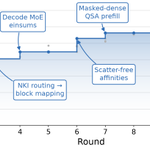
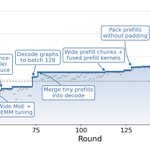
The trick is our in-house serving simulator. Experiments on 16 chips are slow, so each round an agent uses the simulator to find one bottleneck. VibeSys fixes it, and a protected evaluator keeps the change only if it is measurably faster.

1
5
200
Agents are pushing the frontier of model serving. New model, new hardware, no engine? Let agents build it.
By @KeisukeKamahori, @sudopowr, Simon Peter, and @bariskasikci. Thanks to AWS for the compute credits.
Blog: syfi.cs.washington.edu/blog/…
Code: github.com/uw-syfi/vibesys