
The Systems for Future Intelligence lab at @uwcse.
Seattle, Washington
Joined February 2026
- Tweets94
- Following16
- Followers148
- Likes51






UW SyFi retweeted

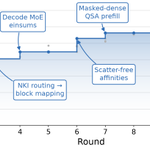
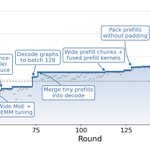
Would you bet that an agent could write an inference engine from scratch in 12 hrs and beat vLLM? We find that it can 😎
Introducing Humanity Last System, a benchmark that tests how well agents can build hyperspecialized serving engines for text, agentic, and multimodal workloads
UW SyFi retweeted

🎯 Much of today's analysis of LLM inference still rests on GQA models. Today's open models, however, have moved beyond GQA. They combine latent caches, sliding windows, sparse attention, compressed caches and linear attention. These designs differ drastically in memory usage and computational efficiency.
📊 With ServingStudio, we compared eleven recent open models with Qwen3-Coder-480B-A35B, a GQA model of similar size. At a 128K-token context, the new designs bring:
- Memory: up to 139× less per request.
- Decode: up to 250× fewer bytes read and 44× faster attention.
- Prefill: up to 183× fewer attention FLOPs and 46× faster attention.
🧵 More in the thread below (1/9)

UW SyFi retweeted

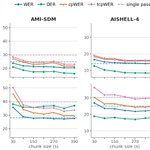
Ruby Lee (@rubywtlee) is a fantastic researcher. As an undergrad researcher in @UWSyFi, she led Murmur and other ML systems projects.
Murmur transcribes long audio 2.5× faster than single-pass decoding and beats WhisperX on accuracy. Ruby is applying to PhD programs this cycle. If you’re recruiting, talk to her!

UW SyFi retweeted
🔥 Serving coding agents well needs a high-performance prefill engine, but existing systems fall short.
🚀 Introducing SSEngine-GLM5.3-Flash: an open-source prefill engine for GLM-5.3-Flash on four B200 GPUs. It combines pipeline parallelism, a tiered prefix cache across GPU memory, DRAM and SSD, and a shortest-remaining-prefill-first scheduler.
📈 On real hardware, it sustains 3.1× (AgentX) and 3.2× (TraceLab) the request rate of any vLLM or SGLang setup we tested.
🧵 More in the thread below (1/8)

UW SyFi retweeted
SyFI is hiring a postdoc or research engineer (~$100K/year) to lead our work on the NSF AI Efficiency Challenge. Build AI infrastructure with us!
Reach out to me or @thepadawang. Please repost or tag a colleague!
UW SyFi retweeted

🚀 Qwen, Kimi, GLM are all betting on linear attention. But it's still slow: the recurrent state is read & rewritten every token.
Meet LeapQuant: the first training-free method to make 8-bit or 4-bit recurrent states work.
📈 Across Qwen, Kimi, and GLM models:
• Matches FP32 accuracy
• 4.25× faster linear attention kernels
• Up to 2× higher inference throughput
• Cuts memory by up to 56%
UW SyFi retweeted

it was really fun to build memory for agents so they operate apps more effectively over time!
we are actively working on scaling up the work. bigger deployments, more types of systems to operate, and more ways to use agents to improve system reliability. stay tuned!

The full paper on our self-defining operator is now out.
We show how an agentic operator that remembers past incidents and synthesizes its own playbooks cuts cost and MTTR by over half.
arxiv.org/abs/2610.14547

UW SyFi retweeted
Excited to share our recent work on leveraging TorchDynamo in AI training and inference systems at @UWSyFi with @thepadawang at #PyTorchConf today! ⚡️
We'll show how to use TorchDynamo beyond torch.compile, as a layer to accelerate, compare, and debug ML systems without rewriting the model.
🗓 5:30–5:55 PM PT
🏛 LL21A, San Jose Convention Center

UW SyFi retweeted
🔥 @DecagonAI just built its real-time TTS serving stack on top of M* (github.com/mstar-project/mst…).
The result:
→ ~30ms time-to-first-audio
→ ~10× higher audio throughput vs. their interleaved baseline
→ Better latency + scaling than vLLM-Omni
This is exactly why we built M*: modern AI workloads aren’t just a transformer loop. They’re heterogeneous pipelines of models, stages, and state and the serving system needs to understand that structure.
Awesome to see M* powering real production workloads.


UW SyFi retweeted
exciting to see M* from @UWSyFi get adopted. congrats to the team!
UW SyFi retweeted

Very exciting to see our work on M* being deployed at scale! Serving models with heterogeneous stages requires rethinking the inference stack, and it's great to see M* enabling this in production!
UW SyFi retweeted

If you want an in-depth analysis of how your coding agents work when you use them, based on thousands of traces from *real* workloads, check out TraceLab!
Paper: arxiv.org/abs/2606.30560
Website: tracelab.cs.washington.edu/

During an agentic session, a quick “hi” after a coffee break can cost a full dollar.
But it’s not because of the “hi.” It’s the million tokens of context you’re repaying for the moment your cache goes cold.
Here's the caching math from @evan_a_frick:
0:00 Why you're billed for last turn's context, not just this one
0:17 Cache hits: ~10% of full price
0:41 Agentic AI = way more back-and-forth than chat
1:16 Paying full price for context even on a 1-token tool call
1:40 Cache hit vs. cache miss
2:13 The $1 "hi": walk away for an hour, come back to a cold cache
2:59 Cost grows by the square, even with caching
3:28 How context compaction helps
4:03 Why Claude Code/Codex may compact at ~200-300K, not the full 1M window
UW SyFi retweeted
Also shoutout to my amazing coauthors @mrdrozdov @lateinteraction @matei_zaharia @mcarbin @erikmlindgren for their amazing mentorship during the Drowning in Documents project and helping me push this project to completion!

Retrieve more, rerank, get better results. That's what most of us expect from search, but it turns out to be wrong! 🤯
I'm SUPER EXCITED to publish the 141st episode of the Weaviate Podcast with Mathew Jacob (@mat_jacob1002)! Mathew led the work behind "Drowning in Documents" during his time at Databricks and is now a Ph.D. student at the University of Washington working on ML systems!
This episode dives deep into "Drowning in Documents". This has been one of the most influential papers for us @weaviate_io as we are exploring scaling reranked retrieval. I think it is a must read for those working in Search and Information Retrieval. 🙌
We begin with an overview of the paper, and then dive into full scoring with cross encoders and phantom hits. We then cover Listwise Rerankers, what next generation cross encoders might look like, and ranking cascades.
On the topic of ranking cascades, I loved learning about Mathew’s work with Melissa Pan (@melissapan), Negar Arabzadeh (@NegarEmpr) and collaborators on “Natural Language Query to Configuration for Retrieval Agents”. Per-query “effort” prediction in Search Agents is certainly going to be a huge component on the future of these systems! (Congratulations to OpenRouter 😆)
We then dove into Mathew’s work on TraceLab, a super exciting effort to understand coding agents such as Claude Code and Codex. ⌨️
This was a super fun conversation, and I really hope you find it useful!
YouTube: youtu.be/fWuavBcoTzk
Spotify: open.spotify.com/episode/2A8…
There's a new version of this post
UW SyFi retweeted
Had so much fun talking to @CShorten30 about our Drowning in Documents work! Was fun going down memory lane about this work :D! Stay tuned for the research that is going to be coming out of Weaviate👀
Retrieve more, rerank, get better results. That's what most of us expect from search, but it turns out to be wrong! 🤯
I'm SUPER EXCITED to publish the 141st episode of the Weaviate Podcast with Mathew Jacob (@mat_jacob1002)! Mathew led the work behind "Drowning in Documents" during his time at Databricks and is now a Ph.D. student at the University of Washington working on ML systems!
This episode dives deep into "Drowning in Documents". This has been one of the most influential papers for us @weaviate_io as we are exploring scaling reranked retrieval. I think it is a must read for those working in Search and Information Retrieval. 🙌
We begin with an overview of the paper, and then dive into full scoring with cross encoders and phantom hits. We then cover Listwise Rerankers, what next generation cross encoders might look like, and ranking cascades.
On the topic of ranking cascades, I loved learning about Mathew’s work with Melissa Pan (@melissapan), Negar Arabzadeh (@NegarEmpr) and collaborators on “Natural Language Query to Configuration for Retrieval Agents”. Per-query “effort” prediction in Search Agents is certainly going to be a huge component on the future of these systems! (Congratulations to OpenRouter 😆)
We then dove into Mathew’s work on TraceLab, a super exciting effort to understand coding agents such as Claude Code and Codex. ⌨️
This was a super fun conversation, and I really hope you find it useful!
YouTube: youtu.be/fWuavBcoTzk
Spotify: open.spotify.com/episode/2A8…
There's a new version of this post
RT @CShorten30: Retrieve more, rerank, get better results. That's what most of us expect from search, but it turns out to be wrong! 🤯
I'm…
UW SyFi retweeted
Finally, have to shoutout @KanZhu854772 for his amazing work with TraceLab. I would stay tuned for some of the work he's going to drop soon, going to be 🔥.
Should also follow @UWSyFi while you're here to keep up with the latest from our group at UW!
Retrieve more, rerank, get better results. That's what most of us expect from search, but it turns out to be wrong! 🤯
I'm SUPER EXCITED to publish the 141st episode of the Weaviate Podcast with Mathew Jacob (@mat_jacob1002)! Mathew led the work behind "Drowning in Documents" during his time at Databricks and is now a Ph.D. student at the University of Washington working on ML systems!
This episode dives deep into "Drowning in Documents". This has been one of the most influential papers for us @weaviate_io as we are exploring scaling reranked retrieval. I think it is a must read for those working in Search and Information Retrieval. 🙌
We begin with an overview of the paper, and then dive into full scoring with cross encoders and phantom hits. We then cover Listwise Rerankers, what next generation cross encoders might look like, and ranking cascades.
On the topic of ranking cascades, I loved learning about Mathew’s work with Melissa Pan (@melissapan), Negar Arabzadeh (@NegarEmpr) and collaborators on “Natural Language Query to Configuration for Retrieval Agents”. Per-query “effort” prediction in Search Agents is certainly going to be a huge component on the future of these systems! (Congratulations to OpenRouter 😆)
We then dove into Mathew’s work on TraceLab, a super exciting effort to understand coding agents such as Claude Code and Codex. ⌨️
This was a super fun conversation, and I really hope you find it useful!
YouTube: youtu.be/fWuavBcoTzk
Spotify: open.spotify.com/episode/2A8…
There's a new version of this post
UW SyFi retweeted

🍰 CAKE paper's out, the design bet: the compiler isn't a fixed black box the agent calls — it's part of the harness, and it's under evolution too.
CAKE didn't inherit existing abstraction layer. no tile/layout abstractions: the vocabulary was distilled by agents from a corpus of production kernels. every pattern the agent couldn't express pushed new primitives into the IR, and the analyses to keep them checkable. every barrier/layout bug that kept coming back became a verifier rule.
none of this can be designed up front. the IR has to co-evolve with the kernels, and the workload tells you what's missing, the corpus tells you if the fix broke anything.
the best language for an agent is the one that tells you what's illegal, what's slow, and which decision might made it faster.
arxiv.org/abs/2608.12629


🍰 another slice of CAKE just dropped: blackwell KDA kernels, ~2.05x geomean speedup vs FlashKDA:
github.com/flashinfer-ai/fla… by @avyyhuang
more cake kernels are baking 👀 not saying what CAKE actually is yet though, the full reveal is in the oven too.

UW SyFi retweeted

Zero Train–Inference Mismatch — now for linear attention, and under async RL 🎯
We got bitwise-exact trainer/generator parity for Gated DeltaNet (Qwen3.5-9B / 35B-A3B) on TorchTitan RL + vLLM, then asked the question nobody had actually tested in open source: does it help async RL?
Two firsts (as far as we know):
1️⃣ First open-source stack to hit train/inference logprob diff = 0 on a
linear-attention model
2️⃣ First to measure what zero mismatch is worth under async off-policy RL
How — smaller than it sounds:
• trainer and generator share one model definition (TorchTitan unified model). No more aligning trainer & generator op by op
• recurrent kernel everywhere on the forward (prefill + decode + trainer), chunked only for backward
• split-K off, batch-invariant GEMM, + a batch-invariant bmm for the MoE router
• we never touch FLA kernel internals — the recurrent kernel is intrinsically batch-invariant: one sequence's own state, fixed order, no cross-sequence reductions
• vLLM's linear-cache management + prefix caching keep working as-is
📊 Qwen3.5-9B + DAPO-Math, async at offpolicy = 4 / 12 / 32:
• logprob_diff = exactly 0 at step 0 ✅ every nonzero after that is staleness, not precision
• at offpolicy=32 the stock stack runs away past 0.065; ours holds ~0.035
• the unified model is free — the entire bill is the kernels
• also verified on MoE 35B-A3B and a 64-turn / 64K-context terminal agent
🤔 Now the honest part: it depends on the config. On math at offpolicy=12, BI leads on train reward and peaks highest on held-out AIME. On the terminal agent it's slightly ahead. On search, and on other math configs, the curves are indistinguishable. What is consistent is the numerics — BI keeps the gap from exploding as you widen the window. Cost: 2–3× trainer throughput (≈5× on the agent).
Our take: bitwise parity is a debugging tool, not a production default. Flip BI on for 20 on-policy steps — if the gap is 0 and your run is still broken, the infra is exonerated and the bug is in your data or your algorithm. That's worth 20 steps, not a whole run.
Next:
• make BI cheap (kill the 2–3×)
• more workloads, more seeds
• stay tuned for more complex agentic training recipes/tests 👀
Full writeup 🔗 yichuan-w.github.io/blog/GDN…
We collaborated closely with the TorchTitan team, and we sincerely encourage everyone to check out TorchTitan RL. With its clean, efficient unified model architecture and native async RL design, we believe it is a strong foundation for your next RL engine.
#LLM #RL #agentic #pytorch #torchtitan

UW SyFi retweeted
When it comes to money, it is no time to play. Go check out our work on systematically optimizing your agent systems to any cost-quality requirements you have!

UW SyFi retweeted

M* is a new system for multimodal inference from our lab @uwsyfi. The system captures multimodal models as dataflow graphs, implements a generic engine for those graphs, and achieves SOTA results inference throughput/latency. Learn more here! m-star.org/


New multimodal model architectures shouldn't require new serving systems.
Introducing our work, M* (M-Star): a universal serving system for multimodal models that separates what a model computes - a dataflow graph - from how it runs: placement, scheduling, batching, and transport.
Joint work across @uwcse, @StanfordAILab, and @CMU_ECE with Atindra Jha, Naomi Sagan, Irmak Sivgin, Rohan Sanda, @ste_veng, Mark Horowitz, @LukeZettlemoyer, Olivia Hsu, @jure, @bariskasikci, and @thepadawang.
