

A community-centered fee-protection protocol for launching, discovering, and participating in transparent token economies. Backed by @cbventures. 🐳
Onchain
Joined September 2021
- Tweets3.6K
- Following140
- Followers15K
- Likes2.8K


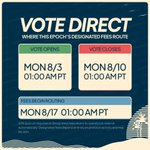


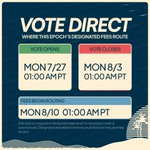




Boardwalk retweeted

$BADDIE by @GmBaddies on @robinhoodcrypto is live on Boardwalk!
Needs 2.5 ETH to graduate. The auction closes in 24h.
Auction Link: app.useboardwalk.com/discove…
Boardwalk is permissionless. Posts are not endorsements. 🐳

Boardwalk retweeted

If you’re considering building a community, would highly recommend checking out @useboardwalk

Boardwalk retweeted

quick update:
-in transit over the weekend, heading to asia, slower to respond.
-a team member had a medical emergency, our comms may be slower next few days given overlap with travel.
-an issuer will be launching via @UseBoardwalk on RH soon, watch for the pro-rata time-weighted auction to go live over the weekend.
there will always be a lot of noise
yet we know, substance wins long term!

Don't launch your token economy without it. 🐳


Vote here: app.useboardwalk.com/vote
The four options:
1️⃣ BWLK Buy & Burn
2️⃣ Route to Operations Reserve
3️⃣ Perma-Lock BWLK/WETH
4️⃣ Route to BWLK Stakers
Disclaimer: Designated fees depend entirely on protocol activity and may be zero.
The previous vote-direction epoch has ended.
BWLK stakers cast 2.6M in voting power to direct designated fees for the next epoch.
1️⃣ To Operations Reserve: 0%
2️⃣ BWLK Buy & Burn: 1%
3️⃣ Perma-Lock BWLK/ETH: 99%
4️⃣ Route to BWLK Stakers: 0%
Result: Perma-Lock BWLK/ETH 🐳

Most token issuers think about the fee percentage. But fewer ask *where* the fee actually works.
A fee tied to one pool will stop reaching the project when trading moves elsewhere.
The better question isn't “What is the fee?”
It's “Does it follow the token?” 🐳

We compared fee mechanics, vesting, immutability, and other considerations across seven major launch platforms.
Just two use auction-based price discovery.
And only one has protected fee routing, onchain fee direction, and a native coordination layer built in.
@useboardwalk

Boardwalk retweeted
Fees for LPs on @useboardwalk for $FIRETURD, the first token economy on @base, start tomorrow.
Epochs run same weekly schedule as vote-direction.
You’ll slowly start to realize 😘
gm from the part of crypto still thinking past day one. ☕ 🐳

Boardwalk retweeted
Most launchpads innovate inside the pool.
Boardwalk uses Uniswap as the market layer and focuses on the economic system around the token.
A Boardwalk launch begins with a transparent, pro-rata auction. If it succeeds, the entire raise is paired with token supply in Uniswap and the seeded LP position is permanently locked. Contributors receive a 10%→0% time-weighted allocation bonus and claim after a seven-day cliff. At liquidity seed, a 40% anti-sniper fee begins decaying to the permanent 1.25% rate over 90 minutes.
The all-in 1.25% swap-fee equivalent is not just a launchpad rake. It routes:
0.35% to issuer-designated recipients
0.40% to participating LPs
0.05% to Uniswap
0.10% across Sherlock, 0x, DeFiLlama Research, SEAL, and DeFi Llama
0.35% to Boardwalk on Express—or 0.30% plus a 0.05% Standard referrer allocation
The percentages are immutable when the token launches. Because 0.95% fee logic lives at the token level rather than inside the pool, opportunistic liquidity strategies cannot meaningfully redirect fee flow away from the intended economy. Issuers are also rate limited to claiming 10% of their remaining accrued balance every 24 hours.
Standard launches can hard code three-year issuer vesting and direct part of the supply toward long-term LP incentives. LPs earn 0.25% pool fees, a dedicated 0.15% stream from token activity, and Participation Points (i.e. multiplier points) that increase their relative allocation the longer they remain staked.
Once live, no admin can mint additional supply, recover the seeded liquidity, rewrite the fee percentages, or alter the vesting amounts and schedule. The core contracts have also undergone published Sherlock audits.
The research question is simple and falsifiable:
Do these mechanics produce cleaner launches, less bot extraction, stronger issuer alignment, and more durable liquidity than conventional launchpads?
That is what Boardwalk is trying to prove.
@Uniswap powers the market. @UseBoardwalk powers the token economy.
@0xProject powers the aggregation.
@sherlockdefi powers the security.
@DefiLlama powers the transparency.
@defillama_res powers the research.
Better markets will grow the pie for everyone. Boardwalk is our contribution. Contracts are public for review and licensed because we fucking cooked. 🧑🍳 🐳
Go take a look: UseBoardwalk.com

Boardwalk retweeted
some @useboardwalk updates:
-express threshold reduced to 2.5e from 5e (live wednesday)
-standard threshold reduced to 2.5e from 5e (live in 7 days)
-standard duration reduced to 2 days from 7 days (live in 7 days)
all changes are behind a 7-day timelock
There's a real difference between routing issuer fees and actually keeping them.
Most platforms only do the first.
Worth knowing before you choose where to launch. 🐳
Most launch platforms put the fee in the pool.
Boardwalk puts it in the token.
That sounds like a small design choice.
It isn't.
Here's the problem it solves.
▓▓░░ 👇 a detailed post 👇░░▓▓
On most venues, the trading fee lives at the pool or venue level. That means the fee only exists where that venue controls it. Move trading activity somewhere else, and the fee meant for the economy simply doesn't happen.
Anyone can spin up a competing pool somewhere else, and the fees from trading there are gone from the people the economy was built to sustain.
Worse, sophisticated actors can quietly capture the fees inside the main pool itself. The most documented version of this is just-in-time (JIT) liquidity.
Here's how JIT liquidity works:
🤖 A bot watches for a large pending trade, drops a tightly targeted liquidity position into the pool a moment before the trade lands, collects most of the fee from that single trade, and pulls the position right back out.
The regular liquidity providers in that pool earn close to nothing on it.
This isn't a rare edge case.
Researchers studying Uniswap v3 catalogued tens of thousands of these events, with a single bot capturing the large majority of the profit and ordinary providers seeing their fees on those trades diluted by most of their value.
So when a builder says "fees support the economy," the honest follow-up is: which fees, in which pool, and who can route around them?
🐳 Boardwalk's answer is to move the fee into the token itself.
For non-exempt transfers, the fee travels with the token wherever it goes.
Standard liquidity actions through Boardwalk are exempt, so providing liquidity the normal way doesn't get taxed. But the strategies that try to capture trading fees outside the standard pools have to pay the built-in fee to do it, which removes the cost advantage that made them profitable in the first place.
In practice, liquidity settles in the standard pools because fighting the design costs more than it returns.
The result is not a promise about price or volume, but about structure.
The fee flow the launch was designed around stays attached to the economy instead of leaking to whoever sets up the cleverest outside pool.
That's the difference between routing fees and protecting them. Routing decides where a fee goes once you've collected it. Protecting decides whether you get to keep collecting it at all.
✅ Boardwalk accomplished both.
Most platforms help you launch a token. The harder problem is keeping the economics you specified intact after the launch gets interesting.
That's the problem Boardwalk was built around.
Onchain starts here. 🐳

Boardwalk retweeted

We compared fee mechanics, vesting, immutability, and other considerations across seven major launch platforms.
Just two use auction-based price discovery.
And only one has protected fee routing, onchain fee direction, and a native coordination layer built in.
@useboardwalk
ICYMI: DeFi Llama Research published a deep dive on Boardwalk, and they opened on the idea we keep coming back to:
👉 Creating a market is only the beginning.
👉 The launch is day one.
What follows decides whether it becomes more than a tradable asset.
The chaos era of token launches built an empire on enormous volume and fees. It cost a legion of traders.
@useboardwalk is built to launch token economies using token-level fees routed to infra partners, auction models, immutable vesting, and more:
defillama.com/research/repor…
