

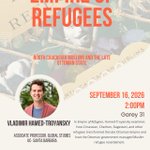
Associate Professor @ucsantabarbara. Historian of migration, refugees, Middle East, Caucasus. Author: Empire of Refugees (Stanford UP, 2024).
Santa Barbara, CA
Joined November 2015
- Tweets2.1K
- Following2.5K
- Followers4.3K
- Likes7.4K






Vladimir Hamed-Troyansky retweeted

When we got suspended from Cornell for our peaceful, anti-genocide encampment, Cornell admin threatened to attach a permanent notice to our transcripts about the suspensions. Cornell chose to protect this rapist, and chose not to notify or warn NSU about him.

New: One of the Cornell students accused of gang rape transferred to a Florida university.
The university says it was unaware of the allegations when it admitted him, raising questions about what disciplinary info follows students between colleges.
shorturl.at/pTyCC


Vladimir Hamed-Troyansky retweeted

Gazeteci Tuba Tekerek, cezaevinden yazdı:
-Uyuşturucu koğuşundan tutuluyorum. Koğuş 40 kişi. 36 kişi uyuşturucudan, 2 kişi
hırsızlıktan, 1 kişi cinayetten burada.
-Ben de yaptığım bir haberden dolayı buradayım. 2024 yılında Gürcistan’da seçimler öncesinde bir LGBT aktivistiyle görüşüp KaosGL’ye haber yapmıştım.
-Akıl almaz bir şekilde KaosGL Instagram hesabı yetkilisi olduğum iddia ediliyor.

Gazeteci Tuba Tekerek’ten Açık Radyo’ya mektup:
Günaydın Ömer Bey,
Günaydın Özdeş,
Yıllardır her Perşembe sabahına böyle başlıyorduk. Maalesef şimdi size ve sevgili Açık Radyo
dinleyicilerine Sincan Kadın Kapalı Cezaevi’nden bir mektupla seslenebiliyorum.
Ve maalesef size bu kez Avrupa ya da Türkiye gündeminden bahsedemeyeceğim. Ama narkotik dünyasıyla ilgili son derece ilginç, güncel bilgilere
sahibim. Zira uyuşturucu koğuşundan tutuluyorum.
Koğuş 40 kişi. 36 kişi uyuşturucudan, 2 kişi
hırsızlıktan, 1 kişi cinayetten burada.
Ben de yaptığım bir haberden dolayı buradayım. 2024 yılında Gürcistan’da seçimler öncesinde bir LGBT aktivistiyle görüşüp KaosGL’ye haber yapmıştım. Akıl almaz bir şekilde KaosGL Instagram hesabı yetkilisi olduğum iddia ediliyor. Hiçbir delile dayanmadan!
Napayım... Bu ülkede oluyor böyle şeyler. Derin bir nefes alıp, dayanmaktan başka çare yok. Özgür demokratik dünya mücadelesine devam.
Neyse... Ben size biraz daha kaldığım koğuştan bahsedeyim;
Bir avluya bakan koğuşta 12 oda var. Odalar 2 kişilik ama
her birinde en az 3 kişi kalıyor. Bizim odada 4 kişi kalıyoruz. Benim 4. yatağı koyacak yer bile yok. Yataklardan birini ranza altına doğru uzatıyoruz. Ben tuvaletin önünde yatıyorum.
Koğuşa girdiğimde bir radyo gördüğümde bir an çok
sevinmiştim, sizin sesinizi duyabileceğim diye. Sonra Açık Radyo’nun karasal yayın lisansının iptal edildiğini hatırladım. Hafifçe çöktüm. Nasıl bir ülkede yaşadığımız kafama bir kez daha dank etti.
Olsun! Ben duymasam da biliyorum siz ordasınız, Ömer Bey ve Özdeş mikrofon başında, Andrey teknik masada, dinleyiciler Açık Radyolarının başında. Kainatın tüm seslerine ve renklerine açığız!
Ömer Bey, Özdeş, Andrey, tüm Açık Radyo emekçileri, programcıları ve pek sevgili Açık Radyo dinleyicileri; hepinize günaydın!
Özgür günlerde görüşmek dileğiyle.
22 Eylül 2026
Tuğba Tekerek
Sincan Kadın Kapalı Cezaevi
B1 Koğuşu
Ankara
#GazetecilikSuçDeğildir

Vladimir Hamed-Troyansky retweeted

Why so many Ukrainians speak russian? Let me explain.
But first, let me ask you a question: Why do Irish and Scotts speak English, Catalans and Basques speak Spanish, Bretons speak French, etc. You probably know the short answer. But let me put a longer one. Ukrainian language was banned by russia 134 times! Here are most notable events:
1720: A decree by Tsar Peter I banned the printing of books in Ukraine.
1753: A decree by Catherine II prohibited teaching in the Ukrainian language.
1768: A decree from the Synod of the russian Orthodox Church called for the confiscation of Ukrainian primers from the population.
1775: Closure of Ukrainian schools after russian troops destroyed the Zaporizhian Sich.
1830-1840s: russification of Ukraine intensified. Even the very name "Ukraine" was prohibited to be used.
1889: At an archaeological congress in Kyiv, it was permitted to read papers "in all languages except Ukrainian."
1895: A ban on Ukrainian children's literature.
1914: A ban on the Ukrainian press.
1938: Mandatory study of the russian language was introduced throughout Ukraine. At the same time, there was a mass closure of national schools, and the prestige of the Ukrainian language declined.
1926-1939: Physical deportations of Ukrainian activists accused of nationalism. Four family members on my mother’s side were deported.
1929: Newly printed dictionary of Ukrainian was prohibited.
1960s: Arrests and extermination of the young generation of Ukrainian intelligentsia.
130 years ago, Ukrainian-speaking area was not limited by Ukraine, but also some parts of russia and Belarus spoke it (see the red area, that's the result of russian Empire census in 1897, when people identified themselves by the language). So, when someone says that some region of Ukraine is “russian speaking”, read the above list again. It’s a miracle that Ukrainian language even survived, and many people sacrificed their lives for it.

Vladimir Hamed-Troyansky retweeted

Thrilled that @CARA1933, a nearly 100 year old institution defending scholars at risk, has announced a landmark Palestine Programme, and virtual fellowship scheme. Years in the making and so crucial. Applications open: cara.ngo/palestine-programme
Vladimir Hamed-Troyansky retweeted

So happy to finally share the news that my book, “A History of Uncertainty: Science between the Ottoman Empire and Early Modern Europe,” will be out in Spring 2027 by the University of Pittsburgh Press.
I still can't believe it's now beyond my hands and on its way to meeting its readers.


Vladimir Hamed-Troyansky retweeted

I wrote this piece a few years to try to historicize and contextualize the current counterrevolutionary war in Sudan. It’s finally out now and is meant to give a sense of what and why it is happening.
Sudan's Counterrevolutionary War read.dukeupress.edu/critical…
Vladimir Hamed-Troyansky retweeted

I don't think most people are fully grasping what happened to Omar Artan. Citizens of African countries cannot travel to the US without first navigating a highly restrictive, discriminatory visa process. Africans face the highest refusal rates globally, not only for US visas +
Vladimir Hamed-Troyansky retweeted

The @AAUP & the AFT have just issued a strong & helpful statement defending academic freedom and condemning the ridiculous campaign of intimidation that has been launched against me.
I am most grateful for this. Here is the statement:
aaup.org/news/aaup-aft-labor…

Vladimir Hamed-Troyansky retweeted

New out! Open Access!
Samuel Dolbee links the transnational environmental history of agriculture with the history of racial formation and immigration in the United States.
#Ottomanempire #California #agriculture #environmentalhistory #races #Armenians
doi.org/10.1017/S17400228261…

Vladimir Hamed-Troyansky retweeted

My new paper on the crystallization of kayadez, Jewish political quetism, is out! I read through the 10 year run of La Boz de Türkiye, the only (later main) Jewish newspaper in Turkey 1939-1949.
Scroll this the thread for a summary of main arguments and the link!

Vladimir Hamed-Troyansky retweeted

A piece I have worked on for nearly a decade is out.
Kantousha and the PoxNotes on Accompaniment read.dukeupress.edu/public-c…

Vladimir Hamed-Troyansky retweeted

In Needs That Bind (Stanford University Press), Orçun Can Okan shows how states and ordinary people navigated the post-Ottoman order through diplomatic, administrative, and legal dealings across bureaucracies, while tracing the ties that endured between republican Turkey and the French and British Mandates in Syria-Lebanon and Iraq.
sup.org/books/middle-east-st…

Vladimir Hamed-Troyansky retweeted
Vladimir Hamed-Troyansky, bu çalışmasında, 19. yüzyılda Osmanlı İmparatorluğu'nun, Milletler Cemiyeti ve Birleşmiş Milletler’in kurduğu mülteci sistemlerinden çok daha önce bir mülteci rejimi oluşturduğunu vurguluyor ve tarihyazımsal bir düzeltme sunuyor.
iletisim.com.tr/kitap/muhaci…
@VHTroyansky

Vladimir Hamed-Troyansky retweeted
Such an incredible teaching and movement resource, especially now. Rich with insights on histories of the Arab world, including (and so rarely done, the Gulf), and political thought within and about movements and revolutions. Abed Takriti is a remarkable scholar and narrator.

In 2024, the Dig launched Thawra, a 19-part series on 20th century Arab radicalism.
We are now releasing the Thawra digital study guide, replete with readings, films, archival materials, & discussion Qs for collective or individual study.
Check it out➡️ thawraproject.com


Vladimir Hamed-Troyansky retweeted

I'm happy to have shared some thoughts about digital humanities methods, big data, and studying the history of the former Soviet Union with the @kennaninstitute.

Useful, illuminating @SusanGrunewald1 essay on new ways of researching Soviet history and of employing AI and digital-humanities techniques to get at and to interpret information. A publication in the @kennaninstitute "Long View" series on books and ideas.
kennaninstitute.org/articles…

Vladimir Hamed-Troyansky retweeted
Forthcoming in Stanford’s Ottoman History Series:
Camille Lyans Cole - Accumulating Power: Capitalism, Belonging, and the Late Ottoman Order
Accumulating Power offers a new way of thinking about belonging, sovereignty, and empire—and how the meanings of being "Ottoman" changed with the intersection of capitalism and imperial reform. Ottoman subjecthood and loyalty transformed around the turn of the twentieth century with the emergence of an international system and intensification of commodity production. Imperial belonging was conditioned by new discourses around community, increasing material conflict, and the new tools, forms, and ideologies of the modern state. People displayed their "Ottoman-ness" in how they coped with these novel political economies and shaped them to their own ends.
With this book, Camille Lyans Cole traces Ottoman belonging through the making of a region, the Gulf of Basra—centered on the port city of Basra, extending to southern Iran and Kuwait—where people, water, commodities, ideas, and money all circulated. Here, elites' desire to claim Ottoman-ness often arose at points of friction between regional ways of life and the transforming structures of the territorializing modern empire-state. Cole centers the lives of six individuals, tracing how each contributed to the material and political worlds of the Gulf of Basra. Through these microhistories, Cole reveals how elites used "technologies of the state"—bureaucratic instruments, discourses, and symbols—to accumulate wealth, capital, access to resources, and imperial status and to declare their own Ottoman-ness.
sup.org/books/middle-east-st…

Vladimir Hamed-Troyansky retweeted

Excited to share that I’ll be giving two book talks in the Los Angeles area next week, first at Occidental College and then at UCLA. Looking forward to discussing sectarianism and sectarian difference, mobility, and the politics of belonging in the Middle East, past and present.
I’m particularly honored that the Middle Eastern and North African Students Association (MENASA) at Occidental invited me. I love engaging with undergraduate students and hearing their perspectives and questions.
Hope to see some of you there!


Vladimir Hamed-Troyansky retweeted
An archive commemorating the lives of Palestinian scholars killed in the genocide in Gaza. rememberinggazascholars.org/