

Your IT, secured and automated in the EU 🇪🇺. Open-source, self-hosted, no vendor lock-in. Cybersecurity & digital sovereignty.
Europe
Joined May 2018
- Tweets19
- Following59
- Followers559
- Likes38

Le compte rendu de la panne mondiale de Microsoft, c'est vraiment une série de problèmes en cascade qui n'auraient jamais dû arriver. Une illustration que l'effet cygne noir existe bien (black swan effect) 🤷♂️
A lire ⤵️

More details on the root cause can be found in the Microsoft 365 Admin center, and an abridged version can be found below.
We are deeply sorry for the impact to all our customers and recognize the impact that this has on their normal business & operations.
The incident on Thursday, November 12th, 2026, was caused by three main factors that together caused a global outage for the networking gateway that fronts many Microsoft 365 services.
First, a latent defect caused servers to become overwhelmed and unresponsive under certain load conditions. This was due to lock contention inside an internal process which caused the machine to become unavailable. This defect was the result of a fix that was prepared specifically for Microsoft 365 networking gateway servers; neither the underlying defect nor the fix applies to broader Windows deployments.
The initial change in behavior first started deployment in July of this year. The update went through safe deployment and saturated globally over several weeks, during which time no issues were observed. For more than three months, the change was deployed worldwide without impact.
Our normal load testing did not detect the latent issue because the different traffic and SKU mix used in our test labs. The contention issue is worsened on machines with more cores and newer hardware; whereas our load testing tended to focus on our weaker hardware SKUs with fewer cores.
Second, a surge in load increased the likelihood for the networking gateways to encounter the contention. Within Microsoft 365, we maintain two independent and heterogenous network gateway systems designed for isolation and high availability. This allows many Microsoft 365 services to fail to/from them during outages or disruptions. Approximately fifteen hours before the outage, Teams failed over from the alternative networking gateway to the ‘primary’ gateway that also supports Exchange Online. This increased the load on the networking gateway and changed its traffic patterns. This type of failover is part of normal operations and is integral to standard Microsoft resiliency efforts.
Third, at the same time, nearly 14% of server capacity for the networking gateway was out of service due to an unrelated issue from the previous day. This server capacity was on track to be returned to active service through routine maintenance and health processes. The service had sufficient capacity headroom, so the reduction in server capacity had no impact on its own.
Taken together, the increased load and the reduced server capacity, caused the network gateway to encounter the latent bug from July. This caused requests to build up until servers ultimately stopped responding. This occurred during the peak window of traffic in the United States.
When servers lose connectivity, our traffic management systems automatically route users to other healthy endpoints. This happens often and is critical to avoiding any interruption due to hardware, software, or network defects and is normally what makes the service resilient. However, the redirected traffic increased the likelihood for the same problem to occur on the remaining endpoints. This caused a cascading failure from server to server as the same amount of load was spread across fewer servers. In less than two hours, the previously unknown defect was encountered across our fleet and rendered them unresponsive. At its lowest, more than 80% of servers were unresponsive.
Normally, the network gateway is composed of thousands of ‘capacity units’ which represent shards of capacity, hardware, and networking infrastructure. These ‘capacity units’ are then organized into regions. In this case, due to a separate issue, the normal bulkheads between these different partitions did not stop the cascading failure. This is what allowed the impact to spread across our network gateway infrastructure globally.
Several services like Teams, OneDrive, SharePoint, and Office apps failed out of the faulty network gateway infrastructure. That is why those services were restored earlier, with Teams chats and meetings functioning without issue for most of the outage. But not all services, like Exchange Online, can fail out of this network gateway.
Recovery took longer than usual because as servers returned to service, they were immediately overwhelmed by waiting traffic and became unresponsive again. Our normally automated recovery processes were not designed to restore service from this broad unresponsive state. Additionally, since the main code defect was a latent bug from several months previous, our normal rollback, flighting, and feature flags were unable to quickly revert the change.
After engineers confirmed the defect as the cause, we developed an update that returned the code path to the previously known good state. To effectively apply this fix, and to slowly bring the service online again, we took groups of servers out of service, applied the change, and restarted them before returning them to service. This process was carefully applied to large quantities of infrastructure at a time (e.g. 50%+ of a region).
The final Post-Incident Review (PIR) will provide more details later this week.
56
📷 Pendant que certains jouent à GTA VI, nous on occupé à un autre jeu : empêcher le vrai braquage.
Bienvenue à Phish City. Ici, pas besoin d'arme ni de cagoule : il suffit de votre nom sur un e-mail pour piéger vos clients, votre comptable, vos fournisseurs. C'est Grand Theft Identity, le casse le plus rentable de 2026, et il est totalement silencieux.
La bonne nouvelle ? Ce jeu-là, vous pouvez le gagner. SPF, DKIM, DMARC, MTA-STS bien réglés, et votre identité e-mail devient inviolable.
📷 Quel est votre niveau d'exposition ? Test gratuit → wget.tech/gta
#GTA6 #Cybersécurité #Phishing #DMARC #SouverainetéNumérique

🌐 Et si quelqu’un pouvait détourner tout votre trafic internet… sans jamais toucher à votre réseau ?
Ce dimanche, on était au hub de Neutrinet, l’opérateur associatif belge dont WGET.tech est membre, pour une session sur la sécurité du routage BGP.
BGP, c’est le « GPS de l’internet » : le protocole qui décide par quel chemin vos données voyagent entre les réseaux du monde entier. Son point faible ? Il repose largement sur la confiance. Un réseau annonce « c’est par moi qu’on joint ces adresses », et les autres le croient. Une annonce erronée ou malveillante peut donc rerouter un trafic entier vers le mauvais endroit : c’est le BGP hijacking.
La parade, c’est un effort collectif :
→ MANRS, les bonnes pratiques mondiales de sécurité du routage,
→ RPKI, qui signe cryptographiquement « ces adresses m’appartiennent vraiment »,
→ le filtrage de préfixes, les looking glass pour la transparence…
Pourquoi on y était ? Parce que la souveraineté numérique, ce n’est pas un slogan : c’est comprendre comment l’internet fonctionne vraiment et être acteur de sa sécurité, pas spectateur. Être membre d’un opérateur citoyen comme Neutrinet, c’est exactement ça.
Merci à l’équipe Neutrinet pour la session. 🙌
#BGP #MANRS #RoutingSecurity #Souveraineténumérique #Neutrinet #Cybersécurité #OpenSource


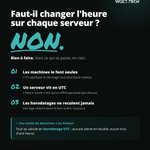
🕑 Cette nuit, les horloges ont reculé. Et chaque année, la même question revient : « il faut repasser sur tous les serveurs pour changer l’heure ? »
Non. Rien à faire. On vous explique pourquoi, sans jargon.
→ Vos machines le font seules : le système connaît déjà les règles de changement d’heure (la base « tzdata ») et applique le décalage automatiquement.
→ Au fond, un serveur ne vit pas à « votre » heure : il vit en UTC (le Temps Universel Coordonné : l’heure de référence mondiale, la même partout, sans heure d’été ni d’hiver). L’heure locale que vous voyez n’est qu’un affichage posé par-dessus. En interne, rien ne bouge.
→ Et vos journaux d’activité (les « logs ») ? Chaque événement y est marqué d’un horodatage : son étiquette date-heure. Mais sous le capot, ce n’est pas « 2h30 » qui est enregistré, c’est un compteur de secondes écoulées depuis une date fixe (le 1er janvier 1970). Ce compteur ne recule jamais, il ne fait qu’avancer. Donc même pendant l’heure « rejouée » cette nuit, vos événements restent rangés dans le bon ordre.
Conséquence : vos outils de détection se fichent complètement du changement d’heure. Aucune alerte ne se déclenche deux fois, aucun « trou » d’une heure n’apparaît dans la surveillance, parce que tout est calculé sur l’horodatage UTC, pas sur l’heure affichée. Le seul vrai risque : une infra mal réglée qui raisonne en heure locale. Et c’est précisément ce qu’on vous évite.
La règle d’or, chez nous comme chez vous : on journalise en UTC, on affiche en local.
👉 Un doute sur votre infra, vos logs ou votre sécurité e-mail ? Parlons-en : [email protected] · wget.tech
#Cybersécurité #DevOps #SysAdmin #UTC #Souveraineténumérique #OpenSource

