


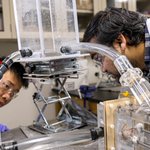



WPI Chemical Engineering researchers are studying bamboo’s potential as a source of lower cost renewable transportation fuel.

Researchers at Worcester Polytechnic Institute have demonstrated that bamboo can be converted into competitive transportation fuel using hydrothermal liquefaction, a process that converts biomass into biocrude. Economic modeling suggests bamboo-based fuel could sell for as little as $2.75 per gasoline-gallon equivalent at commercial scale, with greenhouse gas emissions 26 times lower than conventional petroleum diesel. A life-cycle assessment found the fuel generates just 3.5 grams of CO2-equivalent per megajoule. Bamboo also requires only about 13% of the cultivated land needed to match current US corn ethanol production, grows on poor or degraded soils, and produces negligible waste due to its very low ash content. Unlike annual crops, bamboo is a perennial grass that requires minimal agricultural inputs and stores large amounts of carbon underground. The research is published in Sustainable Energy & Fuels.

WPI retweeted

Modeling the brain 🧠🔍️
Stephanie Dalton Cowan illustrated the cover story for Worcester Polytechnic Institute’s journal about new discoveries in brain mapping through electromagnetic brain stimulation. @WPI
rappart.com/project/wpi-jour…


What’s the best way to learn in the age of AI? The answer could be a teaching method we’re all about at WPI. Project-based learning. It’s immersive, hands-on, experiential learning. All of our students do it, practicing theory in multiple real-world projects and strengthening their collaboration, leadership, and critical thinking skills along the way.
Want to learn more? A new episode of The WPI Podcast explores all things project-based learning with Kris Wobbe, interim dean of The Global School and director of WPI’s Center for Project-Based Learning. bit.ly/4sx1d3X

Can AI help doctors catch melanoma sooner?
@WPI researchers' TwinSight model placed 3rd of 181 teams in an international skin imaging AI challenge, combining two types of deep learning to analyze lesions. The goal: a handheld tool for primary care visits. 🔬
bit.ly/4zCZwEk #AI #Melanoma #DigitalHealth

WPI retweeted

Whether it's your phone, a laptop, or even a toy just hanging around the house, there's a distinct possibility you have a device with a lithium-ion battery in your home. The experts at WPI are testing just how dangerous these batteries can be if they're not treated properly.
Bamboo isn't just for pandas. New WPI research from the Department of Chemical Engineering finds bamboo-derived biofuel could compete with gasoline and diesel on cost while producing far lower greenhouse gas emissions. Because bamboo grows quickly and needs less land, it could help create sustainable fuels without a food-versus-fuel tradeoff. Read more about the study: bit.ly/3TznIrW

WPI retweeted

A researcher @WPI received close to $533,000 to provide research experiences to undergraduates examining the role sepsis can play in triggering severe blood clots wbjournal.com/article/wpi-re…

Could bamboo become a source for renewable fuel for transportation?
WPI researchers Michael Timko and Timothy Woodard explored the possibilities in a new study. bit.ly/3TznIrW


Did you know there’s a partial replica of a 16thCentury Tudor estate on campus? Read more about the history behind Higgins House in the Telegram & Gazette’s Worcester County Wonders series.

Worcester County Wonders: The haunted history of Higgins House @ajungphoto1 @SarahBarnacle telegram.com/story/lifestyle…

WPI retweeted

Created by @WPI students, this series helps residents understand combined sewer overflows (CSOs) and their impact on local waterways.
As winter approaches, heavy rain and snowmelt can strain older sewer systems, increasing the risk of sewage overflows into waterways.

ALT An infographic created by WPI explaining Combined Sewer Overflow (CSO).

ALT An infographic created by WPI explaining Combined Sewer Overflow (CSO) in Spanish.

ALT An infographic created by WPI explaining Combined Sewer Overflow (CSO) in Haitian Creole.

ALT An infographic created by WPI explaining Combined Sewer Overflow (CSO) in Portuguese.
What we keep around us says a lot about what drives us.
Stephen McCauley, Department Head and Associate Professor of Teaching in WPI's Department of Integrative and Global Studies, shared the stories behind six objects in his office: a student's vision of a sustainable city, a rock from the Melbourne Project Center he co-directs, and a handmade crochet box that captures the community at the Global Lab.
bit.ly/4yxnv7z


Alexander Smith, associate professor of economics, provided expert commentary for a MarketWatch article on a growing trend in prediction-market platforms: wagering on reality TV and entertainment.

Following a promotional push around the hit dating show “Love Island” this summer, platforms like Kalshi and Polymarket — which are already giving sportsbooks a run for their money — are now leaning heavily into promoting event contracts around reality TV. Season 35 of “DWTS” has already generated $5.7 million in trading volume as of Monday, Kalshi told us.
If you’re getting bombarded by prediction market ads and feeling tempted to bet on your favorite “DWTS” contestant, or on which movie will win best picture at the Academy Awards, then here's what you should know before opening your digital wallet: trib.al/qr7Zae0

WPI retweeted

Following a promotional push around the hit dating show “Love Island” this summer, platforms like Kalshi and Polymarket — which are already giving sportsbooks a run for their money — are now leaning heavily into promoting event contracts around reality TV. Season 35 of “DWTS” has already generated $5.7 million in trading volume as of Monday, Kalshi told us.
If you’re getting bombarded by prediction market ads and feeling tempted to bet on your favorite “DWTS” contestant, or on which movie will win best picture at the Academy Awards, then here's what you should know before opening your digital wallet: trib.al/qr7Zae0
Rare earths aren’t new, and they aren’t really rare. So why are they suddenly everywhere in the news?
On The WPI Podcast, our experts explain why these materials are essential to smartphones, electric vehicles, clean energy, national defense, and America’s technological future.
🎙️ bit.ly/4z4WR5U


They’re called rare earths—but finding them isn’t the biggest problem. Getting to them is.
The latest episode of The WPI Podcast explores the science, economics, and geopolitics behind these critical materials.
🎙️ bit.ly/4z4WR5U

6–8% of cardiac birth defects start with a narrowed aorta, and most are hard to see before birth.
WPI professor Alan Wei is building a digital twin of the fetal heart to prove blood flow data can catch it sooner, backed by $2.9M from NIH. 🫀
bit.ly/4hFbdmt

On the latest episode of The WPI Podcast, hear how rare earths shape modern life, why China dominates their supply chain, and how WPI research could help the United States become less dependent on sourcing them from other countries.
🎙️ bit.ly/4z4WR5U

About 1,000 lines of code, 1 bar code scan, and a car wash that still runs on the system WPI students built. 🚗💻 Inside the Cape Town Project Center, where IQP teams let the community lead. bit.ly/4xR008s

Will space eventually host AI data centers? The launch yesterday moves testing of the concept a step further. Professor Alexander Wyglinski spoke with Scientific American about some of the advantages and challenges associated with the idea?

Google wants to put AI data centers in space. Today it’s sending up four chips to test whether the idea is brilliant, ridiculous, or a little bit of both.
spklr.io/6010EpZUO
