

Critical Information & Communications Continuity for Microsoft 365. Crisis continuity • Preserve365™ • Business transition • High-consequence events.
London
Joined January 2026
- Tweets39
- Following46
- Followers4
- Likes1

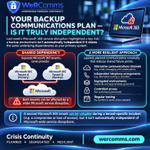





YOUR BACKUP COMMUNICATIONS PLAN COULD HAVE THE SAME SINGLE POINT OF FAILURE AS YOUR PRIMARY SYSTEM.
When organisations consider business continuity, the conversation often centres on backup systems, disaster recovery and alternative IT environments.
But there's an important question that deserves more attention.
What happens when the underlying communications provider itself becomes unavailable?
The recent disruption affecting Microsoft 365 highlighted how dependent many organisations are on platforms such as Outlook, Teams and cloud-based telephony.
A separate Microsoft 365 tenant can provide valuable resilience during a customer-specific incident.
However, if the disruption affects Microsoft's underlying services, that alternative tenant may also be impacted.
True communications resilience requires understanding these shared dependencies.
Organisations should consider:
🔹 Alternative communications channels — Can essential personnel communicate without their primary Microsoft 365 environment?
🔹 Independent telephony — Can critical calls still reach the right people if Teams Phone becomes unavailable?
🔹 Segregated environments — Are contingency arrangements appropriately separated from the primary environment?
🔹 Controlled access — Can authorised personnel access alternative systems without relying on unavailable authentication services?
🔹 Readiness testing — Have these arrangements actually been tested under realistic disruption scenarios?
At WeRcomms, we believe communications continuity should be planned, governed and tested before an incident occurs.
Because having a backup is one thing.
Knowing it will work when your primary systems are unavailable is another.
How confident are you that your organisation's contingency communications arrangements are genuinely independent?
WeRcomms | Confidence Through Continuity™
🌐 wercomms.com/crisis-continui…
#BusinessContinuity #CrisisCommunications #OperationalResilience #Microsoft #WeRcomms

8
YOUR BACKUP COMMUNICATIONS PLAN COULD HAVE THE SAME SINGLE POINT OF FAILURE AS YOUR PRIMARY SYSTEM.
When organisations consider business continuity, the conversation often centres on backup systems, disaster recovery and alternative IT environments.
But there's an important question that deserves more attention.
What happens when the underlying communications provider itself becomes unavailable?
The recent disruption affecting Microsoft 365 highlighted how dependent many organisations are on platforms such as Outlook, Teams and cloud-based telephony.
A separate Microsoft 365 tenant can provide valuable resilience during a customer-specific incident.
However, if the disruption affects Microsoft's underlying services, that alternative tenant may also be impacted.
True communications resilience requires understanding these shared dependencies.
Organisations should consider:
🔹 Alternative communications channels — Can essential personnel communicate without their primary Microsoft 365 environment?
🔹 Independent telephony — Can critical calls still reach the right people if Teams Phone becomes unavailable?
🔹 Segregated environments — Are contingency arrangements appropriately separated from the primary environment?
🔹 Controlled access — Can authorised personnel access alternative systems without relying on unavailable authentication services?
🔹 Readiness testing — Have these arrangements actually been tested under realistic disruption scenarios?
At WeRcomms, we believe communications continuity should be planned, governed and tested before an incident occurs.
Because having a backup is one thing.
Knowing it will work when your primary systems are unavailable is another.
How confident are you that your organisation's contingency communications arrangements are genuinely independent?
WeRcomms | Confidence Through Continuity™
🌐 wercomms.com/crisis-continui…
#BusinessContinuity #CrisisCommunications #OperationalResilience #Microsoft #WeRcomms

10
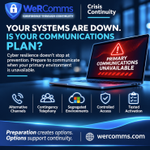
Your Microsoft 365 environment becomes unavailable tomorrow. How does your organisation continue communicating?
During a cyber incident, access to email, Microsoft Teams and business telephony can become disrupted or potentially untrusted.
For leadership teams, press offices and business-critical functions, losing these communication channels can make an already difficult situation significantly harder to manage.
The time to establish alternative communications is before an incident, not during one.
At WeRcomms, we're developing our Crisis Continuity offering around a straightforward principle:
Provisioned. Licensed. Maintained. Ready when required.
Our dedicated Microsoft 365 contingency environments are designed to provide organisations with:
🔹 Alternative email and Microsoft Teams access
🔹 Dedicated contingency telephone numbers and call routing
🔹 Segregated environments for nominated personnel
🔹 Controlled access and security governance
🔹 Ongoing maintenance and scheduled readiness testing
Rather than starting from scratch during a disruption, organisations can have an established environment ready to support their continuity arrangements.
A contingency environment doesn't replace your existing cyber security or business continuity strategy.
It provides another option when normal communications cannot be relied upon.
How confident are you that your organisation could maintain essential communications if its primary Microsoft 365 environment became unavailable?
Learn more: wercomms.com/crisis-continui…
WeRcomms | Confidence Through Continuity™
#BusinessContinuity #CrisisCommunications #CyberResilience #Microsoft365 #WeRcomms

22
🚨 A cyberattack doesn't just threaten your data. It can threaten your ability to communicate.
With cyber incidents continuing to affect organisations across the UK, there's an important question every business should be asking:
If your Microsoft 365 environment became unavailable tomorrow, how would your organisation communicate?
Consider the impact:
🔹 Employees unable to access Outlook or Microsoft Teams.
🔹 Senior leadership struggling to coordinate a response.
🔹 Customers, suppliers and stakeholders unable to reach the right people.
🔹 Communications teams unable to manage enquiries or distribute critical updates.
🔹 Important decisions delayed when clear communication matters most.
Cybersecurity focuses on preventing, detecting and responding to attacks.
**But what happens when those defences are breached and your usual communication channels cannot be trusted or accessed?**
That's where communications continuity becomes essential.
At WeRcomms, we help organisations prepare for these scenarios through dedicated, independently managed contingency communications environments.
Our Crisis Continuity approach is designed to support:
✅ Alternative communications channels for designated personnel.
✅ Dedicated contingency telephone numbers and call routing.
✅ Segregated Microsoft 365 environments for essential communications.
✅ Controlled access to email, collaboration and critical information.
✅ Documented activation procedures and readiness testing.
The middle of a cyber incident is not the time to discover that your contingency communications plan depends on the same systems that have become unavailable.
Preparation creates options. Options support continuity.
Confidence Through Continuity™
🌐 wercomms.com
#CyberResilience #BusinessContinuity #CrisisCommunications #Microsoft365 #WeRcomms

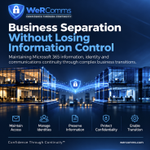
A business separation isn't just about moving systems. It's about maintaining control of information.
During a merger, acquisition, divestment or corporate carve-out, technology separation can introduce challenges that aren't always immediately visible.
Microsoft 365 is often at the centre of those challenges.
Consider what happens when:
🔹 Employees need access to information across two organisations.
🔹 Microsoft 365 identities and administrative responsibilities must be separated.
🔹 Business-critical emails, Teams conversations and SharePoint information need to remain accessible.
🔹 Domains, licensing and authentication arrangements need to transition without unnecessary disruption.
🔹 Confidential information must remain appropriately protected throughout the separation.
These aren't simply migration tasks.
They're questions of information continuity, governance and control.
At WeRcomms, our Business Transition & Separation practice is focused on supporting organisations through these complex changes, with particular attention to Microsoft 365 information, identity and communications continuity.
Because a successful separation isn't just about what moves.
It's about what remains accessible, protected and under control throughout the transition.
WeRcomms | Confidence Through Continuity™
wercomms.com
#WeRcomms #Microsoft365 #BusinessSeparation #InformationContinuity #MergersAndAcquisitions

10
What happens when the people who manage your IT are no longer available?
It's a question many organisations don't consider until something changes.
A company enters administration.
An outsourced IT contract comes to an end.
Key employees leave during a restructuring.
Suddenly, access to business-critical systems and information may depend on people who are no longer involved.
And when that happens, even something as straightforward as accessing historic emails or important business documents can become complicated.
Microsoft 365 environments often rely on several critical dependencies:
🔹 Administrative access — Who controls the environment?
🔹 Identity and authentication — Who can authorise access?
🔹 Licensing and subscriptions — What happens if existing arrangements end?
🔹 Domains and infrastructure — Who maintains control of essential services?
🔹 Information governance — Who is responsible for preserving important business records?
These are not simply technical considerations.
They can affect business continuity, legal obligations, restructuring activities and the ability to make informed decisions.
At WeRcomms, our Information Continuity approach, including Preserve365™, is designed to support organisations and appointed professionals in understanding and managing these dependencies.
Because when responsibility for a business changes, access to its information should not be left to chance.
Business continuity isn't just about keeping systems running. It's about maintaining control when circumstances change.
WeRcomms | Confidence Through Continuity™
🌐 wercomms.com
#WeRcomms #Preserve365 #Microsoft365 #BusinessContinuity #Restructuring

3
Your business continuity plan might look good on paper. But have you tested what it actually depends on?
Many organisations invest significant time developing business continuity and disaster recovery plans.
But there's an important distinction between having a plan and knowing whether that plan will work when it's needed.
Consider a few questions:
🔹 If your primary Microsoft 365 environment became unavailable, how would your leadership team communicate?
🔹 If your usual identity and authentication systems couldn't be trusted, could authorised stakeholders still access an alternative communications platform?
🔹 If your existing IT provider was no longer available, who would maintain access to business-critical information?
🔹 If your organisation entered a major restructuring, would you know who controls its Microsoft 365 data, domains and administrative access?
These aren't simply IT questions.
They're questions about **operational resilience, accountability and business continuity.
At WeRcomms, we focus on Critical Information & Communications Continuity — helping organisations understand the dependencies that can affect communications, information governance and controlled access during high-consequence events.
Because a continuity plan is only as effective as the arrangements supporting it.
The real question isn't whether you have a plan. It's whether you've tested the assumptions behind it.
WeRcomms | Confidence Through Continuity™
🌐 wercomms.com
#WeRcomms #BusinessContinuity #OperationalResilience #Microsoft365 #CyberResilience

1
4
Your organisation has a cyber incident. Microsoft 365 is potentially compromised. How does your leadership team communicate?
It's a question that deserves an answer before an incident occurs.
When confidence in an organisation's primary Microsoft 365 environment is reduced, the challenge isn't limited to restoring systems.
Leadership teams still need to make decisions.
Legal advisers and incident responders need to coordinate.
Employees and external stakeholders may require trusted communications.
But what happens if the usual email accounts, Microsoft Teams environment or identity systems cannot be relied upon?
Having a backup communications platform isn't necessarily the same as having an independent communications capability.
If your alternative still depends on the same identity infrastructure, administrative access or authentication services, it may share some of the vulnerabilities or dependencies affecting your primary environment.
At WeRcomms, our Crisis Continuity approach focuses on helping organisations plan for these situations through:
🔹 Segregated communications and collaboration.
🔹 Independent identity and authentication considerations.
🔹 Controlled access for authorised stakeholders.
🔹 Planned activation, governance and testing.
The time to establish trusted alternative communications is before they're needed.
If your primary Microsoft 365 environment became untrusted tomorrow, would your leadership team have a secure, independently accessible way to communicate?
WeRcomms | Confidence Through Continuity™
🌐 wercomms.com
#WeRcomms #CrisisContinuity #Microsoft365 #BusinessContinuity #CyberResilience

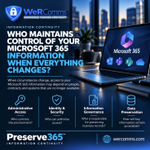
When a business enters administration, what happens to its Microsoft 365 information?
During insolvency, restructuring or significant business change, organisations face difficult decisions around finances, operations, employees and stakeholders.
But one critical area can be overlooked.
Who maintains control of the organisation's digital information?
Microsoft 365 often contains years of business-critical information across Exchange Online, SharePoint, OneDrive and Microsoft Teams.
Yet access to that information may depend on existing IT administrators, licensing arrangements, domain ownership and third-party technology providers.
When responsibility for a business changes, those dependencies can create operational, legal and information governance challenges.
This is the challenge Preserve365™ is designed to address.
Developed by **WeRcomms**, Preserve365™ is our specialist Information Continuity service, focused on supporting:
a
🔹 Information Preservation — Helping preserve business-critical Microsoft 365 information during periods of uncertainty.
🔹 Governance & Control — Supporting appropriate oversight and controlled access for authorised stakeholders.
🔹 Business Transitions — Helping organisations and appointed professionals manage information dependencies during insolvency, administration and restructuring.
🔹 Continuity of Information — Supporting continued availability of important business records, subject to technical and access requirements.
A business may change ownership, enter administration or cease trading. Its information may still need to be preserved, governed and accessible.
At WeRcomms, we believe information continuity should be considered early in any significant business transition.
Preserve365™ | Information Continuity by WeRcomms
Confidence Through Continuity™
🌐 wercomms.com
#WeRcomms #Preserve365 #Microsoft365 #Insolvency #InformationContinuity

23
Who controls your Microsoft 365 information when a business enters administration?
When an organisation enters administration, restructuring or a period of significant business change, attention naturally turns to finances, employees, creditors and operational decisions.
But there's another consideration that can easily be overlooked.
What happens to the organisation's Microsoft 365 information?
Business-critical emails, documents, communications and records may be held across Exchange Online, SharePoint, OneDrive and Microsoft Teams.
Access to that information can depend on existing administrators, licensing arrangements, third-party IT providers and the organisation's underlying Microsoft 365 environment.
When responsibilities change, maintaining appropriate control and access can become increasingly complex.
At WeRcomms, our Information Continuity approach is designed to support organisations and appointed professionals with:
- Preserving business-critical Microsoft 365 information.
- Maintaining appropriate governance and controlled access.
- Supporting information continuity during insolvency and restructuring.
- Helping manage information dependencies during business transitions.
Business circumstances may change. The importance of critical information does not.
WeRcomms | Confidence Through Continuity™
🌐 wercomms.com
#WeRcomms #InformationContinuity #Microsoft365 #Insolvency #BusinessRestructuring

8
A cyber incident doesn't have to take an entire organisation offline to create a communications crisis.
Recent cyber incidents involving major UK retailers, including ASOS, have once again highlighted how important trusted communications and access to business-critical information are during a security event.
When an organisation experiences a cyber incident, the challenge extends beyond identifying and containing the threat.
Leadership teams still need to make decisions.
Legal and regulatory teams may need access to critical information.
Employees, customers and external advisers need reliable communications.
And organisations need to understand which systems and channels they can continue to trust.
The question isn't simply whether your organisation can recover its systems.
It's whether your people can continue communicating, coordinating and accessing essential information safely while an incident is being investigated and resolved.
At WeRcomms, our focus is Critical Information & Communications Continuity — helping organisations plan for these high-consequence situations through segregated communications, controlled access and information continuity.
If confidence in your primary communications environment was reduced tomorrow, would your organisation have an independently accessible alternative ready?
Confidence Through Continuity™
🌐 wercomms.com
#WeRcomms #CrisisContinuity #BusinessContinuity #CyberResilience #Microsoft365 #IncidentResponse #CyberSecurity

18
What happens when your organisation can no longer trust its own Microsoft 365 environment?
Most organisations have business continuity plans.
But many of those plans depend on the very systems that could be affected during a serious cyber incident.
Consider what happens when:
🔹 Corporate email can no longer be trusted.
🔹 Microsoft Teams is unavailable or potentially compromised.
🔹 Senior leadership cannot communicate securely.
🔹 Legal advisers and incident response teams need a trusted environment to coordinate.
🔹 Business-critical decisions still need to be made.
Restoring systems is important.
But how does the organisation communicate while recovery is taking place?
This is where Crisis Continuity becomes a critical consideration.
At WeRcomms, our Crisis Continuity practice focuses on helping organisations prepare for situations where confidence in their primary Microsoft 365 environment is reduced.
Our approach is designed to support:
• Segregated communications and collaboration environments
• Controlled access for authorised stakeholders
• Secure coordination between leadership, legal and response teams
• Planned activation and operational readiness
• Continued communications during high-consequence incidents
Because business continuity isn't just about getting systems back online.
It's about maintaining communication, coordination and control while recovery happens.
WeRcomms | Confidence Through Continuity™
🌐 wercomms.com
#WeRcomms #CrisisContinuity #Microsoft365 #CyberResilience #BusinessContinuity #IncidentResponse

29
When a business enters administration, what happens to its Microsoft 365 information?
An organisation may cease trading, change ownership or enter a formal restructuring process.
But its information doesn't simply stop being important.
Years of business-critical records may remain within:
• Exchange Online — emails and correspondence
• SharePoint — corporate documents and records
• OneDrive — individual working files
• Microsoft Teams — conversations and shared information
Administrators, legal advisers, forensic specialists and other authorised stakeholders may still need access to this information long after the original business operations have changed.
And that raises some important questions.
Who controls the information?
How is it appropriately preserved?
Who should be authorised to access it?
How is that access governed and documented?
These are not simply IT questions. They are information continuity and governance considerations.
At WeRcomms, we're developing Preserve365™, a specialist service designed to support the preservation, governance and controlled access of Microsoft 365 information during insolvency, administration, restructuring and other high-consequence corporate events.
Because when control of a business changes, control of its information still matters.
Confidence Through Continuity™
🌐 wercomms.com
#Preserve365 #Microsoft365 #Insolvency #Restructuring #InformationGovernance #BusinessContinuity #WeRcomms

27
Business continuity doesn’t begin when systems come back online.
During a cyber incident, insolvency, restructuring or other high-consequence event, an organisation can face a much more immediate problem:
How do the right people continue to communicate, access critical information and maintain appropriate control while the situation is still unfolding?
For many organisations, Microsoft 365 sits at the centre of that challenge.
Exchange. Teams. SharePoint. OneDrive. Identity.
These aren't simply IT services. They can contain the communications, documents and business-critical information people need to make decisions at precisely the point when normal operating conditions have changed.
That’s why continuity needs to consider more than recovery.
It needs to consider:
Communication.
Information.
Access.
Governance.
Control.
At WeRcomms, our focus is Critical Information & Communications Continuity — helping organisations plan for how these capabilities can be maintained when confidence in, or control of, the primary Microsoft 365 environment changes.
Because the question isn't only:
“How quickly can we recover?”
It’s also:
“How do we continue operating appropriately until we do?”
Confidence Through Continuity™
#BusinessContinuity #Microsoft #Microsoft365 #CyberResilience #OperationalResilience #CrisisManagement #Restructuring #WeRcomms

14
What happens when Microsoft 365 is available — but no longer trusted?
During a serious cyber incident, the immediate focus is understandably on containment, investigation and recovery.
But there is another operational question organisations should consider before an incident occurs:
If confidence in your primary Microsoft 365 environment is reduced, where does your incident leadership team communicate?
Email and Microsoft Teams may normally be at the centre of an organisation’s communications.
During an incident, however, organisations may need a planned alternative that allows key stakeholders to communicate and collaborate without relying on the environment currently under investigation.
That capability shouldn't be designed during the incident.
It should be planned, segregated, governed and tested in advance.
At WeRcomms, this is the principle behind our Crisis Continuity practice — supporting organisations with a pre-planned communications capability for situations where confidence in the primary environment is reduced.
Cyber resilience isn't only about restoring technology.
It's also about maintaining the ability to communicate while you do it.
Confidence Through Continuity™
#BusinessContinuity #CyberResilience #Microsoft #Microsoft365 #CrisisManagement #IncidentResponse #WeRcomms

8
A cyber incident can affect more than systems. It can affect confidence in the systems people use to manage the incident.
Most organisations have an incident response plan.
Many have defined roles for cyber, IT, executive leadership, legal, communications and external advisers.
But there is a question worth testing before an incident occurs:
If confidence in your primary Microsoft 365 environment is reduced, where will those people communicate?
The environment may still be technically available.
But during an active incident, questions may exist around identities, administrative access, communications or the wider integrity of the environment.
That creates a different continuity problem.
The people responsible for managing the incident still need an appropriate place to:
• communicate and collaborate
• coordinate decisions
• involve authorised external advisers
• manage access to the response environment
• continue operating while the primary environment is assessed or recovered
This is the thinking behind WeRcomms Crisis Continuity.
A prepared, segregated communications capability designed to sit alongside existing cyber incident response, crisis management and business continuity arrangements.
Prepare before the incident.
Activate when required.
Communicate with confidence.
Confidence Through Continuity™
#CyberResilience #IncidentResponse #CrisisManagement #BusinessContinuity #Microsoft #Microsoft365 #OperationalResilience #WeRcomms

11
Microsoft 365 information can outlive the organisation that originally controlled it.
During insolvency, administration, restructuring or other high-consequence change, the requirement for business-critical information doesn't simply disappear.
Emails may still be required.
Documents may need to remain accessible.
Teams conversations may form part of the business record.
Different stakeholders may require controlled access.
And decisions about custody, retention and access may continue long after normal operating arrangements have changed.
The challenge is therefore not simply:
“Is the data still there?”
It is:
Who controls it?
Who can access it?
How is that access governed?
And can actions and decisions be traced?
That is the distinction behind Preserve365™.
A Microsoft 365 information continuity capability designed to support the preservation, governance and controlled accessibility of Exchange, SharePoint, OneDrive and Teams information during high-consequence events and organisational change.
Preserve. Govern. Evidence. Control.
Because information continuity is about more than storage.
It is about maintaining control when normal ownership and operating arrangements change.
Confidence Through Continuity™
#Microsoft365 #InformationGovernance #Insolvency #Restructuring #OperationalResilience #Preserve365 #WeRcomms

8
A Microsoft 365 separation is not simply a migration exercise.
When a business is sold, carved out, restructured or separated, the technology challenge is rarely limited to moving mailboxes and files.
There may be decisions to make around:
Identity — Which users, groups and administrative accounts move?
Information — What business-critical information belongs with each organisation?
Access — Who needs continued access during the transition, including advisers and other third parties?
Domains — How will domains, coexistence and eventual handover be managed?
And throughout the process, the organisations involved may still need to operate.
That makes continuity part of the separation strategy.
At WeRcomms, our Business Transition & Separation capability is designed to support Microsoft 365 continuity through:
Divestitures • Carve-outs • Acquisitions • Restructuring • Insolvency
The objective isn't simply to move technology from A to B.
It's to maintain control while the organisation moves from A to B.
Confidence Through Continuity™
#Microsoft365 #BusinessContinuity #MergersAndAcquisitions #Divestiture #OperationalResilience #WeRcomms

8
Microsoft 365 is available.
But are you still in control of it?
Availability and continuity aren't always the same thing.
An organisation can still have technically functioning Microsoft 365 services while circumstances around the environment have changed significantly.
A cyber incident may reduce confidence in identities or communications.
An insolvency appointment may change who requires control of business-critical information.
A divestiture may require users, domains and information to transition between organisations.
A regulatory or legal event may introduce new requirements around access, preservation and governance.
In each case, the technology may still be running.
But different questions become important:
Who controls the environment?
Who has authorised access?
Where is business-critical information held?
Can the right people still communicate?
Can those arrangements be demonstrated and governed?
That's why we think about continuity differently at WeRcomms.
It's not simply about whether technology is online.
It's about maintaining control, access, information and trusted communications when normal operating conditions change.
Critical Information & Communications Continuity.
Confidence Through Continuity™
#Microsoft365 #OperationalResilience #CyberResilience #BusinessContinuity #InformationGovernance #WeRcomms

10